Skip to content
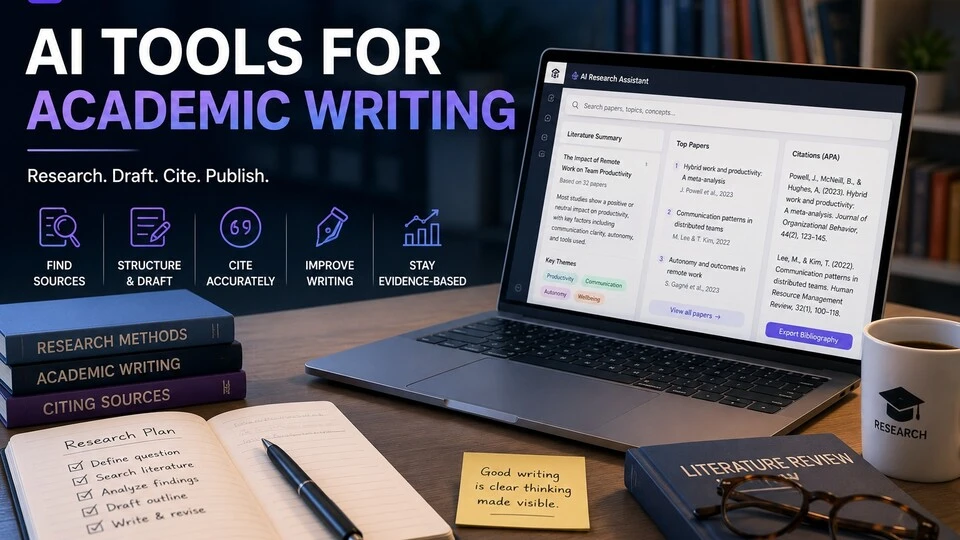
Best AI Tools for Academic Writing (Research, Draft & Cite Faster in 2026)
Quick Navigation: How I Tested • Comparison Table • Risks • Best Tools • FAQ
Academic writing is hard for a reason. It requires finding reliable sources, understanding complex research, synthesizing multiple perspectives, building a rigorous argument, formatting citations correctly, and writing clearly enough for reviewers to evaluate your contribution. Each step demands intellectual effort that no shortcut can eliminate.
AI tools don’t eliminate the intellectual work — but they reduce the mechanical burden that surrounds it. Finding relevant papers takes hours of database searching; AI tools find them in minutes. Formatting citations in the right style is tedious; AI handles it automatically. Editing prose for clarity takes multiple passes; AI identifies issues in seconds. The thinking remains yours; the mechanical execution gets faster.
The ethical dimension matters more in academic writing than in any other AI application. Universities, journals, and funding bodies have specific policies about AI use in academic work. Using AI to polish your writing is generally accepted. Using AI to generate arguments you pass off as your own is academic misconduct. The tools below are evaluated with this distinction in mind.
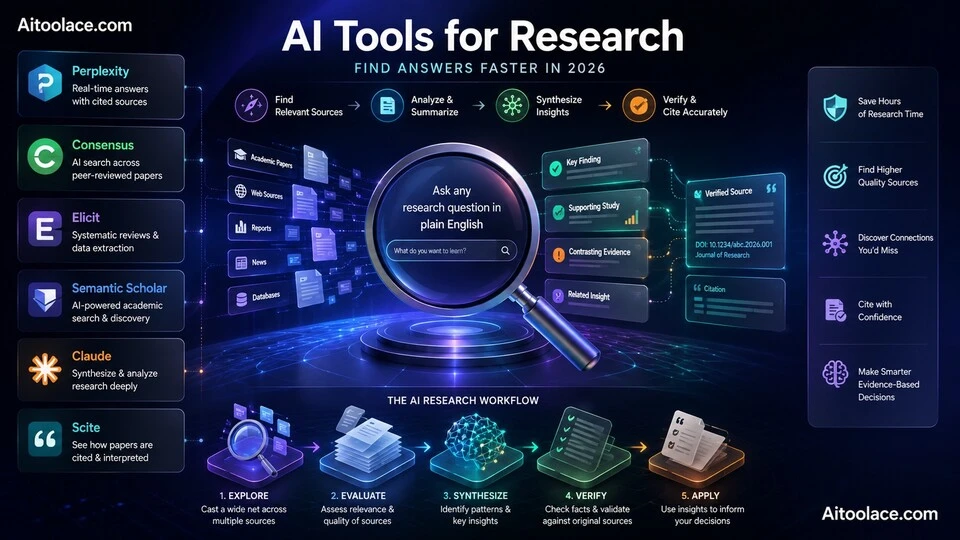
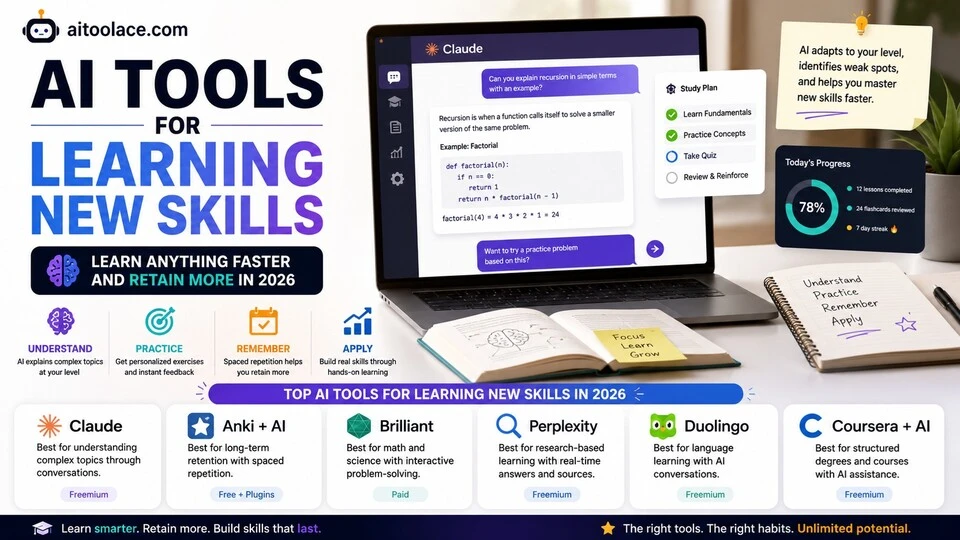
For student tools beyond academic writing, Best AI Tools for Students covers the broader academic toolkit. For research tools specifically, Best AI Tools for Research addresses the discovery and analysis phase.
Quick answer: Zotero with AI plugins is the best citation and paper management system. Grammarly is best for academic prose polishing. Consensus is strongest for finding evidence-based answers from peer-reviewed literature.
How I Tested These Tools
I evaluated each tool based on what matters for academic writing:
- Source management — does it help find, organize, and cite sources efficiently and accurately
- Writing improvement — does it improve clarity and readability without changing your argument or voice
- Citation accuracy — does it format references correctly and consistently in the required style
- Ethical clarity — is it clear how the tool is meant to be used within academic integrity guidelines
- Discipline breadth — does it work across different academic fields (STEM, humanities, social sciences)
I reviewed each tool’s features, tested across different academic writing scenarios, and consulted feedback from researchers and graduate students. I did not fabricate accuracy comparisons or invent productivity metrics.
Comparison Table
| Tool | Best For | Key Strength | Pricing |
|---|---|---|---|
| Zotero + AI plugins | Citation management | Free, open-source reference manager with AI enhancement | Free |
| Grammarly | Academic prose polishing | Clarity, grammar, and tone improvement for scholarly writing | Freemium |
| Consensus | Evidence-based research | AI search across peer-reviewed papers with consensus analysis | Freemium |
| Writefull | Academic language | AI trained specifically on academic writing conventions | Freemium |
| Elicit | Literature review | Systematic extraction of findings across papers | Freemium |
| Claude | Writing assistance | Argument structuring, feedback, and explanation | Freemium |
Best AI Tools for Academic Writing
Zotero + AI Plugins — Best for Citation Management
Zotero is the most widely used free reference manager in academia, and community AI plugins add capabilities that transform how researchers manage sources. AI-powered search within your library, automatic paper summarization, and smart tagging make Zotero more than a bibliography generator — it becomes a personal research database.
What it does well:
- captures and organizes research papers, books, and web sources with one-click browser import
- AI plugins (like ZoteroGPT and Zotero PDF Translate) summarize papers, extract key findings, and translate foreign-language sources
- generates formatted citations and bibliographies in any style (APA, MLA, Chicago, IEEE, and hundreds more) automatically
- syncs across devices so your research library is accessible everywhere
- completely free and open-source with no usage limits on core features
Where it falls short: Zotero’s AI capabilities depend on community plugins, which vary in quality and maintenance. The core tool is a reference manager — the AI features are additions, not native. Setting up plugins requires some technical comfort. The paper summarization from AI plugins is helpful for quick assessment but shouldn’t replace actually reading the papers you cite. And Zotero organizes sources but doesn’t help you write — you need separate tools for the actual writing process.
Best for: any researcher or graduate student who manages academic sources — Zotero is the foundation of an academic writing workflow regardless of what other tools you add.
Grammarly — Best for Academic Prose Polishing
Academic writing needs to be clear, precise, and free of grammatical errors — but most researchers aren’t trained writers. Grammarly catches the issues that undermine otherwise strong academic work: unclear sentences, passive voice overuse, grammatical errors, and inconsistent tone. The academic-specific settings adjust suggestions for scholarly writing conventions.
What it does well:
- catches grammar, spelling, and punctuation errors that spell checkers miss
- identifies unclear sentences and suggests more precise alternatives
- provides tone analysis calibrated for academic writing — flagging language that’s too casual or too convoluted
- works inside Word, Google Docs, and browsers so it integrates into your existing writing workflow
- suggests vocabulary improvements that increase precision without increasing complexity
Where it falls short: Grammarly improves existing writing but doesn’t help you write. It can’t evaluate whether your argument is sound, your evidence is sufficient, or your analysis is rigorous. The suggestions sometimes conflict with discipline-specific conventions — academic writing in philosophy follows different rules than academic writing in engineering. And Grammarly’s sentence-level suggestions can make writing more generic by smoothing out stylistic choices that, while unconventional, are intentional.
For writing tools beyond academia, see Best AI Writing Tools.
Best for: researchers and students who want to improve the clarity and correctness of their academic prose without changing their arguments or voice — a final polishing step before submission.
Consensus — Best for Evidence-Based Research
Consensus searches across millions of peer-reviewed papers and uses AI to determine whether the scientific evidence agrees or disagrees on a given question. For academic writers who need to establish the state of knowledge on a topic, Consensus provides evidence summaries with links to the underlying papers.
What it does well:
- searches peer-reviewed literature specifically, not general web content
- indicates whether studies agree or disagree on a given question — helping you represent the state of evidence accurately
- extracts key findings from papers without requiring you to read every full text during initial literature screening
- filters by study type (meta-analysis, RCT, observational) so you can evaluate evidence quality
- provides direct links to papers for deeper reading and citation
Where it falls short: Consensus only searches published academic literature, which limits its usefulness for topics without substantial peer-reviewed research. The consensus indicators can oversimplify nuanced debates — some questions don’t have a clear “agree/disagree” answer. AI summaries of papers can miss important methodological limitations or contextual nuances. And Consensus helps you find evidence but doesn’t help you write about it — that synthesis and argumentation is your work.
For deeper research tools, see Best AI Tools for Research.
Best for: researchers writing literature reviews, establishing theoretical backgrounds, or verifying claims who need to quickly assess the state of evidence on specific questions.
Writefull — Best for Academic Language
Writefull is trained specifically on academic writing — millions of published papers across disciplines. This specialized training means its language suggestions reflect how academic writing actually sounds, not how general business or creative writing sounds. It understands that academic writing has its own conventions, and its suggestions respect them.
What it does well:
- provides language suggestions trained on published academic papers — suggestions sound scholarly, not corporate
- checks for common academic writing issues: hedging language, citation integration, methodology descriptions
- includes a paraphrase tool that helps you rephrase sources in your own words while maintaining accuracy
- supports LaTeX alongside Word and Google Docs — essential for STEM researchers
- provides a title generator that suggests paper titles based on your abstract
Where it falls short: Writefull focuses on language, not content. It can tell you that “this suggests” is a more appropriate hedge than “this proves,” but it can’t evaluate whether your evidence actually supports either claim. The paraphrase tool helps with language but the responsibility for accurate representation of sources remains yours. And Writefull’s training on existing academic writing means it reinforces current conventions — which is appropriate for fitting into the academic system but doesn’t help you develop a distinctive scholarly voice.
Best for: non-native English speakers writing academic papers and researchers who want their prose to sound natural within academic conventions — especially in STEM fields where LaTeX support matters.
Elicit — Best for Literature Review
Literature reviews require finding all relevant papers on a topic, extracting key data from each, identifying patterns across the literature, and organizing findings into a structured narrative. Elicit automates the most tedious parts — finding, screening, and extracting — so you focus on the analysis and synthesis that constitute your intellectual contribution.
What it does well:
- finds relevant papers based on your research question and extracts key data points (methods, results, limitations) from each
- creates structured tables of findings across multiple papers for systematic comparison
- identifies patterns and gaps in the literature automatically
- supports custom extraction templates — define what data points to pull from each paper
- helps with the screening phase of systematic reviews — quickly assessing relevance across large numbers of papers
Where it falls short: Elicit helps you gather and organize information but doesn’t help you analyze or interpret it. The intellectual work of a literature review — evaluating methodology, identifying theoretical contributions, synthesizing across studies, and developing your own argument — remains entirely yours. The extraction accuracy depends on how well-structured the papers are — qualitative research with nuanced findings gets oversimplified. And Elicit works best for empirical literature reviews; theoretical or philosophical literature doesn’t extract as cleanly into structured tables.
For research discovery, see Best AI Tools for Research.
Best for: graduate students and researchers conducting systematic or semi-systematic literature reviews who need to process large numbers of papers efficiently.
Claude — Best for Writing Assistance and Feedback
Claude serves as an always-available writing advisor for academic work. It helps structure arguments, provides feedback on drafts, explains complex concepts, and assists with the thinking that underlies good academic writing. The key distinction: Claude helps you develop your ideas, not generate ideas to pass off as your own.
What it does well:
- provides structured feedback on draft sections — identifying unclear arguments, logical gaps, and unsupported claims
- helps structure papers — suggesting how to organize sections, what to include, and how to build your argument
- explains complex concepts or methodologies you need to understand for your research
- assists with academic writing conventions — how to integrate citations, structure literature reviews, write methodology sections
- generates outlines and structural frameworks that you develop with your own research and analysis
Where it falls short: Using Claude to generate text you submit as your own academic work is academic misconduct at most institutions. The ethical use is as an advisor — helping you improve your writing, not writing for you. Claude’s knowledge comes from training data that may not include the most recent research in your field. Its feedback on argument quality is based on general reasoning, not domain expertise — a specialist advisor will catch issues Claude misses. And Claude can fabricate citations — never cite a source from Claude without verifying it exists.
For ethical AI use considerations, see Best AI Tools for Students.
Best for: researchers and students who want a writing advisor available at any time — for feedback on structure, clarity checks on drafts, and help thinking through how to present complex arguments. Always within your institution’s AI use policies.
The Real Risks of AI in Academic Writing
1. Academic Integrity Violations
The most serious risk. Using AI to generate text you submit as your own work violates academic integrity policies at most institutions. The consequences — failing grades, degree revocation, damaged reputation — are severe. Understand your institution’s specific AI policy before using any tool. The general principle: AI as a tool (like a calculator or spell checker) is acceptable; AI as a ghostwriter is not.
2. Fabricated Citations
AI tools, including Claude and ChatGPT, can generate citations that look real but don’t exist. Submitting a paper with fabricated references is a career-damaging mistake. Every citation in your paper must be verified against the actual source. No exceptions.
3. Oversimplification of Complex Arguments
AI summarization tools compress complex research into simple takeaways, which can lead to misrepresentation of nuanced findings. “Study X found that Y causes Z” might oversimplify a study that actually found “Y is associated with Z under specific conditions, with several important limitations.” Always read the original papers for any research you cite substantively.
4. Dependency That Weakens Scholarship
Academic writing develops thinking skills — the ability to analyze, synthesize, and argue rigorously. If AI handles these processes for you, you don’t develop the skills that make you a competent scholar. Use AI to accelerate tasks you’ve already mastered, not to bypass learning you haven’t done yet.
Which AI Tool Should You Choose?
- Citation management → Zotero + AI plugins (free, open-source, comprehensive)
- Prose polishing → Grammarly (grammar, clarity, and academic tone)
- Evidence finding → Consensus (peer-reviewed literature with consensus analysis)
- Academic language → Writefull (trained on academic writing conventions)
- Literature review → Elicit (systematic extraction and organization)
- Writing feedback → Claude (structural feedback and argument development)
Best starting approach: Start with Zotero (free) for managing sources and Grammarly (free tier) for prose quality. Add Consensus or Elicit when you need to process large amounts of literature. Use Claude for feedback on structure and argument when you don’t have access to your advisor. Always check your institution’s AI use policy first.
Frequently Asked Questions
Is it ethical to use AI for academic writing?
Using AI as a tool — to find sources, manage citations, check grammar, get structural feedback — is generally accepted. Using AI to generate text you submit as your own work is academic misconduct at most institutions. The line between acceptable and unacceptable use varies by institution and discipline. Check your institution’s specific policy and when in doubt, disclose your AI use.
Can I use AI to write my thesis?
You can use AI to help you write your thesis — finding sources, organizing arguments, checking grammar, getting feedback on drafts. You should not use AI to write sections that you submit as your own intellectual contribution. Your thesis demonstrates your ability to conduct and communicate original research. AI can make the process more efficient; it shouldn’t replace the intellectual work.
How do I avoid fabricated citations from AI?
Never cite a source that you haven’t personally verified exists and says what you claim it says. When AI provides a citation, search for it in Google Scholar, your library database, or the journal’s website. If you can’t find it, it likely doesn’t exist. This verification step is non-negotiable in academic work.
Should I disclose AI use in my papers?
Increasingly, yes. Many journals now require disclosure of AI tool use. Even when not required, transparency about your methodology — including tools you used — is good academic practice. Describe how you used AI (“AI tools were used for literature screening and grammar checking”) rather than whether you used it.
Which AI tool is best for non-native English academic writers?
Writefull is specifically designed for this — its suggestions are trained on academic English and help non-native speakers write in conventions that feel natural to academic readers. Grammarly also helps but its suggestions are more general. Claude can explain why certain phrasings work better in academic English, which helps with learning.
Can AI help with peer review responses?
AI can help you draft responses to reviewer comments — organizing your points, suggesting diplomatic phrasing, and helping structure a thorough response. But the substantive responses to methodological concerns, additional analyses, and revised arguments must be your own work. Use AI for the communication, not the science.
Related AI Tools Guides
- Best AI Tools for Students
- Best AI Tools for Research
- Best AI Writing Tools
- Best AI Tools for Note-Taking
- Best AI Tools for Learning New Skills
Explore all AI tools → Browse by profession and use case
Last updated: June 2026