Skip to content
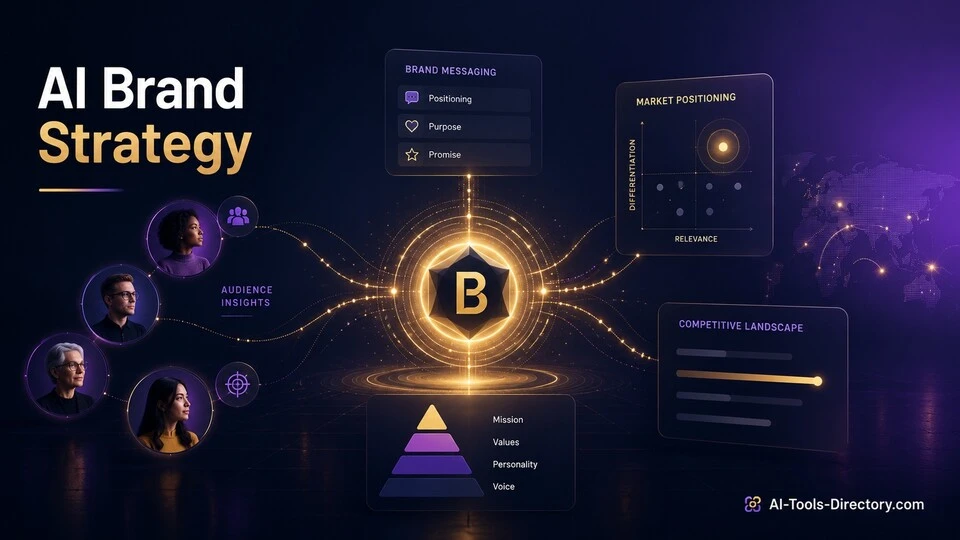
Best AI Tools for Brand Strategy (Build, Position & Grow Your Brand in 2026)
Quick Navigation: How I Tested • Comparison Table • Risks • Best Tools • FAQ
Brand strategy is one of the most valuable and least understood business disciplines. Most businesses have a logo, a color palette, and maybe a tagline — and call that a brand. Actual brand strategy is deeper: it defines who you’re for, what you stand for, how you’re different from alternatives, and why anyone should care. It shapes every decision from product development to customer service to hiring.
The challenge is that brand strategy traditionally requires expensive consultants or senior marketing talent. Small businesses, startups, and growing companies either skip it (and compete on price because they can’t articulate their value) or pay agencies tens of thousands of dollars for brand strategy work that may or may not reflect their actual market position.
AI tools make brand strategy more accessible by providing structured frameworks, competitive analysis, messaging development, and consistency tools that previously required specialized expertise. They don’t replace the deep market understanding that great brand strategists bring, but they make the strategic thinking process available to businesses that otherwise wouldn’t do it at all.
For the copywriting that expresses brand strategy, Best AI Tools for Copywriting covers writing execution. For competitive intelligence that informs positioning, Best AI Tools for Competitor Analysis addresses market awareness.
Quick answer: Claude is the most useful tool for strategic brand thinking and messaging development. Brandwatch is best for monitoring brand perception and market conversations. Frontify is strongest for maintaining brand consistency across teams and channels.
How I Tested These Tools
I evaluated each tool based on what matters for brand strategy:
- Strategic depth — does the tool help with genuine strategic thinking, not just surface-level branding
- Positioning support — can it help define and articulate what makes a brand different and valuable
- Competitive awareness — does it provide meaningful insight into how competitors position themselves
- Messaging development — can it generate messaging that’s distinctive rather than generic
- Consistency management — does it help maintain brand standards across teams and channels
I reviewed each tool’s features, tested across different brand scenarios, and consulted feedback from marketing professionals and brand strategists. I did not fabricate brand performance statistics or invent positioning effectiveness metrics.
Comparison Table
| Tool | Best For | Key Strength | Pricing |
|---|---|---|---|
| Claude | Strategic brand thinking | Deep positioning, messaging, and strategic analysis | Freemium |
| Brandwatch | Brand monitoring | AI-powered social listening and brand perception tracking | Paid |
| Frontify | Brand consistency | Brand guidelines management and asset distribution | Paid |
| Looka | Visual brand identity | AI-generated logos and brand identity packages | Paid |
| Semrush | Brand visibility | SEO and online presence monitoring with competitive analysis | Paid |
| Canva AI | Brand materials | Consistent branded content creation at scale | Freemium |
Best AI Tools for Brand Strategy
Claude — Best for Strategic Brand Thinking
Brand strategy is fundamentally a thinking exercise — understanding your market, defining your position, developing your narrative, and making decisions about what your brand is and isn’t. Claude is the strongest AI thinking partner for this work. It engages with complex strategic questions, challenges assumptions, develops positioning frameworks, and produces messaging that reflects genuine strategic thinking rather than generic marketing language.
What it does well:
- develops brand positioning through structured strategic conversation — analyzing market dynamics, identifying differentiation opportunities, and articulating value propositions
- generates brand messaging frameworks — taglines, value propositions, elevator pitches, and messaging hierarchies adapted to different audiences
- conducts competitive positioning analysis when you provide competitor information — identifying gaps and opportunities in the market
- helps define brand voice and personality with specific guidelines for how the brand communicates across contexts
- challenges your assumptions about your brand — “are you sure that’s actually different from your competitors?” — which is the most valuable thing a strategist does
Where it falls short: Claude doesn’t access market data, customer research, or competitive intelligence independently. It thinks strategically based on the information you provide — which means the strategic analysis is only as good as your input. Claude also can’t validate positioning with real market feedback — it can tell you whether a position sounds compelling, but not whether customers actually care. And Claude’s brand strategy work is conversational — you need to capture, organize, and implement the strategic output yourself.
For writing brand messaging, see Best AI Tools for Copywriting.
Best for: founders, marketing leaders, and brand managers who need a strategic thinking partner for positioning, messaging, and brand direction — especially those without access to expensive brand strategy consultants.
Brandwatch — Best for Brand Monitoring
Brand strategy doesn’t end with definition — it requires ongoing awareness of how your brand is perceived in the market. Brandwatch monitors social media, news, forums, and review sites to show you what people actually say about your brand, your competitors, and your industry. AI analyzes sentiment, identifies trends, and surfaces the conversations that matter.
What it does well:
- monitors brand mentions across social media, news, blogs, forums, and review sites in real time
- AI analyzes sentiment — not just whether mentions are positive or negative, but the specific themes driving perception
- tracks competitor brand mentions alongside yours for comparative positioning intelligence
- identifies emerging trends and conversations in your industry before they become mainstream
- provides visual dashboards that make brand perception data accessible to non-analysts
Where it falls short: Brandwatch monitors what people say publicly — it doesn’t capture private conversations, internal perceptions, or the silent majority who don’t post online. Social media sentiment is a biased sample of actual brand perception. The platform is enterprise-priced, putting it out of reach for small businesses. And monitoring brand perception is valuable only if you act on the insights — many organizations track sentiment without changing their behavior.
For competitor monitoring specifically, see Best AI Tools for Competitor Analysis.
Best for: mid-to-large brands that need continuous awareness of how they’re perceived in the market — especially brands in competitive categories where positioning is actively contested.
Frontify — Best for Brand Consistency
Brand consistency — ensuring that every piece of communication, every design, every customer interaction reflects the same brand standards — is the execution challenge of brand strategy. Frontify provides a platform where brand guidelines, design assets, and templates are centralized and accessible to everyone who creates content for the brand.
What it does well:
- centralizes brand guidelines (voice, visual identity, messaging, usage rules) in a single, accessible platform
- distributes approved brand assets (logos, fonts, colors, templates, photos) so everyone uses the right versions
- provides templates that enforce brand standards while allowing customization for specific uses
- tracks brand asset usage so you know which materials are being used and which are outdated
- supports collaboration across teams, departments, and external partners who create content for the brand
Where it falls short: Frontify manages brand consistency but doesn’t create brand strategy. You need to define your brand before Frontify can enforce it. The platform is most valuable for organizations large enough to have multiple people creating brand content — solo operators or very small teams can maintain consistency without a dedicated platform. And brand consistency tools can become rigid — sometimes a brand needs to evolve, and systems designed to enforce standards can resist necessary change.
For creating brand materials, see Best AI Tools for Designers.
Best for: organizations with multiple teams, departments, or partners creating branded content who need to maintain consistency without bottlenecking everything through a brand manager.
Looka — Best for Visual Brand Identity
Every brand needs a visual identity — logo, colors, typography, and design style. Looka uses AI to generate complete visual identity packages from descriptions of your brand personality, industry, and preferences. For businesses that need professional visual branding without hiring a designer, Looka provides an accessible starting point.
What it does well:
- generates logo options based on your brand name, industry, style preferences, and personality description
- produces complete brand identity packages — logo variations, color palettes, typography selections, and basic brand guidelines
- creates branded materials (business cards, social media profiles, letterheads) using your generated identity
- provides multiple options quickly for comparison and selection
- affordable compared to hiring a brand designer for initial identity development
Where it falls short: AI-generated logos are recognizable as AI-generated to designers and branding professionals. They follow common patterns and lack the distinctive quality that skilled designers create for brand-defining identities. Looka is useful for starting a brand identity but typically insufficient for brands where visual distinction is competitively important. The generated identities look professional but not unique — your logo may share visual DNA with other Looka-generated logos. And visual identity is one element of brand strategy, not the strategy itself — a great logo doesn’t compensate for weak positioning.
For image generation tools, see Best AI Image Generators.
Best for: startups, small businesses, and side projects that need a professional visual identity quickly and affordably — especially as a starting point that can be refined by a designer as the brand grows.
Semrush — Best for Brand Visibility
Brand strategy requires understanding how visible your brand is compared to competitors — in search results, in social media, in online conversations. Semrush provides competitive intelligence about online visibility, showing where you rank, where competitors outperform you, and where opportunities exist to increase brand presence.
What it does well:
- tracks your brand’s search visibility compared to competitors — which keywords you own and which they own
- monitors brand mention volume and sentiment across the web
- identifies content opportunities where your brand can establish authority on topics your audience cares about
- provides competitive analysis of online presence — who’s visible for what topics in your industry
- includes AI-powered content recommendations for building brand authority through SEO
Where it falls short: Semrush measures online visibility, which is one dimension of brand strength but not the only one. A brand can have weak search visibility but strong brand recognition through other channels (events, partnerships, word of mouth). The tool focuses on digital presence, which matters most for digital-first brands. The pricing is significant for small businesses. And Semrush provides data about visibility without providing strategic guidance on how to interpret and act on it — that requires marketing expertise.
For SEO strategy, see Best AI Tools for SEO.
Best for: brands that compete primarily online and need competitive intelligence about search visibility, content authority, and digital brand presence.
Canva AI — Best for Brand Material Production
Brand strategy is only valuable if it’s consistently expressed in every piece of content the brand produces. Canva AI enables teams to create branded content at scale — social posts, presentations, ads, documents, and videos — using brand kits that enforce visual consistency and AI features that accelerate production.
What it does well:
- brand kits store your colors, fonts, logos, and templates so every piece of content is on-brand automatically
- AI features generate layout suggestions, copy variations, and design alternatives within your brand constraints
- enables non-designers across the organization to create on-brand content without design training
- supports batch creation of branded materials for campaigns, product launches, and events
- templates for every format (social, print, presentation, video) maintain consistency across channels
Where it falls short: Canva produces brand-consistent content but doesn’t develop brand strategy. The brand kit enforces standards you define — it doesn’t define them for you. The templates and AI suggestions produce safe, conventional designs — brands that need to stand out visually may find Canva’s output too similar to competitors using the same tools. And brand consistency through templates can become brand rigidity if the templates aren’t updated as the brand evolves.
For broader content creation, see Best AI Tools for Content Creators.
Best for: teams that produce high volumes of branded content and need to maintain visual consistency without routing everything through a designer.
The Real Risks of AI in Brand Strategy
1. Generic Positioning That Doesn’t Differentiate
AI generates positioning statements and value propositions based on common marketing patterns. The result is messaging that sounds professional but says what every competitor in your category says — “innovative solutions,” “customer-centric approach,” “industry-leading technology.” Real positioning requires saying something specific that your competitors can’t or won’t say. AI gives you the starting point; your market knowledge creates the differentiation.
2. Confusing Brand Identity With Brand Strategy
A logo, color palette, and tagline are brand identity elements — visual and verbal expressions of your brand. Strategy is the thinking underneath: who you’re for, what you stand for, how you’re different, and why it matters. AI tools that generate visual identity without strategic foundation produce brands that look professional but don’t mean anything. Start with strategy, then express it visually.
3. Data-Driven Positioning Chasing Trends
AI monitoring tools show what’s trending in your market, which creates a temptation to position your brand around current trends. But brand positioning should be durable — reflecting genuine organizational strengths and values, not whatever’s popular this quarter. Use trend data to inform tactics (campaigns, content), not strategy (positioning, values).
4. Consistency Becoming Rigidity
Brand consistency tools that enforce standards can prevent the evolution that brands need over time. Markets change, audiences evolve, and brands need to adapt. Systems that lock in today’s brand standards can create resistance to necessary updates tomorrow. Build flexibility into your brand management systems — consistency in principles, adaptability in expression.
Which AI Tool Should You Choose?
- Strategic thinking and messaging → Claude (positioning, value propositions, and brand direction)
- Brand perception monitoring → Brandwatch (social listening and sentiment analysis)
- Brand consistency management → Frontify (guidelines, assets, and templates for teams)
- Visual brand identity → Looka (AI-generated logos and identity packages)
- Online brand visibility → Semrush (search, content, and competitive presence analysis)
- Brand material production → Canva AI (consistent branded content at scale)
Best starting approach: Start with Claude (free) to develop your positioning, messaging, and brand voice. Use Canva AI (free or low cost) to produce branded materials consistently. Add Semrush when you need competitive visibility intelligence. Scale to Brandwatch and Frontify when your organization is large enough for brand monitoring and consistency management to be operational challenges.
Frequently Asked Questions
What is the best AI tool for brand strategy?
Claude is the most useful for the strategic thinking — positioning, messaging, differentiation, and brand voice development. Brandwatch is best for understanding brand perception. Frontify is best for maintaining consistency. Most brands need strategic thinking tools (Claude) before they need operational brand management tools.
Can AI create a brand strategy?
AI can facilitate the brand strategy process — providing frameworks, generating options, challenging assumptions, and producing deliverables. It can’t create a genuine brand strategy independently because strategy requires deep understanding of your market, your customers, your organization’s capabilities, and your competitive dynamics. AI is a tool for the strategist, not a replacement for strategic thinking.
How do I develop brand positioning with AI?
Share your market context with Claude — who your customers are, what alternatives they have, what you do differently, and what you believe. Ask Claude to develop positioning options that articulate your differentiation clearly. Evaluate the options against what you know about your market. Refine iteratively until the positioning feels both true to your organization and compelling to your audience.
Is brand strategy necessary for small businesses?
Yes, though the formality can scale. Even a simple statement of who you serve, what problem you solve, and how you’re different from alternatives shapes better business decisions than having no positioning at all. Small businesses don’t need a 50-page brand book — they need clarity about what they stand for and how to communicate it consistently.
How do I maintain brand consistency with AI tools?
Define your brand standards clearly (voice, visual identity, messaging guidelines). Use Canva brand kits to enforce visual consistency. Use Claude to generate content that follows your voice guidelines. Review AI-generated content against your brand standards before publishing. Consistency comes from clear standards and consistent review, regardless of what tools produce the content.
How much should a business invest in brand strategy?
Start at zero with Claude for strategic thinking. A basic brand identity (Looka) costs under $100. Brand monitoring and management tools (Brandwatch, Frontify) are investments for growing brands. The most important investment isn’t money — it’s the time spent thinking clearly about who your brand is for and what it stands for.
Related AI Tools Guides
- Best AI Tools for Copywriting
- Best AI Tools for Competitor Analysis
- Best AI Tools for Marketing Teams in 2026
- Best AI Tools for Social Media Growth
- Best AI Tools for Content Creators
Explore all AI tools → Browse by profession and use case
Last updated: June 2026