Skip to content
Best AI Tools for Compliance & Risk Management (Stay Ahead of Regulations in 2026)
Quick Navigation: How I Tested • Comparison Table • Risks • Best Tools • FAQ
Compliance is expensive. Non-compliance is more expensive. Every business operates within a framework of regulations — data privacy laws, industry standards, financial reporting requirements, employment regulations, environmental rules — and the framework keeps expanding. The cost of maintaining compliance is significant, but the cost of violations (fines, lawsuits, reputational damage, operational disruption) is often catastrophic.
The challenge is that compliance is complex, changing, and document-heavy. Regulations differ by jurisdiction and industry. They change frequently. And demonstrating compliance requires extensive documentation, monitoring, and reporting. Small compliance teams struggle to keep up with the volume of regulatory change while also managing day-to-day compliance operations.
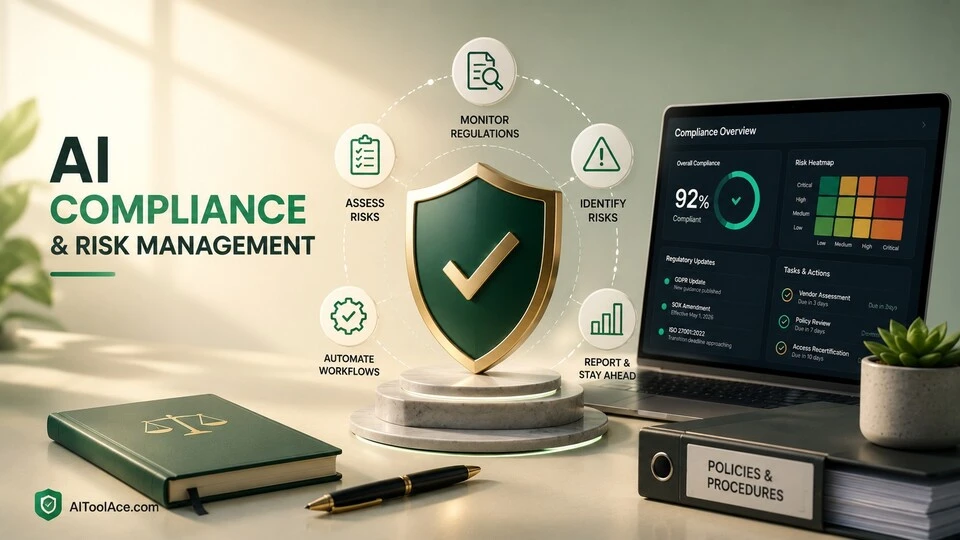
AI tools help by monitoring regulatory changes automatically, mapping new requirements to your existing controls, identifying compliance gaps, automating routine compliance tasks, and generating the documentation that auditors require. They don’t replace compliance expertise — regulations require human interpretation and judgment — but they reduce the operational burden that makes compliance feel overwhelming.
For legal document workflows, Best AI Tools for Contracts & Legal Documents covers contract-specific compliance. For financial compliance specifically, Best AI Tools for Financial Advisors addresses regulated financial services.
Quick answer: Diligent is the most comprehensive governance, risk, and compliance (GRC) platform. OneTrust is best for data privacy compliance (GDPR, CCPA). Claude is most useful for analyzing regulatory text and developing compliance documentation.
How I Tested These Tools
I evaluated each tool based on what matters for compliance and risk management:
- Regulatory monitoring — does it track changes in regulations relevant to your business and alert you proactively
- Gap identification — can it compare regulatory requirements against your existing controls and identify what’s missing
- Workflow automation — does it automate routine compliance tasks (assessments, evidence collection, reporting)
- Audit readiness — does it generate the documentation and evidence auditors require
- Coverage breadth — does it handle multiple regulatory frameworks or only one specific regulation
I reviewed each tool’s features, examined their regulatory coverage, and consulted feedback from compliance officers and risk managers. I did not fabricate compliance improvement statistics or invent risk reduction metrics. I am not a lawyer and this guide does not constitute legal advice.
Comparison Table
| Tool | Best For | Key Strength | Pricing |
|---|---|---|---|
| Diligent | Enterprise GRC | Comprehensive governance, risk, and compliance platform | Paid (enterprise) |
| OneTrust | Data privacy compliance | GDPR, CCPA, and privacy regulation management | Paid |
| Vanta | SOC 2 and security compliance | Automated evidence collection for security frameworks | Paid |
| LogicGate | Risk management | Configurable risk workflows and assessment automation | Paid |
| Claude | Regulatory analysis | Analyzing regulation text and developing compliance documentation | Freemium |
| Drata | Continuous compliance | Automated compliance monitoring with real-time dashboards | Paid |
Best AI Tools for Compliance & Risk Management
Diligent — Best Enterprise GRC Platform
Diligent provides a comprehensive governance, risk, and compliance platform that connects board governance, enterprise risk, compliance management, and audit operations. Its AI features analyze regulatory changes, assess risk exposure, and automate compliance workflows across the organization.
What it does well:
- connects governance, risk, and compliance in one platform so decisions at each level inform the others
- AI monitors regulatory changes across jurisdictions and maps new requirements to your existing control framework
- provides board-ready reporting that translates compliance and risk status into language that leadership understands
- manages the full audit lifecycle — planning, evidence collection, finding tracking, and remediation
- supports multiple regulatory frameworks simultaneously (SOX, GDPR, ISO 27001, industry-specific regulations)
Where it falls short: Diligent is enterprise software designed for organizations with dedicated compliance and risk teams. Small businesses and companies without formal compliance programs don’t need this level of infrastructure. Implementation is complex and requires significant organizational commitment — weeks to months of configuration, data migration, and process alignment. The pricing reflects the enterprise scope. And Diligent provides the framework for compliance management, but the actual compliance decisions — how to interpret regulations, which controls to implement, how to remediate gaps — still require human expertise.
Best for: mid-to-large organizations in regulated industries with dedicated compliance, risk, and audit functions — especially those managing compliance across multiple regulatory frameworks and jurisdictions.
OneTrust — Best for Data Privacy Compliance
Data privacy regulations (GDPR, CCPA, LGPD, and dozens of others) have created a compliance challenge that didn’t exist a decade ago. OneTrust specializes in managing this challenge — tracking consent, managing data subject requests, maintaining processing records, conducting privacy impact assessments, and demonstrating compliance with privacy regulations across jurisdictions.
What it does well:
- manages consent across websites, apps, and marketing channels to comply with privacy regulations
- automates data subject request (DSR) processing — when someone requests access to or deletion of their data
- maintains records of processing activities (ROPA) that privacy regulations require
- conducts and documents privacy impact assessments for new products, features, and data processing activities
- maps data flows across the organization so you know where personal data exists and how it moves
Where it falls short: OneTrust focuses on privacy — it doesn’t manage broader compliance areas (financial regulation, industry standards, environmental compliance). The platform is complex enough that most organizations need dedicated privacy personnel to operate it effectively. Privacy regulations vary significantly by jurisdiction, and OneTrust’s interpretation of requirements is a starting point — your legal team needs to validate the specific compliance approach for your situation. And the cost can be significant for organizations with extensive data processing operations.
For contract compliance, see Best AI Tools for Contracts & Legal Documents.
Best for: organizations that process personal data and need to comply with privacy regulations (GDPR, CCPA, and others) — especially those operating across multiple jurisdictions with different privacy requirements.
Vanta — Best for SOC 2 and Security Compliance
Vanta automates the evidence collection and continuous monitoring that security compliance frameworks (SOC 2, ISO 27001, HIPAA, PCI DSS) require. Instead of manually gathering screenshots, exporting logs, and compiling spreadsheets for auditors, Vanta connects to your systems and collects evidence automatically.
What it does well:
- automates evidence collection for security compliance frameworks by connecting directly to your infrastructure (AWS, GCP, Azure, GitHub, Okta, etc.)
- monitors compliance status continuously — not just at audit time — and alerts when controls drift out of compliance
- maps your controls to multiple frameworks simultaneously so one implementation satisfies SOC 2, ISO 27001, and HIPAA
- provides a trust center that demonstrates your security posture to customers and prospects
- significantly reduces the time and effort required for audit preparation
Where it falls short: Vanta automates evidence collection but doesn’t implement security controls — if your access management is poor or your encryption is incomplete, Vanta will document that fact, not fix it. The platform focuses on security and privacy frameworks — it doesn’t manage financial, environmental, or industry-specific regulatory compliance. Connecting all your systems requires initial technical effort. And the automated approach works best for cloud-native organizations — companies with significant on-premise infrastructure have more manual evidence collection.
For cybersecurity tools, see Best AI Tools for Cybersecurity.
Best for: SaaS companies and technology businesses that need SOC 2 or ISO 27001 certification — especially those selling to enterprise customers who require security compliance documentation.
LogicGate — Best for Risk Management
LogicGate provides a configurable risk management platform that adapts to how your organization thinks about and manages risk. Instead of forcing your risk processes into a pre-built structure, LogicGate lets you configure risk assessment workflows, scoring criteria, and reporting that match your risk framework.
What it does well:
- provides configurable risk assessment workflows that match your specific risk management methodology
- AI assists with risk scoring by analyzing historical data to predict likelihood and impact
- supports multiple risk domains — operational, financial, cybersecurity, third-party, compliance — in one platform
- automates risk assessment distribution, collection, and aggregation across the organization
- provides risk dashboards and reports that communicate risk posture to leadership and board
Where it falls short: LogicGate’s flexibility means configuration effort — the platform adapts to your process, but you need to define that process clearly before configuring it. Organizations without established risk management practices need to develop the framework before the tool becomes useful. The platform is designed for risk management specifically — it handles the risk assessment side well but doesn’t provide the compliance workflow management, audit support, or regulatory monitoring that GRC platforms like Diligent include.
For business analytics that inform risk decisions, see Best AI Tools for Business Intelligence.
Best for: organizations with established risk management practices that need a flexible platform to operationalize their risk framework — especially those whose risk processes don’t fit the rigid structures of standard GRC tools.
Claude — Best for Regulatory Analysis and Documentation
Compliance requires reading, understanding, and interpreting regulatory text — and then producing documentation that demonstrates your interpretation and approach. Claude handles both sides: it analyzes complex regulatory language and explains what it means for your business, and it produces compliance documentation (policies, procedures, risk assessments, audit responses) from your descriptions.
What it does well:
- analyzes regulatory text and explains requirements in plain language — what a regulation actually requires of your business
- identifies how regulatory changes affect your existing compliance posture — “this new rule means you need to update your data retention policy”
- drafts compliance policies, procedures, and documentation from descriptions of your actual practices
- generates audit response materials that present your compliance position clearly and professionally
- helps develop risk assessment narratives that connect identified risks to mitigation controls
Where it falls short: Claude is not a compliance advisor. Its analysis of regulations is based on general understanding, not jurisdiction-specific legal interpretation. Every compliance decision should be validated by qualified legal or compliance counsel. Claude can fabricate regulatory references — always verify that cited regulations exist and say what Claude claims. And Claude doesn’t monitor regulations, track compliance status, or manage ongoing compliance operations — it provides analysis and documentation on demand, not continuous compliance management.
For legal analysis, see Best AI Tools for Lawyers.
Best for: compliance officers and business leaders who need help understanding regulatory requirements and producing compliance documentation — especially for initial policy development, regulatory change analysis, and audit preparation.
Drata — Best for Continuous Compliance
Drata provides continuous compliance monitoring — not just audit preparation but ongoing verification that your controls remain effective between audits. Its AI analyzes your compliance posture in real time, identifies drift before it becomes a finding, and maintains the evidence that auditors require.
What it does well:
- monitors compliance continuously by connecting to your infrastructure and verifying control effectiveness in real time
- identifies compliance drift — when configurations change, access isn’t revoked, or policies expire — and alerts before audit findings
- automates evidence collection across dozens of integrations (cloud providers, identity management, code repositories)
- supports multiple frameworks (SOC 2, ISO 27001, HIPAA, GDPR, PCI DSS) with shared evidence and controls
- provides automated employee onboarding compliance — policy acknowledgment, security training tracking, access provisioning
Where it falls short: Like Vanta, Drata monitors and documents compliance but doesn’t implement controls. The value is proportional to how many of your systems integrate with the platform — gaps in integration create gaps in monitoring. The platform focuses on security and privacy frameworks, not broader regulatory compliance. And continuous monitoring can create alert fatigue if not configured carefully — every temporary configuration change triggering an alert dilutes the signal from genuine compliance issues.
Best for: technology companies that need continuous compliance assurance rather than point-in-time audit preparation — especially those maintaining multiple security certifications simultaneously.
The Real Risks of AI in Compliance
1. AI Misinterpreting Regulations
Regulations are written in legal language that requires expert interpretation. AI tools that analyze regulatory text can misinterpret requirements, miss nuances, or apply the wrong jurisdiction’s rules. Compliance decisions based on AI interpretation without legal review can create the very violations you’re trying to prevent. Always validate AI regulatory analysis with qualified compliance or legal counsel.
2. Automated Compliance Creating False Confidence
Tools that show green dashboards and “100% compliant” scores can create false confidence that your compliance posture is stronger than it actually is. Automated monitoring checks what it’s configured to check — it doesn’t assess risks it wasn’t designed to monitor. A clean dashboard doesn’t mean no compliance risk exists; it means the monitored controls are currently in place.
3. Documentation Without Substance
AI can generate polished compliance documentation — policies, procedures, risk assessments — that looks professional but doesn’t reflect your actual practices. Auditors and regulators evaluate whether your documentation matches reality, not whether it reads well. Generating documentation with AI and then not implementing the described practices is worse than having no documentation — it’s evidence of misrepresentation.
4. Compliance Replacing Risk Management
Compliance and risk management are related but different. Compliance asks “are we following the rules?” Risk management asks “what could go wrong and how do we prepare?” Organizations that focus exclusively on compliance checkboxes without genuine risk assessment can be fully compliant and still vulnerable to risks that regulations don’t address.
Which AI Tool Should You Choose?
- Enterprise GRC → Diligent (governance, risk, and compliance in one platform)
- Data privacy → OneTrust (GDPR, CCPA, and privacy regulation management)
- Security compliance → Vanta (automated SOC 2 and ISO 27001 evidence collection)
- Risk management → LogicGate (configurable risk assessment and management)
- Regulatory analysis → Claude (understand regulations and draft compliance documentation)
- Continuous monitoring → Drata (real-time compliance verification and drift detection)
Best starting approach: Identify your most pressing compliance requirement. For security certifications (SOC 2, ISO 27001), evaluate Vanta or Drata. For privacy (GDPR, CCPA), evaluate OneTrust. For broad GRC needs, evaluate Diligent. Use Claude for analyzing regulatory requirements and drafting documentation regardless of which operational tools you choose.
Frequently Asked Questions
What is the best AI compliance tool?
Diligent is the most comprehensive for enterprise GRC. OneTrust is best for privacy compliance. Vanta and Drata are best for security compliance automation. The right choice depends on which regulations you’re managing and the maturity of your compliance program.
Can AI replace compliance officers?
No. AI automates operational compliance tasks — monitoring, evidence collection, documentation, regulatory tracking. The judgment calls — how to interpret regulations for your specific business, which risks to accept, how to remediate findings, and how to balance compliance cost with business operations — require human expertise and organizational authority that AI doesn’t have.
How do I start a compliance program with AI tools?
Identify your regulatory requirements. Use Claude to understand what each regulation requires. Implement the necessary controls. Choose an operational tool (Vanta for security, OneTrust for privacy) to monitor compliance continuously. And engage qualified legal or compliance counsel to validate your approach — AI tools assist compliance but don’t replace professional guidance.
Is AI-generated compliance documentation acceptable to auditors?
Auditors evaluate whether documentation accurately represents your actual practices, not how it was produced. AI-generated documentation that accurately describes implemented controls is acceptable. AI-generated documentation that describes controls you haven’t implemented is a finding — and potentially evidence of misrepresentation. The generation method matters less than the accuracy.
How much does compliance software cost?
Vanta and Drata start around $10,000-25,000/year for small companies. OneTrust and Diligent are enterprise-priced with custom quotes. Claude’s free tier handles regulatory analysis and documentation drafting. The cost of compliance tools should be evaluated against the cost of non-compliance — fines, legal exposure, lost business, and audit remediation.
Can one tool handle all compliance needs?
Rarely. Most organizations need privacy-specific tools (OneTrust), security compliance tools (Vanta/Drata), and potentially enterprise GRC platforms (Diligent) depending on their regulatory landscape. Some platforms cover multiple areas, but specialized tools typically provide deeper capability for each compliance domain.
Related AI Tools Guides
- Best AI Tools for Lawyers
- Best AI Tools for Contracts & Legal Documents
- Best AI Tools for Financial Advisors
- Best AI Tools for Cybersecurity
- Best AI Tools for Accountants
Explore all AI tools → Browse by profession and use case
Last updated: June 2026