Skip to content
Best AI Tools for Customer Segmentation (Target the Right Audience in 2026)
Quick Navigation: How I Tested • Comparison Table • Risks • Best Tools • FAQ
Most businesses treat their customers as one group. The same email goes to everyone. The same ad targets everyone. The same messaging speaks to everyone. The result is that the message resonates with some customers and falls flat for the rest — wasting marketing spend on people who were never going to respond and under-investing in people who would have.
Customer segmentation solves this by dividing your customer base into groups that share meaningful characteristics — purchase behavior, engagement patterns, demographic profiles, product preferences, or lifecycle stage. Once you understand your segments, you can tailor messaging, offers, and experiences to each group — which consistently produces better results than one-size-fits-all approaches.
Traditional segmentation relies on simple rules: customers who bought in the last 30 days, customers who spent more than $500, customers in a specific geographic region. These rules are easy to create but miss the complex patterns that actually drive customer behavior. AI segmentation analyzes dozens of variables simultaneously and identifies groups that rule-based approaches can’t find — clusters of customers who share behavioral patterns that aren’t visible through simple filtering.
For using segments in email campaigns, Best AI Tools for Email Marketing covers the execution. For understanding customer behavior broadly, Best AI Tools for Customer Feedback & Surveys addresses the research side.
Quick answer: Klaviyo is the best segmentation tool for e-commerce businesses. Segment (Twilio) is the strongest customer data platform for connecting segmentation across tools. HubSpot provides the most accessible segmentation for mid-market companies.
How I Tested These Tools
I evaluated each tool based on what matters for effective segmentation:
- Segment discovery — does the AI identify meaningful customer groups you wouldn’t find with manual rules
- Behavioral depth — does it segment based on actual behavior (purchases, engagement, usage) rather than just demographics
- Activation — can you use the segments immediately in your marketing tools (email, ads, website personalization)
- Predictive capability — does it predict future behavior (likely to buy, likely to churn, likely to upgrade) based on segment patterns
- Data integration — does it combine data from multiple sources for a complete customer view
I reviewed each tool’s features, tested segmentation capabilities, and consulted feedback from marketing professionals and data analysts. I did not fabricate conversion improvement statistics or invent segmentation accuracy metrics.
Comparison Table
| Tool | Best For | Key Strength | Pricing |
|---|---|---|---|
| Klaviyo | E-commerce segmentation | Behavioral segmentation with predictive analytics for online stores | Paid |
| Segment (Twilio) | Customer data platform | Unified customer data across all tools and channels | Paid |
| HubSpot | Mid-market CRM segmentation | Accessible segmentation inside an integrated CRM | Paid |
| Mixpanel | Product behavior segmentation | User behavior analysis for product-led companies | Freemium |
| Amplitude | Predictive segmentation | AI-powered audience prediction and behavioral cohorts | Freemium |
| Claude | Segmentation strategy | Custom analysis of customer data and segment development | Freemium |
Best AI Tools for Customer Segmentation
Klaviyo — Best for E-Commerce Segmentation
Klaviyo is built for e-commerce businesses and provides the deepest segmentation for online stores. It combines purchase history, browsing behavior, email engagement, and predictive analytics to create segments that drive revenue — identifying who’s about to buy, who’s about to churn, and who would respond to specific offers.
What it does well:
- segments customers based on purchase behavior (frequency, recency, monetary value), browsing activity, email engagement, and predicted future behavior
- predictive analytics estimate each customer’s expected next order date, predicted lifetime value, and churn risk
- creates dynamic segments that update automatically as customer behavior changes — a customer who purchases moves from “at risk” to “active” without manual adjustment
- integrates directly with Shopify, WooCommerce, Magento, and other e-commerce platforms for real-time data
- activates segments immediately through email, SMS, and ad platform integrations from the same tool
Where it falls short: Klaviyo is designed for e-commerce — B2B companies, SaaS businesses, and non-retail organizations get less value from the e-commerce-specific features. The predictive models need sufficient purchase history to generate reliable predictions — new stores with limited data won’t see accurate predictions immediately. The pricing scales with contact list size, which becomes expensive as your customer base grows. And Klaviyo’s segmentation, while powerful, operates within Klaviyo’s ecosystem — if your primary marketing tool is something else, the segmentation doesn’t transfer easily.
For e-commerce tools broadly, see Best AI Tools for E-commerce.
Best for: e-commerce businesses with enough purchase history for behavioral patterns to emerge — especially stores with repeat purchase models where identifying buying cycles and churn risk drives revenue.
Segment (Twilio) — Best Customer Data Platform
Segmentation quality depends on data quality — and most businesses have customer data scattered across dozens of tools (CRM, email, analytics, support, billing, product). Segment collects customer data from all these sources, unifies it into complete customer profiles, and makes those profiles available across every tool in your stack. The segmentation then operates on complete data, not fragments.
What it does well:
- collects customer data from every touchpoint (website, app, email, support, purchases, product usage) into unified profiles
- provides a single source of truth for customer data that every tool in your stack can access
- enables segmentation across all customer interactions, not just what one tool sees
- supports real-time data flow — customer actions trigger segment updates and downstream actions immediately
- integrates with hundreds of marketing, analytics, and advertising tools for segment activation
Where it falls short: Segment is infrastructure, not a marketing tool. It collects and distributes data but doesn’t create campaigns, send emails, or manage ads — you need other tools for activation. Implementation requires technical resources — connecting data sources, defining events, and maintaining data quality is engineering work. The pricing is enterprise-level, reflecting its role as core infrastructure. And Segment provides the data foundation for segmentation but doesn’t include the AI analysis layer — you need analytics tools (Mixpanel, Amplitude) on top for the actual segment discovery.
For data analysis, see Best AI Tools for Data Analysts.
Best for: companies with customer data spread across many tools that need a unified data foundation before they can segment effectively — especially companies where fragmented data is the primary barrier to good segmentation.
HubSpot — Best Mid-Market CRM Segmentation
HubSpot provides segmentation inside an integrated CRM — contact properties, deal history, website behavior, email engagement, and form submissions all available for building segments. For mid-market companies that want segmentation without adopting a separate data platform, HubSpot provides accessible segmentation alongside its CRM, marketing, and sales tools.
What it does well:
- segments contacts using CRM data (deal stage, lifecycle stage, properties), marketing data (email engagement, form submissions), and website data (pages visited, content downloaded)
- AI-powered predictive lead scoring identifies which contacts are most likely to convert
- dynamic lists update automatically as contact properties and behavior change
- activates segments directly in HubSpot’s email, ads, and workflow tools — no data transfer needed
- accessible to marketers without technical skills — the list builder uses visual filters, not code
Where it falls short: HubSpot’s segmentation operates on HubSpot data — customer behavior outside HubSpot (product usage, support interactions, offline purchases) needs to be imported or integrated for complete segmentation. The predictive scoring needs sufficient conversion volume to train accurate models. Advanced segmentation (behavioral cohorts, clustering, RFM analysis) requires the higher-tier plans. And HubSpot’s segmentation is powerful for marketing activation but less sophisticated than dedicated analytics tools for discovering new segments.
For sales alongside segmentation, see Best AI Tools for Sales Teams.
Best for: mid-market companies using HubSpot as their CRM that want segmentation integrated into their existing marketing workflow — without adopting separate data platforms or analytics tools.
Mixpanel — Best for Product Behavior Segmentation
For product-led businesses where customer behavior inside the product determines retention and growth, Mixpanel provides the deepest behavioral segmentation. It tracks what users do (features used, workflows completed, frequency of engagement) and identifies behavioral patterns that predict retention, upgrade, or churn.
What it does well:
- segments users based on specific product behaviors — feature adoption, workflow completion, engagement frequency, and usage patterns
- identifies behavioral cohorts — groups of users who share patterns that predict outcomes (retention, upgrade, churn)
- provides funnel analysis that shows where different segments drop off in key workflows
- AI surfaces significant behavioral differences between segments automatically
- generous free plan that covers meaningful analytics for early-stage products
Where it falls short: Mixpanel segments based on product behavior — it doesn’t include marketing engagement, sales interactions, or support history unless that data is explicitly sent to Mixpanel. The segmentation is analytical, not activational — Mixpanel identifies segments but you need separate tools (email, in-app messaging) to reach them. Implementation requires engineering work to instrument events properly. And behavioral segmentation requires enough user volume for patterns to be statistically meaningful.
For product management alongside analytics, see Best AI Tools for Product Management.
Best for: SaaS and product-led businesses that need to understand which user behaviors predict success — especially for identifying what separates retained users from churned users.
Amplitude — Best for Predictive Segmentation
Amplitude goes beyond descriptive segmentation (who your customers are) into predictive segmentation (what your customers will do). Its AI predicts which users are likely to convert, upgrade, churn, or take specific actions — allowing you to target marketing and product efforts at the customers where intervention will have the most impact.
What it does well:
- predicts which users are likely to convert, upgrade, or churn based on behavioral patterns
- creates predictive cohorts — segments of users who share predicted future behaviors, not just past actions
- identifies the behaviors that most strongly predict desired outcomes — “users who do X within Y days are Z% more likely to convert”
- supports experimentation analysis — measuring how product changes affect different segments differently
- provides collaborative features for product, marketing, and data teams to align on segment definitions
Where it falls short: Predictive accuracy depends on data volume and pattern consistency — predictions are less reliable for new products, new markets, or rapidly changing user behavior. The platform is analytically deep but requires data literacy to interpret meaningfully — dashboards of predictions without understanding what drives them don’t improve decisions. Amplitude identifies predicted segments but doesn’t activate them directly — you need integration with marketing and messaging tools. And the pricing can be significant for companies with large user bases.
For business intelligence broadly, see Best AI Tools for Business Intelligence.
Best for: product and growth teams that want to move from reactive segmentation (who did what) to predictive segmentation (who will do what) — especially for targeting interventions that prevent churn or accelerate conversion.
Claude — Best for Segmentation Strategy
Claude doesn’t connect to your customer database or generate segments automatically. Its value is strategic — helping you think through segmentation approaches, analyze customer data you share, develop segment profiles, and create the marketing strategies tailored to each segment.
What it does well:
- analyzes customer data you share and identifies potential segmentation approaches based on the patterns in the data
- develops segment profiles — describing each segment’s characteristics, needs, motivations, and optimal messaging
- creates segment-specific marketing strategies — what to say, how to say it, and through which channels for each group
- helps evaluate whether proposed segments are actionable — a segment you can’t reach or can’t tailor your offer to isn’t useful
- explains segmentation concepts and frameworks for teams new to customer segmentation
Where it falls short: Claude analyzes data you provide — it can’t access your CRM, analytics platform, or customer database. The segmentation analysis is based on the data you share, which may be incomplete. Claude provides strategic thinking, not operational capability — you need dedicated tools to actually create, update, and activate segments. And Claude’s segments are hypotheses based on patterns in your data — they need validation against actual customer behavior before building strategies on them.
For data analysis broadly, see Best AI Tools for Spreadsheets & Excel.
Best for: marketing leaders and founders who need help thinking through their segmentation strategy — especially those who have customer data but aren’t sure how to segment it meaningfully.
The Real Risks of AI Segmentation
1. Segments Without Strategy
AI can identify customer groups, but identifying groups and knowing what to do with them are different things. A segment of “high-value customers who haven’t purchased in 60 days” is only useful if you have a specific strategy for re-engaging them. Creating segments without corresponding marketing strategies produces dashboards, not results.
2. Over-Segmentation
AI can slice your customer base into dozens of micro-segments based on subtle behavioral differences. But marketing to 50 different segments is operationally impossible for most teams. The optimal number of segments balances precision (each segment is meaningfully different) with practicality (your team can create distinct marketing for each). Three to seven actionable segments typically outperforms fifty theoretical ones.
3. Demographic Bias in Behavioral Segments
AI segmentation based on purchase behavior, engagement, and usage can inadvertently create segments that correlate with demographic characteristics — income level, age, geography. If your “high-value” segment skews toward a specific demographic and your “low-value” segment skews toward another, your differentiated marketing may reinforce disparities rather than serve all customers well. Review segments for unintended demographic patterns.
4. Static Segments in Dynamic Markets
Customer behavior changes — seasonal patterns, economic shifts, competitor actions, and life events all affect how customers interact with your business. Segments defined today may not reflect customer reality in six months. Use dynamic segments that update based on current behavior, and review your segmentation strategy regularly rather than treating it as a one-time exercise.
Which AI Tool Should You Choose?
- E-commerce segmentation → Klaviyo (purchase behavior with predictive analytics)
- Unified customer data → Segment (Twilio) (customer data platform connecting all tools)
- CRM-based segmentation → HubSpot (accessible segmentation in an integrated CRM)
- Product behavior analysis → Mixpanel (behavioral cohorts for product-led businesses)
- Predictive segmentation → Amplitude (AI-predicted future behavior segments)
- Segmentation strategy → Claude (analysis, profiles, and strategy development)
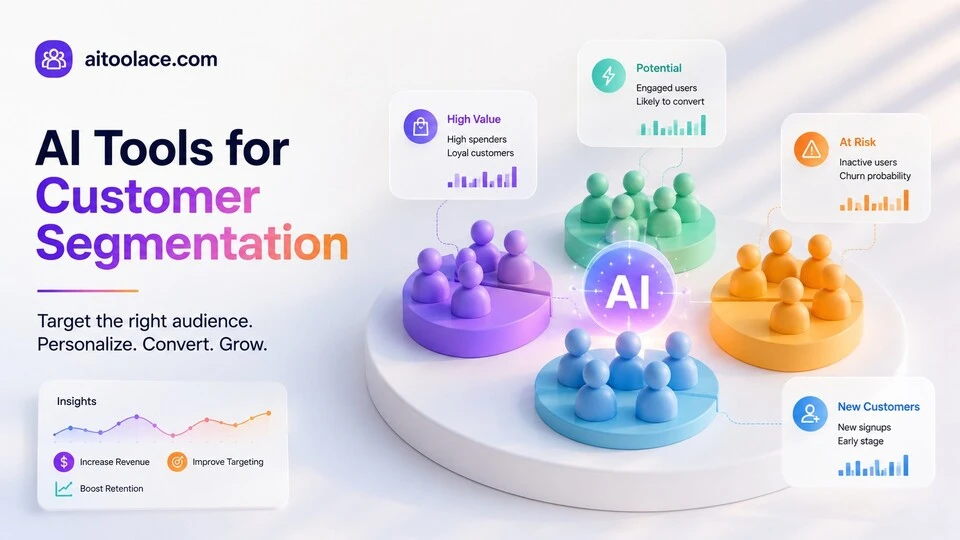
Best starting approach: Start with the segmentation capabilities in your existing tools — HubSpot, Klaviyo, or your CRM likely already support basic segmentation that you’re not using. Begin with three simple segments (new customers, active customers, at-risk customers) and tailor your marketing for each. Add dedicated analytics (Mixpanel, Amplitude) when you need deeper behavioral understanding. Add Segment when your data fragmentation is the primary barrier.
Frequently Asked Questions
What is the best AI tool for customer segmentation?
Klaviyo is best for e-commerce. HubSpot is most accessible for mid-market companies. Mixpanel and Amplitude are best for product-led businesses. The right choice depends on your business model and where your customer data lives.
How many segments should I have?
Start with 3-5 segments that are meaningfully different and that you can create distinct marketing for. More segments than your team can manage operationally creates complexity without value. You can refine and expand segments as your marketing capability and data sophistication grow.
What data do I need for effective segmentation?
At minimum: purchase or conversion history, engagement data (email opens, website visits), and basic contact properties. Better segmentation comes from adding product usage data, support interactions, and survey responses. The more complete your customer view, the more meaningful your segments.
Can AI find segments I wouldn’t discover manually?
Yes — this is one of AI’s strongest applications in marketing. AI analyzes dozens of variables simultaneously and identifies behavioral clusters that manual analysis with simple rules would miss. These AI-discovered segments often reveal unexpected patterns — groups of customers who share behaviors you didn’t know were related.
How do I know if my segments are working?
Measure marketing performance by segment. If your segmented campaigns produce better open rates, conversion rates, and revenue per customer than unsegmented campaigns, the segmentation is working. If performance is similar regardless of segment, your segments may not be meaningfully different or your tailored messaging may not be distinct enough.
Should I segment by demographics or behavior?
Behavioral segmentation (what customers do) consistently outperforms demographic segmentation (who customers are) for marketing effectiveness. Two 35-year-old women in the same city might have completely different needs and preferences. Two customers who browse the same product category and purchase at the same frequency — regardless of demographics — respond to similar messaging. Start with behavior; add demographics only when it improves targeting.
Related AI Tools Guides
- Best AI Tools for Email Marketing
- Best AI Tools for Customer Feedback & Surveys
- Best AI Tools for E-commerce
- Best AI Tools for Data Analysts
- Best AI Tools for Advertising
Explore all AI tools → Browse by profession and use case
Last updated: July 2026