Skip to content
Best AI Tools for Dentists (Save Time on X-Rays & Clinical Notes)
Quick Navigation: How I Tested • Comparison Table • Risks • Best Tools • FAQ
Dental AI has moved past the hype stage. The tools available now address real problems that dentists deal with daily — spending too much time on documentation, missing subtle findings on busy days, and struggling to explain complex treatment plans to patients in language they understand.
The most impactful dental AI tools fall into three categories: radiograph analysis (AI that flags findings on X-rays), clinical documentation (voice-powered charting that eliminates end-of-day note writing), and patient communication (AI that helps explain treatment in clear, non-clinical language). Each category addresses a genuine bottleneck in dental practice.
The challenge is that the dental AI market is crowded with tools that promise transformation but deliver confusion. Some are FDA-cleared diagnostic aids backed by clinical validation. Others are general-purpose tools adapted for dentistry with varying success. This guide separates the genuinely useful from the overhyped.
For AI tools in other healthcare settings, see Best AI Tools for Doctors and Best AI Tools for Nurses.
Quick answer: Overjet is the strongest tool for X-ray diagnostics with FDA clearance and quantitative bone loss measurement. Bola AI is best for dental-specific voice charting. Claude is most useful for patient communication and admin writing.
How I Tested These Tools
I evaluated each tool based on what matters for dental practice:
- Diagnostic accuracy — does the AI reliably identify findings on radiographs, and how does it handle edge cases
- Clinical documentation quality — does it understand dental terminology, tooth numbering systems, and procedure-specific language
- Workflow integration — does it work with existing practice management systems (Dentrix, Eaglesoft, Open Dental)
- Regulatory compliance — is it FDA-cleared (for diagnostic tools), HIPAA-compliant, and does it offer a BAA
- Patient communication — can it translate clinical concepts into language patients actually understand
I reviewed each tool’s features, regulatory status, integration capabilities, and clinical output quality. I consulted feedback from practicing dentists. I did not fabricate detection accuracy statistics or invent ROI metrics.
Comparison Table
| Tool | Best For | Key Strength | Pricing |
|---|---|---|---|
| Overjet | X-ray analysis | FDA-cleared bone loss measurement with quantitative data | Freemium |
| Pearl | Comprehensive imaging | 2D + 3D CBCT analysis with FDA clearance | Paid |
| VideaHealth | Early caries detection | FDA-cleared AI focused on preventive dentistry | Paid |
| Bola AI | Clinical documentation | Dental-native voice charting integrated with PMS | Paid |
| Denti.AI | Perio charting | Voice-driven periodontal measurement recording | Paid |
| Claude | Patient communication | Treatment explanations and admin writing | Freemium |
The Real Risks of Using AI in Dental Practice
1. Diagnostic Overreliance
AI X-ray analysis tools are designed to assist, not replace, your clinical judgment. These tools can flag findings you might miss on a busy day, but they can also generate false positives that lead to unnecessary treatment recommendations if you don’t verify with your own clinical examination. The AI is a second opinion — your clinical assessment remains the primary diagnostic method.
2. Documentation Liability
Voice-powered charting tools can misinterpret dental terminology, especially in noisy operatory environments. Similar-sounding terms (“mesial” and “distal,” specific tooth numbers) can be confused. If you sign off on AI-generated notes without careful review, inaccurate records become your liability. Every AI-generated note needs clinical verification before it enters the patient record.
3. Patient Data Privacy
Not every dental AI tool is HIPAA-compliant. Before uploading patient radiographs or dictating clinical notes, verify that the tool has a signed Business Associate Agreement (BAA), encrypts data appropriately, and does not use patient data to train its models. General-purpose AI tools (ChatGPT, Claude) should never be used with identifiable patient information.
4. Insurance and Audit Implications
Insurance companies are increasingly using AI to review claims. If your diagnostic AI flags something you didn’t treat, or your documentation doesn’t align with AI findings that are part of your record, it could trigger audits or complicate claim processing. Understand how AI findings integrate into your documentation and billing workflow.
Best AI Tools for Dentists
Overjet — Best for X-Ray Diagnostics
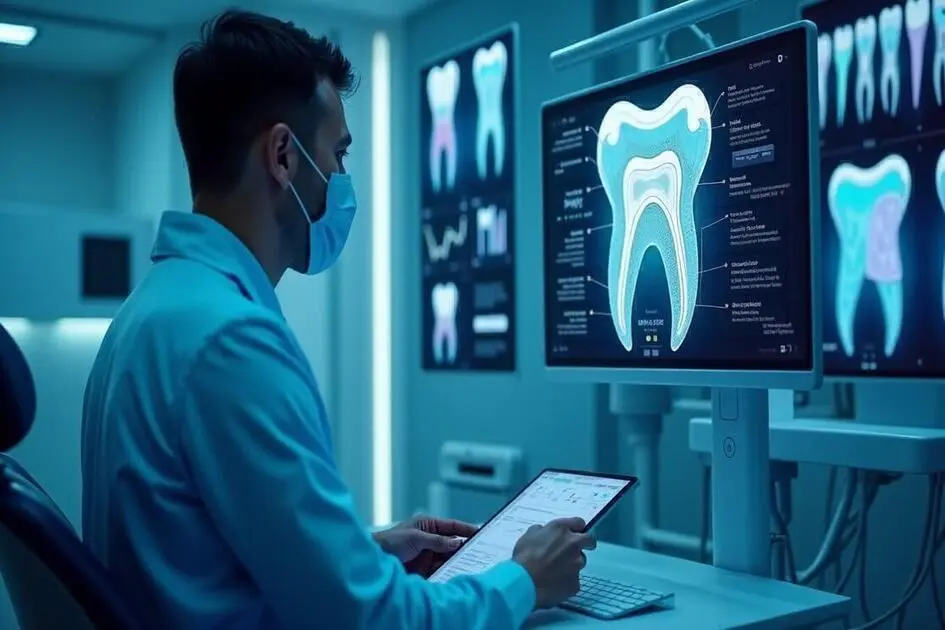
Overjet is an FDA-cleared AI platform that analyzes dental radiographs in real time. It detects and outlines caries, bone loss, and calculus directly on the image, providing measurable periodontal bone level reports that standardize diagnostic documentation.
What it does well:
- quantifies bone loss with precise measurements rather than subjective assessments, creating standardized documentation
- overlays color-coded indicators on radiographs showing areas of concern, which helps with patient education
- provides diagnostic consistency across multiple providers in group practices
- FDA-cleared, which means it has undergone clinical validation for accuracy and safety
Where it falls short: Overjet’s findings are overlays on existing radiographs — they highlight potential issues but can’t account for clinical context that isn’t visible on the X-ray (patient symptoms, clinical examination findings, medical history). False positives do occur, especially in images with artifacts, overlapping anatomy, or unusual presentations. The tool is also most useful for standard bitewing and periapical analysis — complex cases still require full clinical evaluation. And the patient education benefit, while real, can create pressure to discuss AI findings before you’ve fully evaluated them clinically.
Best for: practices that want diagnostic consistency across providers and a reliable second set of eyes on radiographs, with the understanding that clinical verification remains essential.
Pearl — Best for Comprehensive Imaging AI
Pearl offers FDA-cleared AI tools that support both 2D X-rays and 3D CBCT imagery. This broader imaging coverage makes it useful for practices that do complex restorative work, implant planning, or endodontic evaluation alongside routine radiography.
What it does well:
- analyzes both 2D radiographs and 3D CBCT scans, covering the full imaging spectrum
- detects pathologies across multiple imaging modalities in one platform
- provides AI assistance for complex cases that involve CBCT (implant planning, endodontic evaluation)
- FDA-cleared with clinical validation
Where it falls short: Pearl’s broader coverage means the tool is more complex than single-modality alternatives like Overjet. Practices that primarily use standard 2D radiography may not benefit from the CBCT capabilities and may find a focused tool more practical. The pricing reflects the comprehensive feature set, which may not be justified for practices with simpler imaging needs. And as with all diagnostic AI, the findings are suggestions that require your clinical confirmation.
Best for: practices with heavy radiography volumes across multiple modalities, especially those doing implant planning or complex restorative work.
VideaHealth — Best for Early Caries Detection
VideaHealth is FDA-cleared and focuses specifically on early caries detection. Its AI models are trained to identify early-stage decay that might not yet be clinically obvious, supporting preventive intervention before small lesions become large restorations.
What it does well:
- focuses on early-stage caries detection, supporting preventive dentistry approaches
- designed to catch incipient lesions that may not be clinically obvious on visual examination
- provides AI-powered clinical insights during the appointment rather than after
- widely adopted by large dental service organizations, which provides validation of practical utility
Where it falls short: Early caries detection is valuable but also inherently uncertain — the boundary between “early lesion to monitor” and “false positive” isn’t always clear, even with AI assistance. The tool supports early detection but the clinical decision about whether to intervene or monitor remains yours. And focusing specifically on caries means it doesn’t address bone loss assessment, calculus detection, or other pathologies as comprehensively as broader tools.
Best for: prevention-focused practices and pediatric dentistry offices where early intervention has the highest impact.
Bola AI — Best for Clinical Documentation
Bola AI is purpose-built for dental documentation. It uses voice-powered charting that understands dental terminology — tooth numbering systems, surfaces, materials, and procedure-specific language — and writes directly to your practice management system.
What it does well:
- understands dental-specific terminology including tooth numbering (universal, Palmer, FDI), surface notation, and procedural language
- integrates directly with major practice management systems (Dentrix, Eaglesoft, Open Dental)
- captures clinical notes through natural speech during procedures, eliminating post-session charting
- structures dictated information into proper clinical note formats automatically
Where it falls short: Voice recognition in a dental operatory is challenging — suction, handpieces, music, and patient conversation create background noise that can affect accuracy. Similar-sounding terms can be confused, especially at speed. The notes require review before becoming part of the clinical record, which means you’re trading writing time for review time — a significant net improvement, but not the elimination of documentation work entirely. And the system needs time to learn your specific speech patterns and terminology preferences.
Best for: high-volume practices where documentation bottlenecks slow down patient flow, and practices with multiple providers who need consistent documentation standards.
Denti.AI — Best for Periodontal Charting
Denti.AI addresses one of the most tedious tasks in dental hygiene — periodontal charting. Its voice-driven system records probing measurements directly into the chart as the hygienist calls them out, eliminating the need for a second person to record.
What it does well:
- records periodontal probing depths through voice recognition as the hygienist calls out measurements
- fills in the periodontal chart automatically in the correct positions
- captures bleeding points and other clinical observations verbally
- eliminates the need for a second person to record during perio charting
Where it falls short: Voice recognition accuracy for rapid-fire number sequences (“3, 3, 4, 3, 2, 3, 5, 4, 3”) in a clinical environment is good but not perfect. Misrecognized measurements can slip into the chart if not caught during review. The system also requires a specific speaking cadence — too fast and accuracy drops, too slow and it defeats the efficiency purpose. And like Bola AI, background operatory noise can affect recognition quality.
Best for: hygiene-heavy practices and periodontist offices with high perio charting volumes.
Claude — Best for Patient Communication
Claude isn’t a dental tool — it’s a general-purpose AI writing tool that happens to be very useful for the non-clinical writing dentists do. Treatment plan explanations, post-operative instructions, consent form language, referral letters, and patient follow-up messages all benefit from Claude’s ability to translate clinical dental concepts into clear, patient-friendly language.
What it does well:
- translates clinical dental language into clear explanations that patients can actually understand
- adapts tone for different situations — reassuring for anxious patients, detailed for informed patients, simple for elderly patients
- generates post-operative instructions customized to specific procedures
- drafts referral letters, insurance narratives, and professional correspondence quickly
Where it falls short: Claude is not HIPAA-compliant and should never be used with identifiable patient information. Use it for generic content — procedure explanations, template instructions, general patient education materials — not for anything that references a specific patient. The dental information it generates is based on general knowledge and may not reflect current clinical guidelines or your specific practice protocols. Always verify clinical recommendations against evidence-based sources.
For writing patient and professional communications more broadly, see AI Tools for Writing Client Emails.
Best for: any dentist who wants to improve patient communication and create better educational materials without spending significant time on writing.
Which AI Tool Should You Choose?
- Want better diagnostic support → Overjet (FDA-cleared, quantitative, immediate clinical impact)
- Need comprehensive imaging AI → Pearl (2D + 3D coverage for complex cases)
- Focused on prevention → VideaHealth (early caries detection)
- Documentation is your biggest burden → Bola AI (dental-native voice charting)
- Perio charting efficiency → Denti.AI (voice-driven measurement recording)
- Better patient communication → Claude (treatment explanations and admin writing, free to start)
Best starting point: Overjet (free trial) for diagnostic support + Claude (free) for patient communication. These two address different problems and deliver immediate, visible improvements without financial commitment.
Frequently Asked Questions
Is AI safe to use for dental diagnostics?
Yes, when used as a diagnostic aid rather than a replacement for clinical judgment. Tools like Overjet, Pearl, and VideaHealth are FDA-cleared, meaning they’ve undergone clinical validation. The appropriate use is as a second opinion that you verify with your own clinical examination — never as the sole basis for treatment decisions.
Will AI replace dentists?
No. AI handles pattern recognition in radiographs and automates documentation, but it cannot perform clinical examinations, manual procedures, build patient relationships, or exercise the professional judgment that clinical dentistry requires. AI makes competent dentists more efficient — it doesn’t make dentists unnecessary.
Do I need to worry about HIPAA with dental AI tools?
Yes. Any tool that handles patient data (radiographs, clinical notes, patient information) must be HIPAA-compliant with a signed BAA. Dental-specific tools (Overjet, Bola AI, Pearl) address this directly. General-purpose AI tools (Claude, ChatGPT) are not HIPAA-compliant and should never be used with identifiable patient information.
Can dental AI tools integrate with my practice management software?
Most dental-specific AI tools integrate with Dentrix, Eaglesoft, and Open Dental — the three most common dental PMS platforms. Always verify compatibility with your specific system and version before purchasing. Integration quality varies — some tools write directly to the PMS, others require manual transfer.
How much does dental AI cost?
Costs vary significantly. Claude is free to start. Overjet offers a free trial. Dedicated dental AI platforms typically charge per-provider monthly fees that vary based on features and practice size. The specific pricing depends on the tool and your practice configuration — contact vendors directly for current pricing.
What should I try first?
Start with the area that costs you the most time or creates the most frustration. For most dentists, that’s either documentation (try Bola AI) or diagnostic confidence (try Overjet’s free trial). Add patient communication tools (Claude) once your clinical workflow is streamlined.
Related AI Tools Guides
- Best AI Tools for Doctors
- Best AI Tools for Nurses
- Best AI Tools for Therapists
- Best AI Tools for Coaches
- ChatGPT vs Claude vs Gemini
Explore all AI tools → Browse by profession and use case
Last updated: April 2026