Skip to content
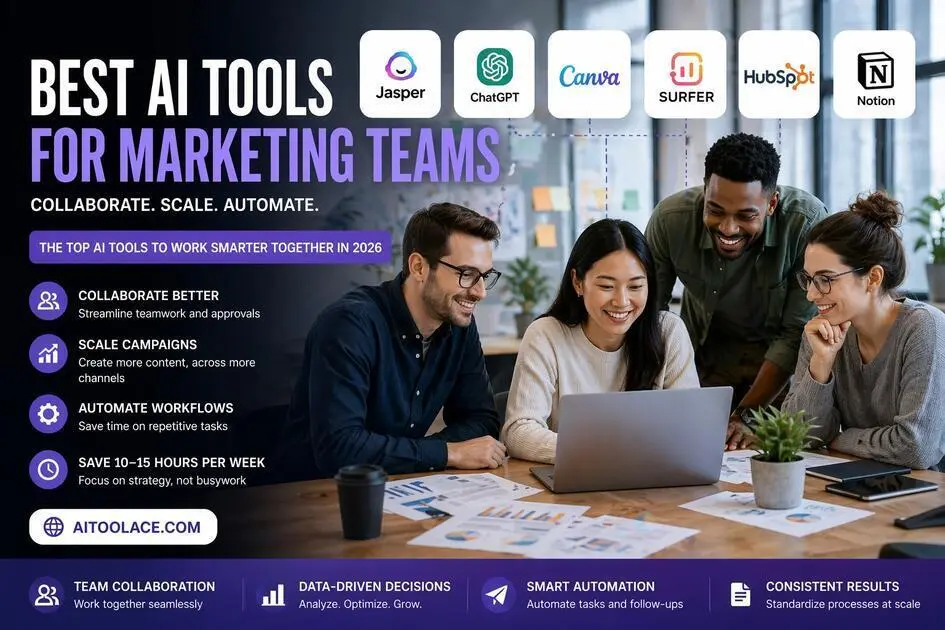
Best AI Tools for Marketing Teams in 2026 (Collaborate, Scale & Automate Faster)
Quick Navigation: How I Tested • Comparison Table • Content • SEO • Analytics • Risks • FAQ
Most AI tool guides focus on individual marketers working alone. This guide is specifically about marketing teams — where the challenges are different. Teams deal with brand consistency across multiple people, approval workflows that slow everything down, campaign coordination across channels, and the constant pressure to produce more content without adding headcount.
AI tools help with these team-specific problems, but they also create new ones if adopted poorly. A tool that works great for a solo marketer can create chaos when six people use it without shared guidelines. This guide covers which tools actually work in a team context, what they do well, and where they create problems.
If you’re a freelancer or solo marketer, see Best AI Tools for Marketers instead. For teams focused specifically on content production, Best AI Tools for Copywriters (Write Faster, Convert Better) covers writing-specific workflows.
Quick answer: The strongest marketing team stack combines Jasper for content production with shared brand voice, HubSpot AI for campaign operations and analytics, and Canva AI for collaborative design. Notion AI ties everything together as the central workspace.
How I Tested These Tools
I evaluated each tool based on what matters specifically for team use:
- Multi-user workflows — can multiple people work in the tool simultaneously without stepping on each other
- Brand consistency — does the tool help maintain consistent voice, style, and quality across team members
- Approval and review — does it support workflows where content needs to be reviewed before publishing
- Integration depth — does it connect with the other tools the team already uses
- Onboarding speed — how quickly can a new team member start producing useful work
I reviewed each tool’s team features, tested the collaboration interfaces, and consulted feedback from marketing managers running teams of various sizes. I did not fabricate productivity statistics or invent team scenarios.
Comparison Table
| Tool | Best For | Key Team Strength | Pricing |
|---|---|---|---|
| Jasper | Content production | Shared brand voice and templates | Paid |
| ChatGPT | Flexible general use | Versatile across all functions | Freemium |
| Surfer SEO | SEO alignment | Shared content guidelines | Paid |
| HubSpot AI | Marketing operations | Unified campaign data and reporting | Paid |
| Canva AI | Design collaboration | Brand kits and shared templates | Freemium |
| Notion AI | Team organization | Central workspace for planning | Freemium |
Best AI Tools for Team Content Production
Jasper — Best for Content Teams at Scale
Jasper’s value for teams isn’t just that it generates content — it’s that it can generate content that sounds consistent regardless of who on the team is using it. The shared brand voice feature lets you define your company’s tone, and every team member’s output follows those guidelines.
What it does well:
- maintains a shared brand voice that every team member’s content follows automatically
- provides content templates that standardize output across blog posts, ads, emails, and social
- supports collaboration workflows where drafts can be reviewed and edited before publishing
- lets new team members produce on-brand content quickly instead of spending weeks learning the voice
Where it falls short: Jasper’s brand voice feature is helpful but not perfect. It captures general tone well but can’t replicate the specific quirks and personality that make a brand’s content distinctive. The output tends toward “professional and consistent” rather than “memorable and unique.” You still need a senior writer or editor to add the personality layer. The pricing also scales with team size, which can get expensive for larger teams.
Best for: content teams that produce high volumes across multiple channels and need consistency more than creativity.
ChatGPT — Best Flexible Team Tool
ChatGPT doesn’t have team-specific features like shared brand voices or approval workflows. What it has is flexibility — it can help with virtually any marketing task, from brainstorming to data analysis to draft writing. For teams, its value is as a general-purpose tool that fills gaps between specialized platforms.
What it does well:
- handles a wide range of marketing tasks without requiring specialized setup for each one
- useful for brainstorming, competitive analysis, first drafts, and quick research
- accessible to every team member regardless of their technical skill level
- improves over a conversation — you can refine outputs through back-and-forth
Where it falls short: Without shared settings, every team member uses ChatGPT differently and gets different results. There’s no built-in way to enforce brand guidelines, review outputs before they’re used, or maintain consistency across the team. It’s a personal productivity tool being used in a team context, and the seams show. For a detailed comparison with other AI assistants, see ChatGPT vs Claude vs Gemini.
Best for: teams that need a versatile, low-cost AI tool for a wide range of tasks and are willing to manage consistency through human processes rather than tool features.
Best AI Tools for Team SEO
Surfer SEO — Best for Content Optimization
When multiple writers produce content for the same site, SEO consistency becomes a real problem. One writer optimizes well, another ignores keyword density, and a third over-optimizes. Surfer SEO addresses this by providing shared content guidelines that every writer follows.
What it does well:
- provides content scoring and guidelines that standardize SEO quality across multiple writers
- offers real-time optimization feedback during writing so issues are caught before publishing
- includes competitive analysis tools that help the team align on keyword strategy
- creates a shared reference point for content quality that doesn’t depend on individual expertise
Where it falls short: Surfer optimizes for search engines, not for readers. Content that scores perfectly in Surfer can feel formulaic and keyword-heavy to actual humans. The tool is also most useful for blog content — it’s less helpful for social media, email, or ad copy where SEO optimization doesn’t apply. Teams need to balance Surfer’s recommendations with editorial judgment.
Best for: marketing teams with multiple writers producing SEO-focused blog content who need consistent optimization quality.
Best AI Tools for Team Analytics
HubSpot AI — Best for Marketing Operations
HubSpot’s AI features are most valuable in a team context because they sit on top of HubSpot’s CRM and marketing platform. Every team member sees the same campaign data, the same lead information, and the same performance metrics — which eliminates the “different spreadsheet, different numbers” problem that plagues many marketing teams.
What it does well:
- provides a single source of truth for campaign performance data across the entire team
- uses AI for lead scoring so marketing and sales teams agree on which leads are worth pursuing
- automates reporting that would otherwise require someone to manually compile data from multiple sources
- connects campaign outcomes to revenue so the team can see which activities actually drive results
Where it falls short: HubSpot is expensive and complex. The AI features are genuinely useful, but they’re part of a larger platform that requires significant setup and ongoing maintenance. If your team isn’t ready to commit to HubSpot as your central marketing platform, the AI features alone don’t justify the cost. The learning curve is real — expect weeks of onboarding, not days.
For teams focused on sales alignment, see also Best AI Tools for Sales Teams.
Best for: marketing teams that need unified campaign analytics and are ready to commit to HubSpot as their central operating platform.
Best AI Tools for Design Teams
Canva AI — Best for Collaborative Design
Most marketing teams need visual content but don’t have enough designers to handle the volume. Canva AI bridges this gap by letting non-designers create on-brand visual assets using shared templates and brand kits.
What it does well:
- maintains brand consistency through brand kits that lock in colors, fonts, and logos
- provides templates that non-designers can use to create professional visual content
- supports real-time collaboration where multiple team members can work on the same design
- includes AI-powered features like background removal, resize suggestions, and layout recommendations
Where it falls short: Canva’s templates are used by millions of users, which means your visual content can look generic. The AI suggestions are safe and conventional rather than creative or distinctive. For campaigns where visual differentiation matters, you still need a dedicated designer. Canva is best for volume production of standard marketing assets, not for standout creative work.
For dedicated design workflows, see Best AI Tools for Designers.
Best for: marketing teams where multiple people need to create visual content and brand consistency matters more than creative distinction.
Best AI Tools for Workflow and Collaboration
Notion AI — Best for Team Organization
Notion AI doesn’t produce marketing content — it organizes the process of producing it. Content calendars, campaign briefs, SOPs, meeting notes, and project tracking all live in one workspace where AI can summarize, generate, and organize information.
What it does well:
- centralizes content calendars, campaign plans, and documentation in one searchable workspace
- uses AI to generate summaries of long documents, meeting notes, and project updates
- provides a shared workspace where everyone can see what’s planned, in progress, and completed
- flexible enough to adapt to different team structures and workflow preferences
Where it falls short: Notion’s flexibility is also its weakness — it requires someone to set up and maintain the workspace structure. Without intentional organization, Notion workspaces become cluttered and hard to navigate. The AI features are useful for summarization and generation but don’t replace the need for someone to keep the system organized. Teams without a designated Notion administrator often end up with a mess.
Best for: marketing teams that need a central hub for planning and documentation and have someone willing to set up and maintain the workspace.
The Real Risks for Marketing Teams
1. Inconsistent AI Usage Across the Team
If each team member uses AI tools differently — different prompts, different tools, different quality standards — the result is inconsistent output that damages brand perception. Before rolling out AI tools to a team, establish shared guidelines: which tools to use, how to prompt them, what quality bar to meet, and what review process to follow.
2. Content Homogenization
AI tools produce competent but generic content. When an entire team relies heavily on AI for content production, everything starts to sound the same — and it sounds like everyone else’s AI-generated content too. Maintain a clear editorial voice that goes beyond what AI can produce, and make sure human editing adds personality and specificity.
3. Skipping the Review Step
Speed is the main appeal of AI tools, but speed without review is dangerous. One team member publishes an AI-generated post with incorrect information, and the brand’s credibility takes the hit. Every piece of AI-assisted content needs human review before publishing — no exceptions.
4. Tool Proliferation
Marketing teams tend to add tools faster than they remove them. AI tools compound this problem because each one solves a specific problem well. Resist the urge to adopt every tool on this list. Start with 2–3 that address your biggest bottlenecks and only add more when you have a specific, documented need.
Which Tool Should You Choose?
- Content production at scale → Jasper (brand voice + templates)
- Flexible general-purpose → ChatGPT (versatile but requires manual consistency)
- SEO alignment across writers → Surfer SEO (shared content guidelines)
- Marketing operations and analytics → HubSpot AI (unified data platform)
- Design collaboration → Canva AI (brand kits + templates for non-designers)
- Team planning and organization → Notion AI (central workspace)
Most marketing teams benefit from 3–4 tools. Start with the one that addresses your team’s most painful bottleneck and add others only when you’ve fully adopted the first one.
Frequently Asked Questions
What is the best AI tool for marketing teams?
There is no single best tool — the answer depends on your team’s biggest bottleneck. For content production, Jasper provides the strongest team features. For campaign operations, HubSpot AI offers unified analytics. For design collaboration, Canva AI is the most accessible. Most effective teams use a combination.
How are team AI tools different from individual AI tools?
Team tools emphasize shared resources (brand voice, templates, guidelines), collaboration features (editing, approval, commenting), and consistency (ensuring multiple people produce coherent output). Individual tools optimize for personal productivity without these coordination features.
Can small marketing teams benefit from AI?
Yes — arguably more than large teams. AI allows a small team to produce a volume and variety of content that would otherwise require more people. The key is choosing tools that reduce bottlenecks rather than adding complexity. A 3-person team with the right AI tools can operate like a team twice its size.
How do I get my team to actually adopt AI tools?
Start with one tool that solves an obvious, specific problem. Let team members see the benefit through their own experience rather than mandating adoption. Provide shared guidelines and templates so the initial experience is smooth. Expand only after the first tool is genuinely integrated into the team’s workflow.
What’s the biggest risk of AI tools for marketing teams?
Inconsistency. When different team members use AI differently, the output quality varies widely. This manifests as inconsistent brand voice, varying content quality, and occasional errors that slip through without review. Shared guidelines and mandatory review processes are essential.
Do these tools integrate with each other?
Most do. HubSpot connects with most marketing tools natively. Notion integrates with Slack, Google Workspace, and many others. Canva connects to social platforms and cloud storage. ChatGPT and Jasper integrate with other tools through Zapier and APIs. Check integration compatibility before committing to a specific stack.
Related AI Tools Guides
- Best AI Tools for Marketers
- Best AI Tools for Social Media Managers
- Best AI Tools for Copywriters (Write Faster, Convert Better)
- Best AI Tools for Sales Teams
- Best AI Tools for Small Business Owners
Explore all AI tools → Browse by profession and use case
Last updated: April 2026