Skip to content
Best AI Tools for Influencer Marketing (Find, Vet & Manage Creators in 2026)
Quick Navigation: How I Tested • Comparison Table • Risks • Best Tools • FAQ
Influencer marketing works when you partner with the right creators. It fails — expensively — when you partner with the wrong ones. The wrong creator might have fake followers, an audience that doesn’t match your target market, engagement rates inflated by bots, or a content style that doesn’t align with your brand. Every one of these mistakes costs money and produces nothing.
The difficulty is that evaluating influencers manually is time-consuming and unreliable. Follower counts are misleading. Engagement rates can be manufactured. Audience demographics aren’t visible from the outside. And managing campaigns across multiple creators — briefing, reviewing content, tracking deliverables, measuring results — scales poorly without systems.
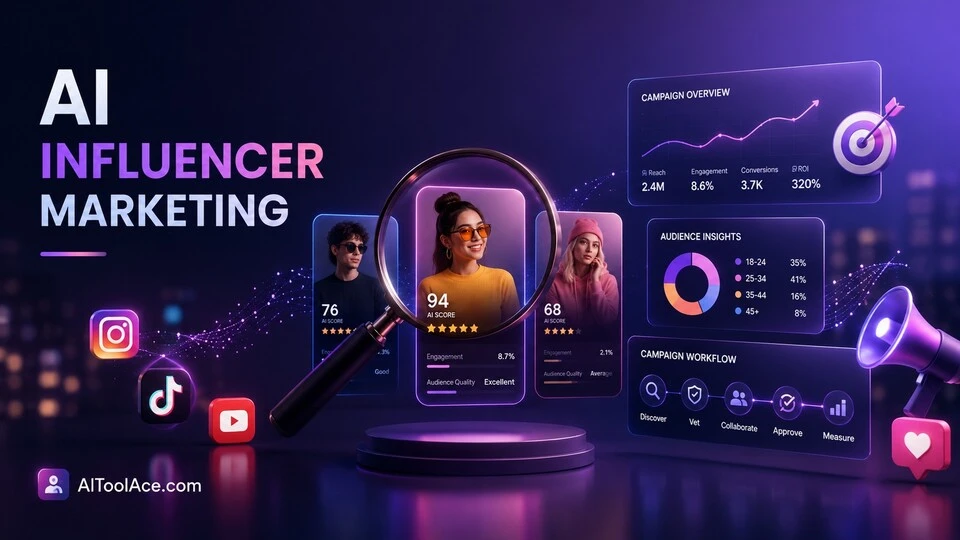
AI tools address both sides of this problem. They analyze creator profiles to identify genuine audiences, authentic engagement, and relevant content alignment. And they manage campaign operations — outreach, contracting, content approval, and performance measurement — at scale. The combination turns influencer marketing from an intuition-driven gamble into a data-informed strategy.
For growing your own social presence alongside influencer partnerships, Best AI Tools for Social Media Growth covers organic growth. For broader marketing team workflows, Best AI Tools for Marketing Teams in 2026 addresses team coordination.
Quick answer: Modash is the strongest tool for finding and vetting influencers with authentic audiences. Grin is the best platform for managing influencer campaigns end-to-end. CreatorIQ is strongest for enterprise-scale influencer programs.
How I Tested These Tools
I evaluated each tool based on what matters for effective influencer marketing:
- Creator discovery — can it find relevant creators based on audience demographics, content type, and brand fit
- Audience verification — does it identify fake followers, bot engagement, and audience quality issues
- Campaign management — can it handle outreach, contracts, content review, and deliverable tracking at scale
- ROI measurement — does it connect influencer activity to business outcomes, not just vanity metrics
- Relationship management — does it support ongoing creator partnerships, not just one-off transactions
I reviewed each tool’s features, tested discovery and vetting capabilities, and consulted feedback from marketing managers and brand partnerships teams. I did not fabricate ROI statistics or invent engagement rate improvements.
Comparison Table
| Tool | Best For | Key Strength | Pricing |
|---|---|---|---|
| Modash | Creator discovery and vetting | Most comprehensive influencer database with audience analytics | Paid |
| Grin | Campaign management | End-to-end influencer relationship and campaign platform | Paid |
| CreatorIQ | Enterprise programs | Enterprise-scale influencer program management | Paid (enterprise) |
| Upfluence | E-commerce influencer marketing | Finds influencers among your existing customers | Paid |
| HypeAuditor | Fraud detection | Deepest audience quality and fake follower analysis | Paid |
| Claude | Strategy and outreach | Influencer strategy development and outreach messaging | Freemium |
Best AI Tools for Influencer Marketing
Modash — Best for Creator Discovery and Vetting
Modash provides the most comprehensive influencer database with deep audience analytics. Instead of browsing Instagram or TikTok hoping to find relevant creators, Modash searches across platforms using filters that matter — audience demographics, engagement quality, content topics, and brand affinity. The AI analyzes each creator’s audience to verify authenticity before you invest in a partnership.
What it does well:
- searches across a database of millions of creators on Instagram, TikTok, and YouTube with granular filtering
- provides audience demographics for each creator — age, gender, location, interests — so you verify audience match before outreach
- identifies fake followers and suspicious engagement patterns that indicate inflated metrics
- shows audience overlap between creators so you avoid reaching the same people through multiple partnerships
- tracks creator performance over time so you can identify consistent performers versus one-hit wonders
Where it falls short: Modash finds and vets creators but doesn’t manage campaigns. Once you’ve identified the right influencers, you need a separate tool (Grin, email, spreadsheet) for outreach, contracting, and campaign coordination. The audience data is based on AI analysis of public profiles, which is directionally accurate but not perfectly precise — it estimates demographics rather than verifying them. And the platform works best for Instagram, TikTok, and YouTube — emerging platforms have thinner coverage.
Best for: brands and agencies that need to find and vet influencers systematically — especially those running campaigns across multiple creators where audience quality verification prevents wasted spend.
Grin — Best for Campaign Management
Grin manages the entire influencer marketing workflow — from discovery through outreach, contracting, content approval, product shipping, payment, and performance reporting. For brands that run ongoing influencer programs rather than one-off campaigns, Grin provides the operational infrastructure that prevents things from falling through the cracks.
What it does well:
- manages the complete influencer workflow — discovery, outreach, contracts, content approval, shipping, payment, and reporting
- tracks every deliverable and deadline across multiple creators and campaigns simultaneously
- integrates with e-commerce platforms (Shopify) for product seeding, discount codes, and affiliate tracking
- provides a creator CRM that maintains relationship history across campaigns — treating creators as partners, not transactions
- generates performance reports that connect influencer content to revenue through tracked links and codes
Where it falls short: Grin’s comprehensive approach means significant setup and learning curve. Brands running occasional influencer campaigns don’t need this level of infrastructure. The platform is designed for direct-to-consumer brands with physical products — service businesses and B2B companies get less value from the product seeding and e-commerce integration features. And the pricing reflects the comprehensive feature set — it’s an investment that makes sense at scale but not for small programs.
For managing sales alongside marketing, see Best AI Tools for Sales Teams.
Best for: DTC brands running ongoing influencer programs with multiple creators, product seeding, and performance tracking — where operational efficiency directly affects program profitability.
CreatorIQ — Best for Enterprise Programs
CreatorIQ is built for enterprise brands and agencies that manage large-scale influencer programs — hundreds of creators, multiple campaigns, global markets, and sophisticated measurement requirements. Its AI handles creator matching, campaign optimization, and cross-platform measurement at the scale that enterprise programs demand.
What it does well:
- manages large creator networks across multiple campaigns, markets, and platforms simultaneously
- AI matches brands with creators based on audience alignment, content style, and past performance data
- provides enterprise-grade reporting that connects influencer activity to business KPIs (awareness, consideration, conversion)
- supports global programs with multi-currency, multi-language, and regional compliance features
- integrates with enterprise marketing stacks (CRM, analytics, e-commerce) for unified measurement
Where it falls short: CreatorIQ is enterprise software — the complexity, pricing, and implementation requirements are beyond what small and mid-size brands need. The platform assumes dedicated influencer marketing teams to operate it effectively. The sophistication of measurement and reporting requires analytics expertise to interpret meaningfully. And enterprise tools optimize for scale and efficiency, which can make smaller, more personal creator relationships feel transactional.
For enterprise marketing broadly, see Best AI Tools for Marketing Teams in 2026.
Best for: large brands and agencies managing influencer programs at significant scale — dozens to hundreds of active creator partnerships across multiple campaigns and markets.
Upfluence — Best for E-Commerce Influencer Marketing
Upfluence takes a unique approach: instead of searching external databases for influencers, it identifies creators who are already your customers. Your email list, your social followers, your existing customer base — Upfluence analyzes them to find people who already buy your products and have audiences you want to reach.
What it does well:
- identifies influencers within your existing customer and email database — creators who already know and buy your products
- provides authentic partnerships because the creators genuinely use your products before you approach them
- supports product seeding, affiliate programs, and discount code management for e-commerce campaigns
- integrates with Shopify, WooCommerce, and other e-commerce platforms for seamless campaign execution
- tracks sales generated through each creator with attribution to specific campaigns and content
Where it falls short: Upfluence’s customer-first approach only works if your customer base includes relevant creators — new brands or brands with small customer bases have fewer internal influencers to discover. The platform handles e-commerce influencer campaigns well but is less suited for awareness-focused or brand-building campaigns where sales attribution isn’t the primary metric. And the discovery is limited to your existing network — you still need other tools to find creators outside your customer base.
For e-commerce marketing broadly, see Best AI Tools for E-commerce.
Best for: e-commerce brands with established customer bases that want to build authentic influencer partnerships with people who already buy and love their products.
HypeAuditor — Best for Fraud Detection
Fake followers, bought engagement, and audience fraud waste influencer marketing budgets on partnerships that look impressive on paper but deliver nothing. HypeAuditor provides the deepest analysis of audience authenticity — identifying suspicious patterns, bot activity, and inflated metrics that indicate a creator’s influence isn’t real.
What it does well:
- provides the most detailed audience quality analysis — identifying fake followers, bot engagement, and suspicious growth patterns
- assigns audience quality scores that make it easy to compare creators on authenticity, not just size
- detects engagement manipulation — likes, comments, and shares from bots or engagement pods
- analyzes audience demographics for authenticity — flagging accounts where the audience geography doesn’t match the creator’s content language or location
- tracks quality changes over time — identifying creators whose audience quality is declining
Where it falls short: HypeAuditor is an analysis tool, not a campaign management platform. It vets creators but doesn’t help you manage outreach, contracts, or campaign operations. The fraud detection, while comprehensive, produces false positives — legitimate creators with unusual growth patterns or diverse audiences can be flagged incorrectly. And focusing exclusively on fraud detection can create analysis paralysis — spending more time vetting creators than actually running campaigns.
Best for: brands and agencies that need to verify influencer authenticity before committing budget — especially for large partnerships where the investment is significant enough to justify thorough vetting.
Claude — Best for Strategy and Outreach
Claude doesn’t discover creators or manage campaigns. Its value in influencer marketing is strategic and communicative — developing campaign strategies, writing outreach messages that get responses, creating campaign briefs that communicate clearly, and analyzing campaign results.
What it does well:
- develops influencer marketing strategies — identifying the right creator types, content formats, and campaign structures for your goals
- writes outreach messages that feel personal and professional — standing out from the generic “collaboration opportunity” emails creators receive constantly
- creates campaign briefs that communicate brand requirements clearly without being restrictive
- analyzes campaign results you share — identifying what worked, what didn’t, and what to change for future campaigns
- helps negotiate partnership terms by evaluating whether proposed rates and deliverables are reasonable
Where it falls short: Claude can’t search creator databases, analyze audience demographics, or manage campaign logistics. It helps you think strategically and communicate effectively, but the operational execution requires dedicated influencer marketing tools. And Claude’s strategic advice is based on general marketing principles — your specific industry, audience, and competitive dynamics may require approaches that general patterns don’t cover.
For marketing content creation, see Best AI Tools for Content Creators.
Best for: marketers who need strategic guidance for influencer programs and effective outreach messaging — especially those launching influencer marketing for the first time.
The Real Risks of AI in Influencer Marketing
1. Metrics Without Meaning
AI tools provide extensive data about creators — follower counts, engagement rates, audience demographics, growth trends. But metrics don’t tell you whether a creator’s audience actually cares about their recommendations or whether the creator’s content style aligns with your brand. Data-driven decisions about influencer partnerships still require human judgment about brand fit and authenticity.
2. Prioritizing Reach Over Relevance
AI discovery tools can bias toward creators with larger audiences because the algorithms weight reach highly. But a creator with 10,000 highly engaged followers in your exact target market often outperforms a creator with 500,000 loosely connected followers. Don’t let AI tools push you toward bigger creators when smaller, more relevant ones would produce better results.
3. Over-Automating Relationships
Influencer marketing works because it’s built on authentic relationships between creators and audiences. Automating the brand-creator relationship — templated outreach, standardized contracts, automated follow-up — can make the partnership feel transactional rather than collaborative. The best influencer partnerships involve genuine connection between the brand and the creator, which requires human investment.
4. Attribution Oversimplification
AI tools that attribute sales to influencer campaigns through tracked links and codes capture only the directly trackable impact. Influencer marketing also drives awareness, consideration, and trust that don’t show up in direct attribution — someone who sees an influencer’s post and searches for your brand later doesn’t get attributed to the campaign. Don’t evaluate influencer programs solely on directly tracked conversions.
Which AI Tool Should You Choose?
- Creator discovery and vetting → Modash (largest database with audience quality analysis)
- Campaign management → Grin (end-to-end workflow for ongoing programs)
- Enterprise scale → CreatorIQ (large-scale program management)
- E-commerce partnerships → Upfluence (find influencers in your customer base)
- Fraud detection → HypeAuditor (deepest audience authenticity analysis)
- Strategy and outreach → Claude (campaign strategy and effective creator messaging)
Best starting approach: Start with Modash or HypeAuditor to find and vet creators. Use Claude to write outreach and develop campaign briefs. Add Grin when your program is large enough to need operational management. Use Upfluence if you’re an e-commerce brand wanting authentic partnerships with existing customers.
Frequently Asked Questions
What is the best AI tool for influencer marketing?
Modash is best for finding and vetting creators. Grin is best for managing campaigns. HypeAuditor is best for verifying audience authenticity. Most influencer marketing programs benefit from combining a discovery tool with a management tool.
How do I find the right influencers for my brand?
Use AI tools (Modash, HypeAuditor) to search by audience demographics, content topics, and engagement quality — not just follower count. Verify that the creator’s audience matches your target customer profile. Review their content to ensure brand alignment. And start with smaller test partnerships before committing to larger deals.
How do I detect fake influencers?
HypeAuditor provides the deepest fraud analysis. Key signals include sudden follower spikes, engagement rates that don’t match follower count, comments that are generic or irrelevant to the content, follower demographics that don’t match the creator’s content language, and follower-to-following ratios that suggest follow-for-follow growth.
What should I pay influencers?
Rates vary enormously by platform, niche, audience size, and content type. Common benchmarks are CPM-based (cost per thousand followers) but the right price depends on the creator’s engagement quality, audience relevance, and content production value. Use AI tools to analyze comparable partnerships and negotiate based on the specific value the creator brings to your brand.
Should I focus on micro or macro influencers?
For most brands, micro-influencers (10K-100K followers) deliver better ROI because their audiences are more engaged and more relevant to specific niches. Macro-influencers (100K+) provide broader reach but lower engagement rates and higher costs. The right mix depends on whether your goal is awareness (macro) or conversion (micro).
How do I measure influencer marketing ROI?
Track direct metrics (link clicks, discount code redemptions, attributed sales) alongside indirect metrics (brand mention volume, social following growth, search volume increases). Use unique tracking links and codes for each creator. And measure over time — influencer marketing builds brand awareness that converts over weeks and months, not just during the campaign period.
Related AI Tools Guides
- Best AI Tools for Social Media Growth
- Best AI Tools for Marketing Teams in 2026
- Best AI Tools for Content Creators
- Best AI Tools for E-commerce
- Best AI Tools for Lead Generation
Explore all AI tools → Browse by profession and use case
Last updated: June 2026