Skip to content
Best AI Tools for Inventory Management (Track, Forecast & Optimize Stock in 2026)
Quick Navigation: How I Tested • Comparison Table • Risks • Best Tools • FAQ
Inventory is where cash flow goes to sleep. Too much inventory ties up capital in products sitting on shelves. Too little inventory means lost sales and frustrated customers. The sweet spot — having exactly enough of each product to meet demand without excess — is what every business aims for and few achieve consistently.
The difficulty is that demand is unpredictable. Seasonal patterns, marketing campaigns, competitor actions, economic shifts, and random variation all affect how much of each product sells on any given day. Managing inventory manually means constantly reacting — ordering more after stockouts, discounting after overstock — rather than anticipating.
AI inventory tools shift the approach from reactive to predictive. They analyze historical sales patterns, incorporate external signals (seasonality, trends, events), and generate forecasts that tell you what to order, when to order it, and how much. The predictions aren’t perfect, but they’re consistently better than gut feeling or simple historical averages.
For the broader supply chain workflow, Best AI Tools for Supply Chain Management covers logistics and procurement. For e-commerce businesses specifically, Best AI Tools for E-commerce addresses the full online selling toolkit.
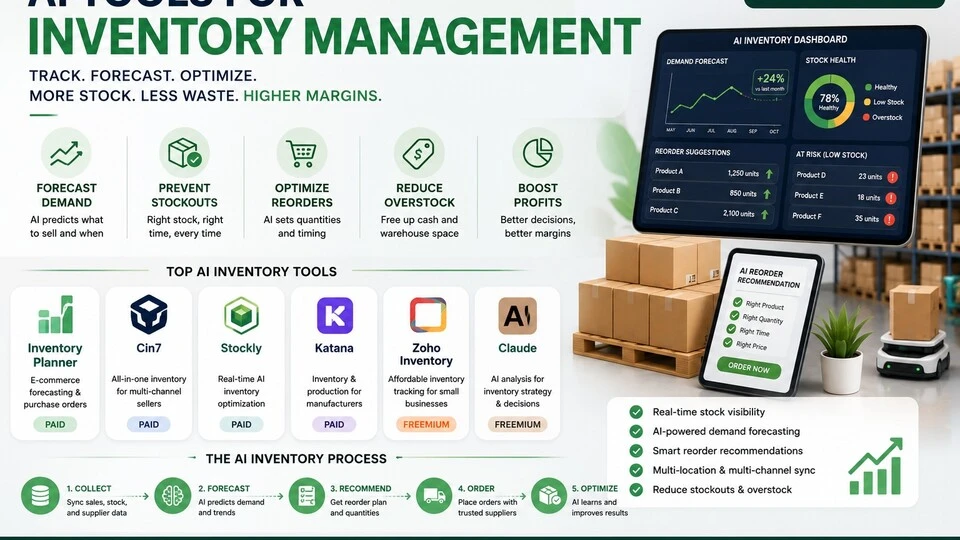
Quick answer: Inventory Planner is the best dedicated forecasting tool for e-commerce. Cin7 is the strongest all-in-one inventory platform for multi-channel sellers. Stockly is best for real-time inventory optimization with AI.
How I Tested These Tools
I evaluated each tool based on what matters for inventory management:
- Forecast accuracy — does the AI predict demand better than simple reorder points or spreadsheet calculations
- Reorder intelligence — does it account for lead times, minimum order quantities, and supplier constraints
- Multi-channel support — can it track inventory across online stores, physical locations, and warehouses
- Overstock prevention — does it identify slow-moving inventory before it becomes a write-off
- Integration — does it connect with your e-commerce platform, accounting software, and suppliers
I reviewed each tool’s features, examined their forecasting approaches, and consulted feedback from e-commerce operators and retail managers. I did not fabricate accuracy improvements or invent cost reduction statistics.
Comparison Table
| Tool | Best For | Key Strength | Pricing |
|---|---|---|---|
| Inventory Planner | E-commerce forecasting | Demand prediction and purchase order generation | Paid |
| Cin7 | Multi-channel inventory | Unified inventory across online, retail, and wholesale | Paid |
| Stockly | Real-time optimization | AI-powered dynamic stock allocation | Paid |
| Katana | Manufacturing inventory | Production planning with raw material tracking | Paid |
| Zoho Inventory | Small business inventory | Affordable tracking with order management | Freemium |
| Claude | Inventory analysis | Custom analysis of inventory data and strategy | Freemium |
Best AI Tools for Inventory Management
Inventory Planner — Best for E-Commerce Forecasting
Inventory Planner connects directly to Shopify, Amazon, WooCommerce, and other e-commerce platforms and generates demand forecasts at the SKU level. It tells you exactly what to order, when to order it, and how much — accounting for lead times, seasonality, and sales trends so your purchase orders arrive before stockouts happen.
What it does well:
- forecasts demand at the individual SKU level using historical sales data, seasonality patterns, and trend analysis
- generates ready-to-send purchase orders with quantities calculated from forecasts and current stock levels
- accounts for supplier lead times so orders arrive when needed, not after stockouts
- identifies overstock and slow-moving items with recommended markdown strategies
- connects directly to major e-commerce platforms for automated, real-time data sync
Where it falls short: Inventory Planner works best with products that have stable, historical demand patterns. New products without sales history, viral products with unpredictable demand, and heavily promotional items challenge the forecasting models. The tool focuses on what to order and when — it doesn’t manage warehouse operations, pick-pack-ship workflows, or logistics. Forecast accuracy depends on data quality — incomplete or inconsistent sales records produce unreliable recommendations. And the pricing is a recurring cost that small sellers with few SKUs may not justify.
Best for: e-commerce businesses with established products and enough sales history for meaningful forecasting — especially sellers managing hundreds or thousands of SKUs across platforms.
Cin7 — Best for Multi-Channel Inventory
Cin7 provides unified inventory management across every sales channel — online stores, physical retail, wholesale, marketplaces, and B2B. Its AI features optimize stock allocation across channels, predict demand by location, and automate reorder processes across a complex, multi-channel operation.
What it does well:
- tracks inventory in real time across all sales channels — Shopify, Amazon, eBay, physical stores, wholesale, B2B portal
- AI optimizes stock allocation — determining how much inventory to hold in each location based on channel-specific demand
- automates purchase orders based on reorder points adjusted by AI demand forecasting
- handles complex inventory scenarios — bundles, variants, serial numbers, batch tracking, expiration dates
- provides a complete order management system alongside inventory tracking
Where it falls short: Cin7 is a comprehensive platform, which means significant setup complexity. Configuring multi-channel inventory, warehouse locations, and automation rules takes weeks, not days. The platform is more than simple e-commerce sellers need — if you sell on one platform from one location, Cin7 adds complexity without proportional value. The pricing reflects the enterprise feature set. And the AI forecasting, while useful, works best with consistent historical data across channels — new channels or rapidly changing product mixes produce less reliable predictions.
For broader e-commerce tools, see Best AI Tools for E-commerce.
Best for: multi-channel retailers and wholesalers that sell across online stores, marketplaces, physical locations, and B2B — where unified inventory visibility prevents overselling and stock allocation matters.
Stockly — Best for Real-Time Inventory Optimization
Stockly takes a different approach from traditional inventory management. Instead of static reorder points, it uses AI to dynamically optimize stock levels based on real-time signals — current demand velocity, incoming supply, promotional calendar, and even competitor activity. The system continuously adjusts recommendations rather than waiting for weekly or monthly reviews.
What it does well:
- adjusts inventory recommendations in real time based on current demand signals, not just historical patterns
- accounts for promotional activity — increasing recommended stock before planned campaigns and reducing after
- identifies opportunities to redistribute inventory between locations based on where demand is strongest
- provides dynamic safety stock calculations that adjust for demand volatility rather than using fixed buffers
- integrates with existing ERP and inventory systems as an optimization layer
Where it falls short: Real-time optimization requires real-time data, which means reliable integration with your sales channels and inventory systems. If data feeds are delayed or incomplete, the dynamic recommendations lose their advantage over simpler systems. The tool is most valuable for businesses with high SKU counts and variable demand — simple businesses with predictable sales patterns don’t need dynamic optimization. And Stockly works as an optimization layer on top of your existing inventory system, not as a replacement for it.
Best for: retail and e-commerce businesses with variable demand patterns, frequent promotions, and enough complexity that static reorder points consistently under-perform or over-perform.
Katana — Best for Manufacturing Inventory
Katana manages inventory for businesses that manufacture or assemble products — tracking raw materials, work-in-progress, and finished goods. Its AI features help with production planning, material requirements forecasting, and identifying bottlenecks in the manufacturing process.
What it does well:
- tracks inventory across three stages — raw materials, work-in-progress, and finished goods — with visibility at each stage
- provides production planning that calculates raw material requirements based on sales orders and demand forecasts
- identifies production bottlenecks by analyzing where inventory accumulates in the manufacturing process
- integrates with e-commerce platforms so sales orders automatically trigger production and material procurement
- handles bill of materials (BOM) management for products with multiple components
Where it falls short: Katana is designed for manufacturing and assembly businesses. Pure retailers, dropshippers, and service businesses don’t need raw material tracking and production planning. The platform works best for light manufacturing — complex manufacturing operations with sophisticated production scheduling may outgrow Katana’s planning capabilities. And the AI features focus on material requirements and production timing, not on finished goods demand forecasting — you may need a separate forecasting tool for the demand side.
For broader supply chain management, see Best AI Tools for Supply Chain Management.
Best for: small to mid-size manufacturers, assemblers, and makers who sell directly to consumers and need to coordinate raw material procurement with production and sales.
Zoho Inventory — Best for Small Business
Zoho Inventory provides affordable inventory tracking with order management, multi-channel integration, and basic AI features. For small businesses that need to move beyond spreadsheets but can’t justify the cost of enterprise inventory platforms, Zoho provides essential capabilities at an accessible price.
What it does well:
- provides inventory tracking, order management, and shipping integration at an affordable price point
- integrates with Zoho’s ecosystem (Zoho Books, Zoho CRM) for unified business operations
- supports multi-channel selling across Shopify, Amazon, eBay, and Etsy
- includes reorder point alerts and basic demand analysis
- free plan covers basic needs for very small businesses
Where it falls short: Zoho Inventory’s AI capabilities are basic compared to dedicated tools like Inventory Planner or Stockly. The demand forecasting is limited to simple reorder points rather than sophisticated prediction models. The platform handles standard inventory scenarios well but struggles with complex situations — bundles, kits, manufacturing, and multi-warehouse optimization require more capable tools. And Zoho’s interface, while functional, isn’t as polished or intuitive as newer competitors.
For small business tools broadly, see Best AI Tools for Small Business Owners.
Best for: small businesses moving from spreadsheets to proper inventory management who need an affordable, functional system — especially those already using other Zoho tools.
Claude — Best for Inventory Analysis and Strategy
Claude doesn’t track inventory or generate purchase orders. Its value is analytical — helping you understand your inventory data, identify patterns, develop strategies, and make better decisions about how to manage stock. You share your data and get structured analysis.
What it does well:
- analyzes inventory data you share — turnover rates, stockout frequency, overstock patterns, seasonal trends
- helps develop inventory strategies — which products to stock deeper, which to reduce, when to run clearance
- evaluates supplier options by analyzing delivery performance, pricing, and reliability data
- models scenarios — “what happens to our cash flow if we increase safety stock by 20%”
- explains inventory management concepts for business owners learning to manage stock more effectively
Where it falls short: Claude can’t access your inventory system, track real-time stock levels, or generate purchase orders. Every analysis requires you to provide the data. The recommendations are based on general inventory principles, not your specific supply chain constraints. And strategic analysis is one-time — Claude doesn’t monitor your inventory ongoing or alert you to problems as they develop.
For business data analysis, see Best AI Tools for Spreadsheets & Excel.
Best for: business owners and operations managers who need help understanding their inventory data and developing strategies — especially those making decisions about inventory policy, supplier selection, or stock optimization.
The Real Risks of AI Inventory Management
1. Forecast Errors Amplified at Scale
AI forecasts are better than simple methods, but they’re still predictions. When you use AI forecasts to automatically generate purchase orders across hundreds of SKUs, even small forecast errors can result in significant overstock or stockout across the product line. Always review AI-generated purchase orders before sending them, especially for high-value or long-lead-time items.
2. Seasonal Patterns Missed or Over-Applied
AI learns from historical patterns, including seasonality. But seasonal patterns change — a product that was a summer bestseller may not repeat next summer if the market shifted. Conversely, new products without a full year of data don’t have seasonal patterns for the AI to learn. Supplement AI forecasts with your own market knowledge about upcoming seasonal shifts.
3. Supplier Dependency Hidden by Automation
Automated reorder systems can create invisible supplier concentration — always ordering from the same supplier because they have the shortest lead time, without considering the risk of dependency. If that supplier has a disruption, your entire supply is affected. Review your supplier allocation periodically, even when automation handles the ordering.
4. Overstock Disguised as Safety Stock
AI systems that recommend safety stock levels can justify excess inventory as “necessary buffer.” Safety stock should protect against realistic demand variability, not serve as a cushion for poor forecasting. If your safety stock consistently sits unused, it’s overstock with a better name. Review safety stock levels against actual demand variability regularly.
Which AI Tool Should You Choose?
- E-commerce demand forecasting → Inventory Planner (SKU-level predictions with purchase orders)
- Multi-channel inventory → Cin7 (unified stock across all sales channels)
- Real-time optimization → Stockly (dynamic adjustments based on live demand)
- Manufacturing inventory → Katana (raw materials + production + finished goods)
- Small business basics → Zoho Inventory (affordable tracking with order management)
- Inventory strategy → Claude (custom analysis and decision support)
Best starting approach: If you’re a small e-commerce seller, start with Zoho Inventory (free plan) to get out of spreadsheets. Add Inventory Planner when your SKU count and order volume justify AI forecasting. Scale to Cin7 when you sell across multiple channels. Manufacturers should evaluate Katana from the start.
Frequently Asked Questions
What is the best AI inventory management tool?
Inventory Planner is best for e-commerce demand forecasting. Cin7 is best for multi-channel inventory management. The right choice depends on your business model — single-channel e-commerce, multi-channel retail, manufacturing, or wholesale all have different needs.
Can AI prevent stockouts?
AI reduces stockouts by predicting demand more accurately and generating timely reorder recommendations. It can’t prevent all stockouts — unexpected demand spikes, supplier delays, and shipping disruptions can cause stockouts regardless of how good the forecast is. AI improves the odds significantly but doesn’t guarantee zero stockouts.
How accurate is AI demand forecasting?
AI forecasting is consistently more accurate than simple methods (last year’s sales, moving averages) for products with established sales history. Accuracy varies by product type — stable, predictable products forecast well, while trendy, seasonal, or new products are harder to predict. No forecast method is perfectly accurate; the goal is reducing error, not eliminating it.
When should I move from spreadsheets to inventory software?
When you spend more time managing the spreadsheet than the inventory. Common trigger points: tracking more than 50 SKUs, selling on multiple channels, experiencing regular stockouts or overstock, or when manual reorder calculations take significant time weekly. The transition cost is quickly recovered in fewer stockouts and better cash flow management.
How do I reduce overstock without increasing stockouts?
Improve forecast accuracy (use AI tools instead of gut feeling), reduce lead times (work with faster suppliers or hold less pipeline inventory), implement dynamic safety stock (adjust buffer based on demand variability, not fixed quantities), and review slow-moving items regularly (mark down before they become write-offs). AI tools help with all of these.
Do small businesses need AI inventory management?
Very small businesses (under 50 SKUs, single channel) can manage with spreadsheets and manual reorder points. Once you grow beyond that — more products, more channels, more suppliers — the complexity exceeds what manual management handles effectively. AI tools become valuable when the cost of stockouts and overstock exceeds the cost of the tool.
Related AI Tools Guides
- Best AI Tools for E-commerce
- Best AI Tools for Supply Chain Management
- Best AI Tools for Small Business Owners
- Best AI Tools for Spreadsheets & Excel
- Best AI Tools for Automating Workflows
Explore all AI tools → Browse by profession and use case
Last updated: June 2026