Skip to content
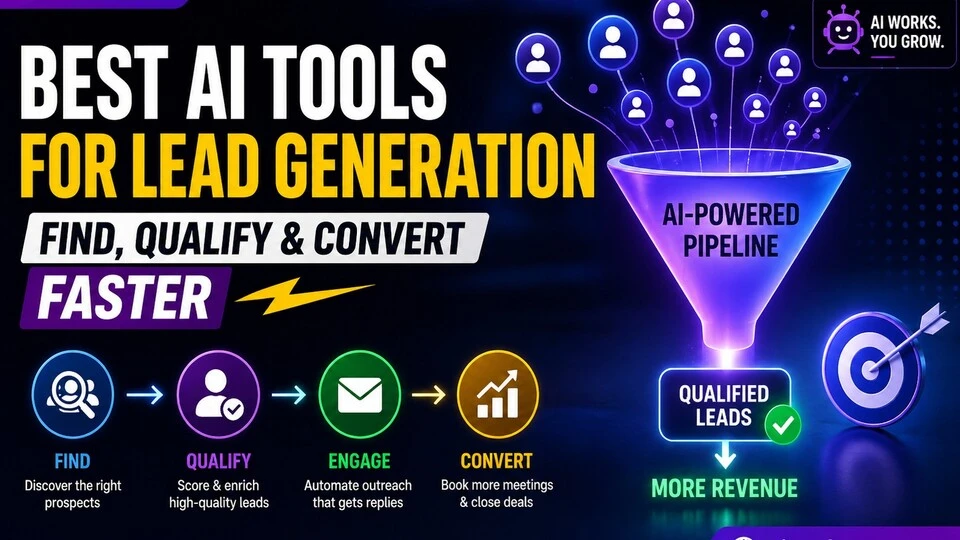
Best AI Tools for Lead Generation (Find, Qualify & Convert Faster)
Quick Navigation: How I Tested • Comparison Table • Risks • Best Tools • FAQ
Most businesses struggle with lead generation not because they lack tools, but because they waste time on the wrong prospects. Sales teams spend a disproportionate amount of time on manual research, unverified contact lists, and outreach that goes nowhere.
AI tools address this by automating the parts of lead generation that are repetitive and time-consuming — finding contacts, verifying data, enriching profiles, and managing outreach sequences. The value isn’t in replacing human judgment, it’s in freeing up time so salespeople can focus on conversations that actually convert.
If you’re already running email campaigns, Best AI Tools for Email Marketing covers the content and automation side. For the full sales workflow beyond lead generation, see Best AI Tools for Sales Teams.
Quick answer: The strongest lead generation stack in 2026 combines Apollo for prospecting, Clay for data enrichment, Instantly for outreach, and HubSpot for pipeline management.
How I Tested These Tools
I evaluated each tool based on what matters for lead generation in practice:
- Prospecting quality — does the tool help you find the right people, or just a lot of people
- Data accuracy — how reliable is the contact information it provides
- Enrichment depth — can you learn enough about a prospect to write a relevant message
- Outreach integration — does the tool connect smoothly to your sending workflow
- Pipeline management — can you track leads from first touch to conversion
I reviewed each tool’s capabilities, documentation, user feedback from trusted communities, and tested the interfaces directly. I did not invent conversion rates or fabricate test scenarios.
Comparison Table
| Tool | Best For | Key Strength | Pricing |
|---|---|---|---|
| Apollo | Prospecting | Large B2B database with built-in outreach | Freemium |
| Clay | Data enrichment | 50+ data sources for deep lead research | Paid |
| Instantly | Cold outreach | Inbox rotation and scaled sending | Paid |
| HubSpot | CRM and pipeline | Lead tracking from first touch to close | Freemium |
| Seamless.ai | Contact discovery | Real-time verified emails and phone numbers | Paid |
| Lemlist | Personalization | Dynamic images and multi-channel sequences | Paid |
Best AI Tools by Use Case
Apollo — Best for Prospecting
Apollo is the most widely used B2B prospecting platform because it combines a large contact database with built-in outreach tools. You can find prospects, verify their contact info, and start email sequences without leaving the platform.
What it does well:
- provides a large B2B contact database with detailed filtering by industry, role, company size, location, and funding stage
- includes built-in email sequencing so you can prospect and outreach in one place
- verifies email addresses before sending, which reduces bounce rates
- tracks engagement across your outreach sequences
Where it falls short: Apollo’s database is large but not always perfectly accurate. Some contact details are outdated, especially for smaller companies or recent job changes. The built-in outreach features are functional but less advanced than dedicated sending tools like Instantly.
Best for: teams that want prospecting and basic outreach in a single platform without juggling multiple tools.
Clay — Best for Data Enrichment
Clay fills the gap between having a name and having enough context to write a relevant message. It pulls data from dozens of sources — company size, tech stack, funding history, hiring activity, social profiles — and lets you build automated research workflows.
What it does well:
- enriches leads with data from 50+ sources, far beyond what any single database provides
- lets you build custom workflows that automate the research you’d otherwise do manually on LinkedIn
- creates personalization variables you can plug directly into outreach templates
- helps score and prioritize leads based on enriched data so you focus on the best prospects first
Where it falls short: Clay has a real learning curve. Setting up enrichment workflows takes time, and the tool is more powerful than most small teams need. If you’re sending a few hundred emails a week, the setup effort may not justify the benefit.
For teams managing complex client relationships, see also Best AI Tools for Consultants.
Best for: data-driven teams running high-volume outreach who need their messages to feel researched and relevant.
Instantly — Best for Cold Outreach
Instantly solves the technical side of cold outreach — sending a high volume of emails across multiple accounts without triggering spam filters. It handles inbox rotation, follow-up scheduling, and deliverability management.
What it does well:
- distributes sending across multiple email accounts to protect sender reputation
- automates multi-step follow-up sequences with conditional logic
- provides A/B testing for subject lines and messaging
- tracks opens, clicks, and replies across all campaigns
Where it falls short: Instantly is a sending tool, not a writing tool or a prospecting tool. It won’t help you find leads or write better emails — it just makes sure the emails you write actually reach the inbox. You need other tools upstream.
For optimizing the content of your emails, see Best AI Tools for Email Marketing.
Best for: teams that have good leads and good messaging but need to scale their sending without deliverability problems.
HubSpot — Best for CRM and Lead Management
HubSpot manages the full lifecycle of a lead — from first contact through qualification to closed deal. Its strength is giving you visibility into where every prospect stands and automating the handoffs between marketing and sales.
What it does well:
- tracks every interaction with a lead across email, website, and sales touchpoints
- provides AI-powered lead scoring based on behavior and engagement patterns
- automates lead assignment and follow-up triggers so hot leads don’t go cold
- gives marketing and sales teams a shared view of the same data
Where it falls short: HubSpot is powerful but complex. The free tier is limited, and the paid tiers escalate quickly. For small teams doing straightforward outreach, it can be more infrastructure than you need.
For teams that combine sales and marketing closely, see Best AI Tools for Marketing Teams in 2026.
Best for: teams that need structured pipeline management and visibility into lead progression.
Seamless.ai — Best for Contact Discovery
Seamless.ai does one thing well: finding verified contact information for people you want to reach. It searches in real time for email addresses and phone numbers, which means the data tends to be more current than static databases.
What it does well:
- finds direct email addresses and phone numbers for decision-makers
- searches in real time rather than relying on a static database, improving accuracy
- lets you build outreach lists based on company and role criteria
- integrates with CRM and outreach tools for smooth data transfer
Where it falls short: Seamless.ai is a contact discovery tool, not a full prospecting platform. It helps you find how to reach someone, but it doesn’t help you figure out who to reach or what to say. You need targeting strategy and messaging independently.
For freelancers building client pipelines, see Best AI Tools for Freelancers.
Best for: teams that know exactly who they want to reach but need accurate, verified contact details.
Lemlist — Best for Personalization
Lemlist’s value proposition is making outreach feel personal at scale. Beyond basic merge fields, it supports dynamic images, personalized screenshots, and multi-channel sequences that combine email with LinkedIn touchpoints.
What it does well:
- creates dynamic personalized images (prospect’s website screenshot, their name on a mockup) automatically
- supports multi-channel sequences combining email and LinkedIn
- provides detailed engagement tracking at the individual prospect level
- lets you A/B test different personalization approaches
Where it falls short: Lemlist’s advanced features require effort to set up. If you’re just using first name and company name, you won’t see a meaningful improvement over simpler tools. The ROI comes from actually using the deep personalization features.
For writing better client communications in general, see AI Tools for Writing Client Emails.
Best for: teams willing to invest in personalization setup for better engagement and reply rates.
Risks of Using AI for Lead Generation
1. Targeting the Wrong People
The most common lead generation failure isn’t technical — it’s strategic. If your ideal customer profile is vague or wrong, AI tools will efficiently find and contact the wrong people. Define your targeting criteria carefully before scaling anything.
2. Data Quality Problems
No database is perfectly accurate. Email addresses go stale, people change jobs, companies restructure. Always verify critical contacts before high-stakes outreach, and build data hygiene into your regular workflow rather than treating it as an afterthought.
3. Deliverability Risks
Scaling outreach too aggressively damages sender reputation, and recovery takes months. Warm up new accounts gradually, use inbox rotation, and monitor bounce rates. The temptation to send more emails faster is the most common way teams sabotage their own campaigns.
4. Over-Reliance on Automation
AI handles volume well but handles nuance poorly. Fully automated outreach without human review produces generic messages that prospects ignore. The best results come from AI managing the logistics while humans manage the messaging and relationships.
Which Tool Should You Choose?
- Just starting out → Apollo + Instantly (prospecting + sending in one flow)
- Data-driven approach → Clay + HubSpot (enrichment + pipeline management)
- Maximizing engagement → Instantly + Lemlist (volume + personalization)
- Full system → Apollo + Clay + Instantly + HubSpot (end-to-end lead generation)
Start with Apollo + Instantly — that covers prospecting and outreach. Add Clay when you need deeper personalization data, and HubSpot when you need proper pipeline management.
Frequently Asked Questions
What are the best AI tools for lead generation in 2026?
The most effective tools are Apollo for prospecting, Clay for data enrichment, Instantly for cold outreach, HubSpot for CRM and pipeline management, and Seamless.ai for contact discovery. Most teams benefit from combining 2–4 of these depending on their workflow.
Can AI fully automate lead generation?
AI can automate prospecting, data enrichment, outreach sending, and initial qualification. But strategy, targeting decisions, message quality, and relationship building still require human input. Fully automated lead generation without human oversight consistently underperforms.
How reliable is AI-generated contact data?
It varies by tool and data source. Real-time search tools like Seamless.ai tend to be more current than static databases. Multi-source enrichment through Clay improves accuracy. But no tool is 100% accurate — verification before important outreach is always worth the effort.
Does AI lead generation work for small businesses?
Yes. AI tools level the playing field by automating the most time-consuming parts of prospecting. A small team with the right tools can identify and reach qualified prospects as effectively as a much larger sales organization.
How should I start with AI lead generation?
Start with Apollo to find prospects and Instantly to send outreach. Get comfortable with those two tools before adding enrichment (Clay) or CRM (HubSpot). Trying to implement everything at once creates complexity without improving results.
What’s the biggest mistake in AI-powered lead generation?
Prioritizing volume over targeting. Sending thousands of emails to poorly targeted prospects doesn’t generate leads — it generates spam complaints and damages your domain reputation. Quality targeting with relevant messaging always outperforms high-volume generic outreach.
Related AI Tools Guides
- Best AI Tools for Email Marketing
- Best AI Tools for Sales Teams
- Best AI Tools for Marketing Teams in 2026
- Best AI Tools for Freelancers
- Best AI Tools for Small Business Owners in 2026
Explore all AI tools → Browse by profession and use case
Last updated: May 2026