Skip to content
Best AI Tools for Legal Research (Find Case Law & Statutes Faster in 2026)
Quick Navigation: How I Tested • Comparison Table • Risks • Best Tools • FAQ
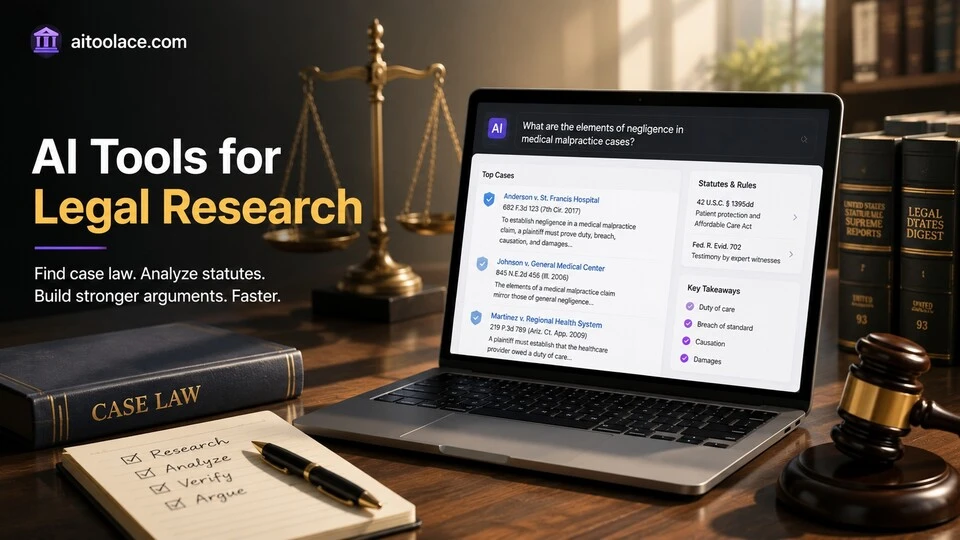
Legal research is the foundation of legal practice — and it’s one of the most time-intensive activities a lawyer performs. Finding the right cases, understanding how courts have interpreted statutes, identifying relevant precedents, and building the chain of authority that supports an argument requires searching through vast databases of case law, statutes, regulations, and secondary sources. A task that should take minutes often takes hours because legal databases are difficult to search effectively.
Traditional legal research tools work well for lawyers who know exactly what they’re looking for — a specific case citation, a statute number, a known legal principle. They work poorly when the research question is open-ended — “has any court addressed this issue in this context” or “what’s the strongest argument against this defense.” These questions require understanding meaning, not just matching keywords.
AI legal research tools bridge this gap by understanding legal concepts, not just legal terms. They find relevant cases based on the legal issue you describe, not just the keywords you enter. They identify how courts have cited and interpreted specific precedents. And they summarize complex legal opinions so you can assess relevance without reading every full opinion.
For the broader lawyer toolkit beyond research, Best AI Tools for Lawyers covers practice management and client work. For contract-specific legal work, Best AI Tools for Contracts & Legal Documents addresses document drafting and review.
Quick answer: CoCounsel (Thomson Reuters) is the most comprehensive AI legal research tool with verified citations. Casetext is the strongest AI-powered legal search for cost-conscious firms. Claude is most useful for analyzing legal concepts and drafting research memos.
How I Tested These Tools
I evaluated each tool based on what matters for legal research:
- Search intelligence — does it find relevant cases based on legal concepts, not just keyword matching
- Citation verification — does every cited case actually exist and actually say what the tool claims
- Jurisdictional awareness — does it understand that law varies by jurisdiction and surface the right authority
- Analysis depth — does it help you understand the cases it finds, not just list them
- Practical efficiency — does it genuinely reduce research time compared to traditional database searching
I reviewed each tool’s features, research capabilities, and citation reliability. I consulted feedback from practicing attorneys and legal researchers. I did not fabricate accuracy statistics or invent time-saving metrics. I am not a lawyer and this guide does not constitute legal advice.
Comparison Table
| Tool | Best For | Key Strength | Pricing |
|---|---|---|---|
| CoCounsel | Comprehensive AI research | AI research verified against Westlaw’s legal database | Paid |
| Casetext | AI-powered legal search | Conceptual search with verified citations at lower cost | Paid |
| Claude | Legal analysis and memos | Strongest reasoning for analyzing legal issues and drafting | Freemium |
| vLex Vincent | Global legal research | AI-powered search across international legal databases | Paid |
| Fastcase + AI | Budget legal research | Affordable research platform with AI enhancements | Paid |
| Scite for Law | Citation context | Shows how legal cases cite and treat prior decisions | Paid |
Best AI Tools for Legal Research
CoCounsel (Thomson Reuters) — Best Comprehensive AI Research
CoCounsel combines AI with Westlaw’s comprehensive legal database — the gold standard for legal research in the United States. When CoCounsel finds a case, that case exists in Westlaw’s verified collection. When it summarizes a holding, the summary reflects the actual opinion. This verification layer is what separates CoCounsel from general-purpose AI tools that can fabricate legal citations.
What it does well:
- searches Westlaw’s comprehensive database using natural language — describe the legal issue and get relevant cases, statutes, and secondary sources
- verifies every citation against the actual database — eliminating the hallucination risk that makes general AI tools dangerous for legal research
- provides KeyCite integration that shows whether cited cases are still good law — overruled, distinguished, or questioned
- summarizes cases with the specific holdings, reasoning, and facts relevant to your research question
- supports multi-jurisdictional research — finding how different states and circuits treat the same issue
Where it falls short: CoCounsel requires a Westlaw subscription plus the CoCounsel add-on, which represents significant cost — especially for solo practitioners and small firms already stretched by Westlaw fees. The AI search is excellent at finding cases within the Westlaw database but can’t access sources outside it (court filings not in Westlaw, regulatory guidance, administrative decisions from some agencies). The summaries are helpful for initial assessment but don’t replace reading the full opinions for cases central to your argument. And CoCounsel’s research is U.S.-focused — international legal research requires additional tools.
Best for: law firms with existing Westlaw subscriptions that want AI-enhanced research capabilities — especially litigation firms where finding and analyzing case law is a daily activity.
Casetext — Best AI-Powered Legal Search
Casetext provides AI-powered legal search that understands legal concepts rather than just matching keywords. Its CoCounsel feature (following its acquisition by Thomson Reuters) lets you describe a legal issue in natural language and get relevant cases with verified citations — at a price point more accessible than full Westlaw with CoCounsel.
What it does well:
- searches for case law using natural language descriptions of legal issues — finding relevant cases even when they use different terminology
- understands legal concepts so related cases are surfaced based on the legal principle, not just shared words
- provides parallel search that finds authority supporting and opposing your position simultaneously
- includes brief analysis features that help identify the strongest cases for your argument
- more affordable than full Westlaw for firms that don’t need every Westlaw feature
Where it falls short: Following its Thomson Reuters acquisition, Casetext’s future direction and pricing are evolving — it may become more integrated with Westlaw or remain a separate product. The database coverage, while extensive, may not include every jurisdiction’s unpublished opinions or some specialized administrative decisions. The AI search works best for common legal issues with substantial case law and is less useful for novel legal questions without precedent. And the results require the same critical evaluation any legal research demands — AI finds cases, but assessing their weight and applicability is lawyering.
Best for: law firms and legal professionals who want AI-enhanced legal research at a more accessible price point than full Westlaw — especially small to mid-size firms where research efficiency directly affects profitability.
Claude — Best for Legal Analysis and Research Memos
Claude doesn’t search legal databases. Its value in legal research is analytical — helping you think through legal issues, analyze cases you’ve found, develop arguments, and draft research memos. When you have a complex legal question that requires reasoning through multiple authorities and developing a coherent analytical framework, Claude provides the thinking partnership that accelerates memo writing.
What it does well:
- analyzes legal issues with structured reasoning — identifying elements, applying tests, evaluating factors, and developing arguments
- drafts research memos that organize your analysis into the structure courts and partners expect
- identifies counter-arguments and weaknesses in your position so you can address them proactively
- synthesizes multiple cases into a coherent analysis of how the law applies to your facts
- explains complex legal concepts clearly — useful for client communications and teaching junior associates
Where it falls short: Claude does not have access to legal databases and cannot verify that cases exist. It can fabricate case citations, holdings, and even entire legal opinions that sound authoritative but are completely fictional. Never cite a case from Claude without independently verifying it in Westlaw, Lexis, or another reliable legal database. Claude’s legal knowledge has a training data cutoff — recent decisions, new statutes, and regulatory changes may not be reflected. And Claude provides general legal analysis, not jurisdiction-specific advice informed by local practice and procedure.
For legal writing broadly, see Best AI Tools for Lawyers.
Best for: lawyers who need a thinking partner for complex legal analysis and a drafting assistant for research memos — with the discipline to verify every citation and validate every legal conclusion independently.
vLex Vincent — Best for Global Legal Research
Legal practice increasingly involves international elements — cross-border transactions, multi-jurisdictional disputes, comparative law research. vLex provides AI-powered search across legal databases from over 100 countries, making international legal research practical for firms that previously had to rely on local counsel for every foreign jurisdiction.
What it does well:
- searches legal databases across 100+ countries with AI that understands legal concepts across different legal systems
- provides comparative law analysis — how different jurisdictions treat the same legal issue
- supports research in multiple languages — the AI translates and understands legal concepts across language barriers
- includes secondary sources, regulatory materials, and legal commentary alongside primary law
- makes international legal research accessible to firms without foreign law librarians
Where it falls short: International legal research is inherently complex — different legal systems (common law, civil law, religious law) structure authority differently, and AI that understands one system doesn’t automatically navigate another. The database coverage varies by country — major jurisdictions are well-represented while smaller jurisdictions may have gaps. And international legal research results require evaluation by someone who understands the specific legal system — finding a relevant French court decision doesn’t help if you don’t understand how the French legal system works.
For compliance across jurisdictions, see Best AI Tools for Compliance & Risk Management.
Best for: firms with international practices — cross-border transactions, international arbitration, immigration, trade law — where researching foreign legal systems is a regular need.
Fastcase + AI — Best Budget Legal Research
Fastcase provides a comprehensive legal research platform at a significantly lower price than Westlaw or LexisNexis. Its AI features add conceptual search, case summarization, and citation analysis — delivering meaningful AI research capabilities for firms where Westlaw’s premium pricing isn’t justified by their research volume.
What it does well:
- provides access to case law, statutes, regulations, and court rules at a fraction of Westlaw/Lexis pricing
- AI-powered search understands legal concepts and finds relevant cases beyond keyword matching
- includes citation analysis that shows how cases have been cited and treated by subsequent courts
- available as a free benefit through many state and local bar associations — check your bar membership benefits
- sufficient coverage for most general practice research needs
Where it falls short: Fastcase’s database, while extensive, doesn’t match Westlaw’s depth — some unpublished opinions, historical cases, and specialized secondary sources are unavailable. The AI features are functional but less sophisticated than CoCounsel’s integration with Westlaw’s comprehensive database. The citation analysis doesn’t match Westlaw’s KeyCite or Lexis’s Shepard’s for completeness. And some specialized practice areas (tax, patent, securities) may require the deeper resources that premium databases provide.
For small business legal needs, see Best AI Tools for Small Business Owners.
Best for: solo practitioners and small firms that need competent legal research without premium database pricing — especially those whose bar association membership includes Fastcase access.
Scite for Law — Best for Citation Context
Understanding how a case has been cited by subsequent decisions is crucial for evaluating its authority. Scite analyzes citation context specifically — showing whether each subsequent citation supports, distinguishes, questions, or overrules the original decision. This context transforms citation counts from a simple number into a meaningful indicator of how the legal community has received a decision.
What it does well:
- shows how each case has been cited by subsequent decisions — supporting, distinguishing, questioning, or overruling
- identifies decisions that have been treated positively versus those facing increasing skepticism
- helps evaluate whether a case remains strong authority or has been weakened by subsequent developments
- provides the citation context analysis quickly — reviewing how a case has been received across hundreds of subsequent decisions
- supplements KeyCite and Shepard’s with a different analytical perspective on case authority
Where it falls short: Citation context analysis requires substantial citation networks to be meaningful — recent decisions and decisions from less-cited jurisdictions may not have enough subsequent citations for useful analysis. The AI classification of citations as “supporting” or “distinguishing” is generally accurate but can mischaracterize nuanced citations that partially support and partially limit. And citation analysis is one component of evaluating case authority — the quality of the court’s reasoning, the factual similarity to your case, and the hierarchical authority all matter beyond how the case has been cited.
For research tools broadly, see Best AI Tools for Research.
Best for: litigators who need to evaluate the current strength of specific precedents — especially when opposing counsel relies on cases whose authority may have been weakened by subsequent developments.
The Real Risks of AI Legal Research
1. Hallucinated Citations — The Critical Risk
General-purpose AI tools (ChatGPT, Claude) fabricate legal citations. They generate case names, citation formats, and holdings that look real but don’t exist. Lawyers who submit AI-generated citations without verification face sanctions, disciplinary action, and malpractice liability. This has happened repeatedly since AI became widely available. Every citation from any AI source must be independently verified in a reliable legal database. No exceptions.
2. Incomplete Research Presented as Comprehensive
AI research tools return results based on their database coverage and search algorithms. A search that returns 15 relevant cases may have missed the most important one — the case from the controlling jurisdiction with the most analogous facts. AI research should supplement thorough research methodology, not replace it. The absence of results doesn’t mean the authority doesn’t exist.
3. Summaries That Miss Nuance
AI case summaries compress complex legal reasoning into brief descriptions. The summary “the court held that X” may miss critical qualifications — “the court held that X in the specific context of Y, noting that the analysis might differ where Z.” Relying on summaries for cases central to your argument is dangerous — read the full opinion for any case you cite substantively.
4. Jurisdictional Confusion
AI tools that search across multiple jurisdictions can produce results that are legally accurate but jurisdictionally irrelevant. A well-reasoned opinion from a sister state’s appellate court has persuasive authority but doesn’t bind your court. AI research tools don’t always clearly distinguish between binding and persuasive authority — that evaluation requires understanding your specific court’s hierarchy.
Which AI Tool Should You Choose?
- Comprehensive verified research → CoCounsel (AI with Westlaw’s verified database)
- AI search at lower cost → Casetext (conceptual search with verified citations)
- Legal analysis and memos → Claude (reasoning and drafting with mandatory citation verification)
- International legal research → vLex Vincent (AI search across 100+ country databases)
- Budget legal research → Fastcase + AI (solid research at accessible pricing)
- Citation authority analysis → Scite for Law (how subsequent courts treat precedents)
Best starting approach: Use the research database your firm already subscribes to and activate its AI features (CoCounsel for Westlaw, AI for Lexis). Add Claude for legal analysis, memo drafting, and thinking through complex issues — with mandatory independent citation verification. Add Scite when you need deeper citation context analysis. Evaluate Casetext or Fastcase if cost is a barrier to your current research platform.
Frequently Asked Questions
What is the best AI tool for legal research?
CoCounsel (Westlaw) provides the most comprehensive AI-powered legal research with verified citations. Casetext is the strongest alternative at a lower price point. Claude is most useful for legal analysis and memo drafting. The right choice depends on your firm size, research volume, and existing database subscriptions.
Can I trust AI legal research results?
Trust the research from tools that verify citations against actual legal databases (CoCounsel, Casetext, Fastcase). Never trust citations from general-purpose AI tools (ChatGPT, Claude) without independent verification. And even with verified tools, assess the relevance and weight of every case AI returns — finding a case is not the same as evaluating its authority for your specific argument.
How do I avoid citing hallucinated cases?
Only cite cases you have independently verified in a reliable legal database (Westlaw, LexisNexis, Fastcase). If you used Claude or another general AI to draft a memo, verify every single citation before finalizing. Make citation verification a non-negotiable step in your research workflow, not an optional quality check.
Is AI legal research accurate enough for court filings?
AI research from verified databases (CoCounsel, Casetext) produces reliable citations and accurate case summaries. However, court filings require more than accurate citations — they require strategic case selection, argument development, and application to specific facts that AI assists with but doesn’t complete. Use AI to find and understand authority; use your professional judgment to build the argument.
How much does AI legal research cost?
Fastcase is often free through bar membership. Casetext is priced below full Westlaw for small firms. CoCounsel requires Westlaw plus an add-on at enterprise pricing. Claude’s free tier handles analysis and drafting. The total research cost depends on your firm’s size, practice area, and research volume. Many firms can reduce overall research costs by using AI to research more efficiently, even with the tool subscription costs.
Should I replace my current legal database with AI tools?
Not yet. AI tools enhance legal research but don’t replace comprehensive legal databases. The most effective approach is AI features on top of a reliable database — CoCounsel on Westlaw, AI on LexisNexis, or Casetext as an AI-first alternative. Pure AI tools without verified databases create unacceptable citation risks for practicing lawyers.
Related AI Tools Guides
- Best AI Tools for Lawyers
- Best AI Tools for Contracts & Legal Documents
- Best AI Tools for Research
- Best AI Tools for Compliance & Risk Management
- Best AI Tools for Academic Writing
Explore all AI tools → Browse by profession and use case
Last updated: July 2026