Skip to content
Best AI Tools for Mental Health Support (Accessible Help When You Need It in 2026)
Quick Navigation: How I Tested • Comparison Table • Risks • Best Tools • FAQ
Mental health care has an access problem. Millions of people who could benefit from professional support don’t receive it — because of cost, availability, stigma, or simply not knowing where to start. Therapy waitlists stretch for months in many areas. A single session costs $100-250 without insurance. And the step from “I think I might need help” to actually booking an appointment feels enormous for many people.
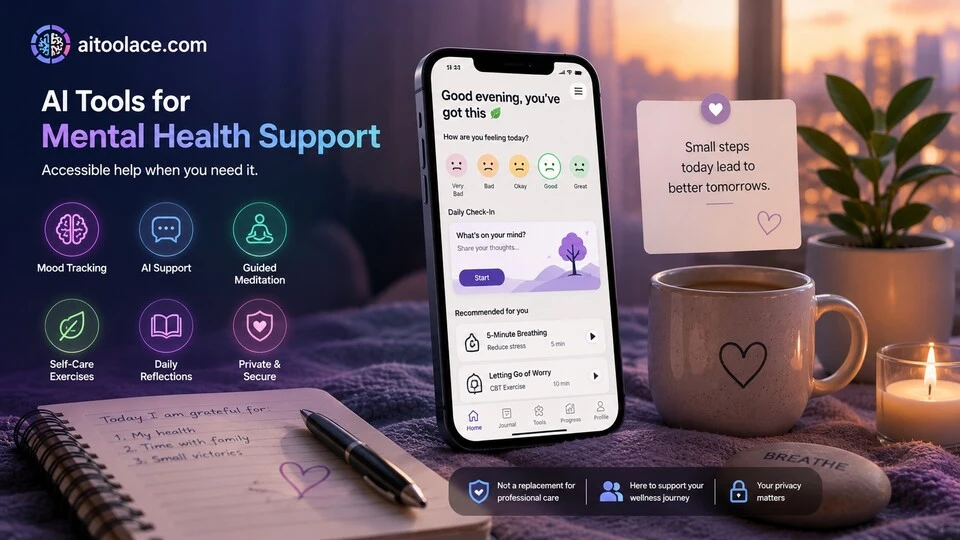
AI mental health tools don’t solve the systemic access problem, but they provide a meaningful first step. They offer mood tracking that helps people understand their emotional patterns. They deliver evidence-based therapeutic techniques (cognitive behavioral therapy exercises, mindfulness practices, journaling prompts) in accessible formats. And they provide a space to process thoughts and feelings without the barriers that prevent people from seeking professional help.
The most important thing to say upfront: AI mental health tools supplement professional care — they do not replace it. These tools are helpful for general emotional wellness, stress management, and self-awareness. They are not appropriate for clinical mental health conditions, crisis situations, or as substitutes for therapy with a licensed professional. If you’re experiencing a mental health crisis, please reach out to a professional or contact a crisis helpline for support.
For therapists using AI in their practice, Best AI Tools for Therapists covers the clinical side. For general wellness and fitness, Best AI Tools for Fitness & Wellness addresses physical wellbeing.
Quick answer: Woebot is the most evidence-based AI mental health tool using CBT techniques. Calm provides the best meditation and sleep support with AI personalization. Headspace is strongest for mindfulness with structured programs.
How I Tested These Tools
I evaluated each tool based on what matters for accessible mental health support:
- Evidence basis — is the approach based on established therapeutic techniques (CBT, mindfulness, DBT)
- Accessibility — is it affordable and easy to use for people who may not have mental health experience
- Safety — does it clearly communicate its limitations and direct people to professional help when appropriate
- Privacy — does it protect sensitive emotional and mental health data appropriately
- Usefulness — does regular use produce meaningful improvements in emotional awareness and coping
I reviewed each tool’s features, therapeutic approach, and safety practices. I consulted feedback from users and mental health professionals. I did not fabricate clinical outcome statistics or invent therapeutic effectiveness claims. I am not a mental health professional and this guide does not constitute medical or therapeutic advice.
Comparison Table
| Tool | Best For | Key Strength | Pricing |
|---|---|---|---|
| Woebot | CBT-based support | Evidence-based cognitive behavioral therapy exercises | Freemium |
| Calm | Meditation and sleep | Guided meditation, sleep stories, and relaxation content | Paid |
| Headspace | Mindfulness programs | Structured mindfulness courses with progressive training | Paid |
| Wysa | Emotional support conversations | AI chat with therapeutic conversation techniques | Freemium |
| Daylio | Mood tracking | Simple, consistent mood and activity tracking | Freemium |
| Jour | Guided journaling | AI-powered journaling prompts for self-reflection | Freemium |
Best AI Tools for Mental Health Support
Woebot — Best Evidence-Based CBT Support
Woebot delivers cognitive behavioral therapy (CBT) techniques through conversational AI — the same evidence-based approach that licensed therapists use, adapted for self-guided daily practice. You check in with your mood, and Woebot guides you through exercises that help you identify thought patterns, challenge unhelpful thinking, and develop healthier responses to difficult emotions.
What it does well:
- delivers evidence-based CBT techniques through accessible, conversational interactions
- helps identify cognitive distortions — the unhelpful thought patterns that contribute to anxiety and low mood
- provides in-the-moment coping tools when you’re experiencing difficult emotions
- tracks mood over time so you can see patterns in what triggers emotional responses
- developed with clinical research backing — not just a chatbot with therapeutic language
Where it falls short: Woebot is a self-help tool, not therapy. It delivers CBT exercises but can’t provide the personalized assessment, treatment planning, and therapeutic relationship that licensed therapists offer. The conversational format, while accessible, can feel scripted during complex emotional experiences. Woebot doesn’t adjust its approach based on clinical assessment — everyone gets similar exercises regardless of their specific situation. And for people experiencing significant mental health challenges, self-guided CBT exercises may be insufficient — professional support is essential.
Best for: people who want to learn and practice CBT techniques for managing everyday stress, anxiety, and mood challenges — especially those on therapy waitlists or between therapy sessions who want daily support.
Calm — Best for Meditation and Sleep
Sleep and stress management are foundational to mental health, and Calm addresses both through guided meditation, sleep stories, breathing exercises, and relaxation content. AI personalization recommends content based on your mood, time of day, and usage patterns — creating a daily wellness practice adapted to your needs.
What it does well:
- provides extensive guided meditation library across different focuses — stress, anxiety, focus, self-compassion, gratitude
- sleep stories and soundscapes help with falling asleep — one of the most commonly reported mental health struggles
- AI recommends content based on your mood check-in, time of day, and what’s worked for you before
- includes breathing exercises and body scan meditations for acute stress and anxiety management
- daily reminders and streak tracking help build a consistent meditation practice
Where it falls short: Meditation is one wellness practice, not a mental health treatment. Calm is excellent for stress management and sleep improvement but isn’t designed for clinical anxiety, depression, or other mental health conditions. The content is passive — you listen and follow along — which doesn’t build the active coping skills that CBT-based tools provide. The subscription cost adds up, especially when free meditation apps exist. And the AI personalization, while helpful, is based on simple preference matching rather than clinical assessment.
Best for: people who want to build a meditation and relaxation practice for stress management and better sleep — especially those new to meditation who benefit from guided instruction.
Headspace — Best for Structured Mindfulness
Headspace provides structured mindfulness programs that teach meditation progressively — from complete beginner through advanced practices. Instead of choosing from a library, you follow courses that build skills systematically, which produces deeper engagement than random session selection.
What it does well:
- provides structured courses that teach mindfulness progressively — not just individual sessions but a learning path
- covers specific challenges with targeted programs — stress, sleep, focus, anger, grief, and self-esteem
- animations and explanations make mindfulness concepts accessible to people who find meditation intimidating
- includes movement exercises (yoga, stretching) alongside seated meditation for a complete mindfulness practice
- AI suggests courses and sessions based on your goals and progress through previous programs
Where it falls short: Like Calm, Headspace is a wellness tool rather than a mental health treatment. The structured courses are effective for building a mindfulness practice but aren’t designed to address clinical mental health conditions. The progressive format means you need to commit to a course over weeks — people looking for immediate help may find the gradual approach frustrating. The subscription cost is comparable to Calm, and both offer similar core functionality despite different approaches. And mindfulness practice helps many people but isn’t effective for everyone — some people find meditation increases their anxiety rather than reducing it.
For learning new practices, see Best AI Tools for Learning New Skills.
Best for: people who want to learn mindfulness systematically rather than casually — especially those who respond well to structured programs and progressive skill building.
Wysa — Best for Emotional Support Conversations
Wysa provides an AI conversation partner that uses therapeutic techniques — active listening, cognitive reframing, emotional validation, and coping skill suggestions — in a chat format. For people who want to process emotions through conversation but face barriers to accessing therapy, Wysa provides a safe, non-judgmental space.
What it does well:
- provides therapeutic conversation techniques — active listening, validation, reframing — in an accessible chat format
- offers a library of self-help tools organized by emotional state — anxiety, sadness, anger, loneliness, stress
- includes crisis detection that recognizes concerning language and provides professional resources
- supports the step between “I need to talk to someone” and actually booking a therapist
- available 24/7 — emotional needs don’t follow business hours
Where it falls short: Wysa’s conversational AI is empathetic by design but isn’t a therapist. It applies general therapeutic techniques without the assessment, diagnosis, and personalized treatment planning that licensed professionals provide. The conversations can feel repetitive over time as the AI cycles through its technique library. Wysa can’t provide the human connection that’s a critical component of therapeutic healing. And for people who need genuine therapeutic intervention, using an AI conversation partner as a substitute may delay accessing appropriate care.
Best for: people who want a safe space to process emotions through conversation — especially those who aren’t ready for therapy but need more than meditation apps provide.
Daylio — Best for Mood Tracking
Understanding your emotional patterns is the first step toward managing them. Daylio makes mood tracking simple — a quick daily check-in with your mood level and activities — and uses AI to identify patterns over time. You start seeing connections between what you do and how you feel, which creates awareness that supports better choices.
What it does well:
- makes mood tracking effortless — daily check-ins take seconds with a tap-based interface
- tracks activities alongside mood so you see correlations between what you do and how you feel
- provides visual mood reports that reveal patterns over weeks and months
- identifies triggers and trends that you might not notice without systematic tracking
- supports customization — define your own activities, mood levels, and tracking categories
Where it falls short: Mood tracking provides awareness but not intervention. Knowing that your mood drops on Sunday evenings doesn’t automatically give you tools to address it. Daylio identifies patterns but doesn’t provide therapeutic techniques for changing them — you need other tools or professional support for that. The tracking requires consistency, and many users stop after a few weeks when the novelty fades. And the data is self-reported, which is inherently subjective — your 3/5 mood rating on Monday means something different than your 3/5 on Friday.
Best for: anyone who wants to understand their emotional patterns better — especially people starting a mental health journey who need baseline awareness of their mood and its triggers.
Jour — Best for Guided Journaling
Journaling is one of the most evidence-supported self-help practices for emotional processing — and one of the hardest to maintain. Jour makes journaling easier by providing AI-generated prompts that guide your reflection toward meaningful self-exploration rather than leaving you staring at a blank page.
What it does well:
- provides guided journaling prompts that direct reflection toward productive self-exploration
- AI adapts prompts based on your mood and previous entries — the questions evolve with your emotional state
- offers structured journaling templates for specific situations — processing a difficult conversation, preparing for a stressful event, reflecting on gratitude
- tracks journaling patterns and emotional themes over time
- provides a private, secure space for emotional expression without judgment
Where it falls short: Journaling is a self-help practice, not therapy. The prompts guide reflection but can’t provide the insight, interpretation, and guidance that a therapist offers. AI-generated prompts occasionally feel generic or miss the specific emotional context of your situation. The value depends on how honestly and deeply you engage — superficial entries produce superficial benefit. And guided journaling works best as a complement to other practices (therapy, meditation, exercise), not as a standalone mental health approach.
For broader writing tools, see Best AI Writing Tools.
Best for: people who find journaling valuable but struggle with consistency or knowing what to write about — especially those who want structured reflection rather than freeform writing.
The Real Risks of AI Mental Health Tools
1. Substituting Tools for Professional Care
The most significant risk is that AI tools become a substitute for professional mental health care rather than a supplement. Someone experiencing clinical depression, severe anxiety, trauma responses, or suicidal ideation needs a licensed professional, not an app. AI tools can provide daily support alongside professional care, but they cannot provide diagnosis, treatment planning, or the therapeutic relationship that produces meaningful clinical improvement.
2. False Sense of Progress
Using a mental health app daily can create a feeling of “doing something about it” without actually addressing underlying issues. Tracking mood, completing exercises, and meditating are positive practices — but they may not be sufficient for someone whose mental health challenges require professional intervention. Be honest about whether your tools are producing genuine improvement or just activity.
3. Data Privacy With Sensitive Information
Mental health data is among the most sensitive personal information. AI tools that collect mood data, emotional journal entries, and conversation transcripts about psychological struggles must handle this data with extreme care. Review each tool’s privacy policy, understand how your data is stored and used, and consider whether the tool meets your expectations for confidentiality.
4. One-Size-Fits-All Approaches
AI mental health tools deliver standardized techniques to diverse users. CBT exercises that help one person may not help another. Meditation that reduces anxiety for most people can increase it for some. Journaling prompts that encourage reflection in some people can trigger rumination in others. Pay attention to whether a tool is actually helping you, and stop using approaches that don’t feel right — even if they’re supposed to work.
Which AI Tool Should You Choose?
- Evidence-based CBT exercises → Woebot (structured therapeutic techniques for daily practice)
- Meditation and sleep → Calm (guided meditation, sleep stories, and relaxation)
- Structured mindfulness learning → Headspace (progressive mindfulness courses)
- Emotional conversation support → Wysa (therapeutic chat for processing emotions)
- Mood pattern awareness → Daylio (simple daily tracking with pattern identification)
- Guided self-reflection → Jour (journaling prompts adapted to your emotional state)
Best starting approach: Start with Daylio (free) to build awareness of your emotional patterns. Add one active practice — Woebot for CBT techniques, Calm or Headspace for meditation, Jour for journaling — based on what resonates with you. If you’re experiencing persistent mental health challenges, these tools work best as supplements to professional care, not substitutes for it.
Frequently Asked Questions
Can AI mental health apps replace therapy?
No. AI mental health tools provide evidence-based exercises, mood tracking, and emotional support — but they cannot provide the clinical assessment, personalized treatment planning, therapeutic relationship, and professional accountability that licensed therapists offer. Use AI tools as daily support alongside professional care, not as a replacement.
Are AI mental health apps safe?
For general emotional wellness and stress management, yes — the apps in this guide are based on established therapeutic techniques and include safety features for crisis detection. For clinical mental health conditions, these tools should supplement rather than replace professional care. If you’re in crisis, please reach out to a professional or contact a crisis helpline.
Which approach is better — CBT, meditation, or journaling?
Different approaches work for different people and different challenges. CBT (Woebot) is most structured and directly addresses thought patterns. Meditation (Calm, Headspace) reduces stress and builds emotional awareness. Journaling (Jour) supports emotional processing and self-reflection. Many people benefit from combining approaches. Try what resonates and continue what helps.
How do I know if I need professional help?
If your emotional challenges are persistent (lasting weeks rather than days), interfere with daily functioning (work, relationships, self-care), include thoughts of harming yourself, or don’t improve with self-help practices, professional support is important. Mental health apps are a positive step, but recognizing when you need more is equally important.
Are these apps private?
Privacy varies by app. Review each tool’s privacy policy regarding data storage, encryption, sharing with third parties, and use for AI training. Mental health data is sensitive — choose tools with clear privacy commitments. Most apps in this guide offer data encryption and user-controlled data deletion, but verify the specific policies.
How much do AI mental health tools cost?
Daylio and Wysa have functional free tiers. Woebot is free. Calm and Headspace cost around $70/year. Jour has a freemium model. Most people can build an effective daily mental health practice for $0-15/month.
Related AI Tools Guides
- Best AI Tools for Therapists
- Best AI Tools for Fitness & Wellness
- Best AI Tools for Personal Finance
- Best AI Tools for Learning New Skills
- Best AI Productivity Tools
Explore all AI tools → Browse by profession and use case
Last updated: June 2026
This is a sensitive topic. If you’re experiencing mental health difficulties, AI tools can be a helpful part of your support system. For more personalized guidance, speaking with a mental health professional or reaching out to a trusted person in your life can make a meaningful difference.