Skip to content
Best AI Tools for Nonprofit Organizations (Do More With Less in 2026)
Quick Navigation: How I Tested • Comparison Table • Risks • Best Tools • FAQ
Nonprofits operate under a fundamental constraint that most businesses don’t face: every dollar spent on operations is a dollar not spent on mission. Staff are stretched thin. Budgets are tight. And the administrative work — grant writing, donor communication, event coordination, reporting, marketing — competes directly with the programs that justify the organization’s existence.
AI tools are particularly valuable for nonprofits because they reduce the cost of operational tasks that every organization needs but few can staff adequately. Writing a grant proposal takes days. Creating a fundraising campaign takes weeks. Generating donor reports takes hours. AI compresses each of these timelines, freeing staff to focus on programs and impact.
The barrier for most nonprofits isn’t awareness of AI tools — it’s budget. The good news is that many AI tools offer free tiers that are genuinely useful, and several offer nonprofit discounts. The tools below are evaluated with budget constraints in mind.
For small organizations managing operations broadly, Best AI Tools for Small Business Owners covers operational tools. For fundraising email campaigns, Best AI Tools for Email Marketing addresses that channel specifically.
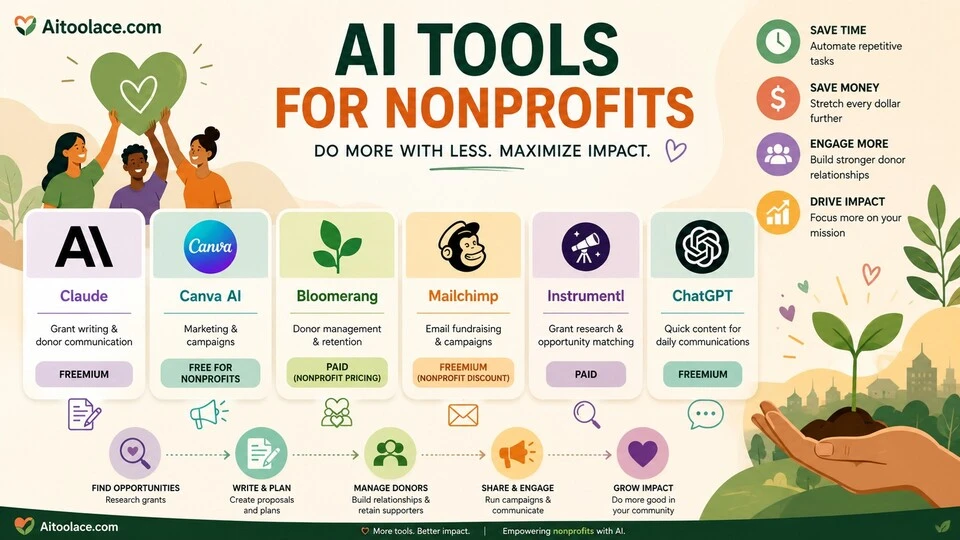
Quick answer: Claude is the most useful tool for grant writing and donor communication. Canva AI (free for nonprofits) is best for marketing materials. Bloomerang is the strongest donor management platform with AI for small to mid-size nonprofits.
How I Tested These Tools
I evaluated each tool based on what matters for nonprofit operations:
- Budget fit — is it free, discounted for nonprofits, or affordable enough for tight budgets
- Grant writing quality — can it produce compelling, funder-appropriate grant proposals
- Donor management — does it help maintain and grow donor relationships at scale
- Campaign creation — can it produce fundraising and awareness content efficiently
- Staff accessibility — can non-technical staff with limited training use it effectively
I reviewed each tool’s features, tested the interfaces, and consulted feedback from nonprofit professionals. I did not fabricate fundraising statistics or invent donor retention improvements.
Comparison Table
| Tool | Best For | Key Strength | Pricing |
|---|---|---|---|
| Claude | Grant writing and communication | Highest quality writing for proposals and donor outreach | Freemium |
| Canva AI | Marketing and campaigns | Free for nonprofits with full design capabilities | Free for nonprofits |
| Bloomerang | Donor management | AI-powered donor retention and engagement scoring | Paid (nonprofit pricing) |
| Mailchimp | Email fundraising | Email campaigns with nonprofit discount | Freemium (nonprofit discount) |
| Instrumentl | Grant research | Find matching grant opportunities with AI | Paid |
| ChatGPT | Quick content generation | Fast drafts for social posts, newsletters, and event copy | Freemium |
Best AI Tools for Nonprofits
Claude — Best for Grant Writing and Donor Communication
Grant proposals are the lifeblood of many nonprofits — and they’re among the most time-consuming documents to write. Each funder has different requirements, priorities, and formatting expectations. Claude produces grant proposal drafts that are well-structured, persuasive, and adaptable to different funders’ guidelines.
What it does well:
- drafts grant proposals with clear problem statements, program descriptions, outcome metrics, and budget justifications
- adapts proposals to different funder requirements — government grants read differently from foundation proposals
- writes donor communication — thank-you letters, impact reports, appeal letters, newsletter content — with appropriate emotional resonance without being manipulative
- helps develop program narratives that connect activities to outcomes in the way funders expect
- generates board reports, annual report content, and stakeholder communications
Where it falls short: Claude doesn’t know your organization, your programs, or your community. It produces well-structured proposals that need your specific data — outcomes you’ve achieved, populations you serve, partnerships you’ve built. A grant proposal without specific organizational data is just a template, no matter how well-written. Claude also can’t research funders or match your organization to appropriate grants — it writes the proposal, not the strategy. And the free tier has usage limits that heavy grant-writing periods may exceed.
For professional writing more broadly, see Best AI Writing Tools.
Best for: nonprofits that write multiple grant proposals annually and want faster first drafts — especially small organizations without dedicated grant writers.
Canva AI — Best for Marketing and Campaign Materials
Canva offers its full platform free to registered nonprofits — including premium templates, brand kits, and AI features. For nonprofits that need professional-looking marketing materials (event flyers, social media graphics, annual reports, fundraising campaign visuals) without a design budget, this is one of the most valuable free tools available.
What it does well:
- completely free for verified nonprofits — including premium features that normally cost $13/month per user
- provides templates for nonprofit-specific needs — fundraising campaigns, event promotion, impact reports, volunteer recruitment
- maintains brand consistency across all materials through brand kits
- AI features help with layout suggestions, text generation, and image enhancement
- supports team collaboration so multiple staff and volunteers can create on-brand materials
Where it falls short: Canva’s templates are used by millions of organizations, which means your materials may look similar to other nonprofits’. For organizations where visual identity is important to their brand positioning, Canva’s templates may be too generic. The AI design suggestions are safe rather than creative. And while Canva is free for nonprofits, the verification process takes time, and not all organization types qualify.
For broader design tools, see Best AI Tools for Designers.
Best for: any nonprofit that needs professional marketing materials — the free access makes this a no-excuse tool for every nonprofit.
Bloomerang — Best for Donor Management
Bloomerang is a donor management platform designed for small to mid-size nonprofits. Its AI features score donor engagement, predict giving likelihood, identify at-risk donors, and suggest optimal communication timing — helping nonprofits retain donors more effectively than manual relationship management allows.
What it does well:
- scores donor engagement based on giving history, event attendance, email interaction, and volunteer activity
- identifies at-risk donors who are likely to lapse so you can intervene with targeted outreach before they stop giving
- suggests optimal times and channels for donor communication based on individual engagement patterns
- provides a complete donor management system — contact records, gift tracking, acknowledgment letters, reporting
- designed specifically for nonprofits with pricing and features appropriate for the sector
Where it falls short: Bloomerang is most useful for organizations with enough donors for AI patterns to emerge — very small nonprofits with a few dozen donors can manage relationships manually. The platform focuses on individual donor management and is less suited for institutional fundraising (government grants, corporate partnerships). Data migration from your existing system takes effort, and the engagement scoring needs historical data to be accurate. And while Bloomerang’s pricing is nonprofit-friendly, it’s still a recurring cost that the smallest organizations may struggle to justify.
For managing customer (donor) retention, see Best AI Tools for Customer Retention.
Best for: nonprofits with hundreds or thousands of individual donors that need to improve retention and engagement systematically.
Mailchimp — Best for Email Fundraising
Email is the primary fundraising channel for most nonprofits. Mailchimp provides email campaign management with AI features — subject line optimization, send time prediction, audience segmentation, and campaign performance analysis. The nonprofit discount makes it accessible for organizations with limited marketing budgets.
What it does well:
- provides email campaign management with audience segmentation, automation, and performance tracking
- AI optimizes subject lines, predicts optimal send times, and suggests content improvements
- supports automated email sequences — welcome series for new donors, annual appeal campaigns, event follow-ups
- offers a nonprofit discount that reduces costs significantly
- integrates with donor management platforms and CRM tools for unified donor data
Where it falls short: Mailchimp’s nonprofit discount helps but doesn’t make it free — costs still grow with list size. The AI features are helpful optimizations but don’t fundamentally change email campaign effectiveness — the message and the ask still matter more than send time or subject line tweaks. Mailchimp is an email tool, not a fundraising platform — it sends emails but doesn’t manage donations, track giving history, or generate tax receipts. And the free plan limits features and audience size significantly.
For email marketing beyond nonprofits, see Best AI Tools for Email Marketing.
Best for: nonprofits that use email as a primary fundraising and communication channel and need affordable campaign management with basic AI optimization.
Instrumentl — Best for Grant Research
Before you can write a grant, you need to find the right grants to apply for. Instrumentl uses AI to match your organization’s mission, programs, and location with relevant funding opportunities — saving the hours of manual searching through grant databases and funder websites.
What it does well:
- matches your organization’s profile with relevant grant opportunities from a comprehensive database
- tracks application deadlines, requirements, and submission status in one dashboard
- provides funder profiles with giving history, average grant sizes, and past recipients
- sends alerts when new matching opportunities are added to the database
- saves research time by filtering out grants you don’t qualify for
Where it falls short: Instrumentl finds opportunities but doesn’t write proposals. The matching algorithm is helpful but not perfect — it sometimes suggests grants that are tangentially related or that your organization doesn’t actually qualify for. The platform is subscription-based, which adds cost for organizations already stretched thin. And Instrumentl works best for organizations with clearly defined programs — organizations with broad or evolving missions get less precise matches.
Best for: nonprofits that rely on grants for a significant portion of their funding and want to discover more opportunities without spending hours on manual research.
ChatGPT — Best for Quick Content Generation
Nonprofits need a constant stream of content — social media posts, newsletter blurbs, event descriptions, volunteer recruitment messages, impact stories, and board meeting summaries. ChatGPT generates this content quickly, providing first drafts that staff can edit and publish.
What it does well:
- generates high volumes of content quickly — social posts, newsletter sections, event descriptions, volunteer appeals
- works across all content types that nonprofits need without requiring different tools for each
- accessible and familiar — most staff can use it immediately without training
- free tier provides enough usage for regular content generation
- handles varied tone requirements — fundraising appeals sound different from volunteer recruitment
Where it falls short: ChatGPT’s content is competent but generic. Nonprofit content that actually drives engagement needs your organization’s specific stories, impact data, and voice. Unedited ChatGPT content sounds like every other nonprofit’s unedited AI content. The writing quality for longer, more complex documents (grant proposals, strategic plans) is lower than Claude’s. And ChatGPT doesn’t know your organization — every conversation starts from scratch.
For content creation more broadly, see Best AI Tools for Content Creators.
Best for: nonprofit staff who need to produce regular content across multiple channels and want faster first drafts — especially for social media, newsletters, and routine communications.
The Real Risks of AI for Nonprofits
1. Generic Storytelling That Doesn’t Connect
Nonprofit communication depends on authentic stories that connect donors to impact. AI-generated stories feel artificial — they follow predictable emotional arcs without the specific, messy, real details that make stories compelling. Use AI for structure and first drafts, but make sure every communication includes specific details from your actual work that only your organization can provide.
2. Grant Proposals That Sound Like Templates
Funders read hundreds of proposals. AI-generated proposals that follow the same structure with the same language are immediately recognizable — and immediately forgettable. The proposals that win funding demonstrate deep understanding of the problem, a specific and credible approach, and evidence that the organization can deliver. AI can structure the proposal; your expertise and data make it compelling.
3. Donor Communication Losing Authenticity
Donors give because they feel connected to a mission and trust the organization. Automated, AI-generated donor communications can erode that connection if they feel impersonal. A thank-you letter that’s obviously AI-generated does less for donor retention than a handwritten note. Use AI for operational communications; keep the relationship-critical touchpoints genuinely personal.
4. Data Privacy with Beneficiary Information
Nonprofits often work with vulnerable populations. Using AI tools with beneficiary data — client stories, service records, demographic information — raises serious privacy concerns. Never input identifiable beneficiary information into general-purpose AI tools. Use only tools with appropriate data protections for sensitive populations.
Which AI Tool Should You Choose?
- Grant writing and proposals → Claude (highest quality writing for fundraising documents)
- Marketing and design → Canva AI (free for nonprofits, professional materials)
- Donor management → Bloomerang (AI-powered retention and engagement scoring)
- Email fundraising → Mailchimp (nonprofit discount, campaign automation)
- Grant research → Instrumentl (AI matching with funding opportunities)
- Quick daily content → ChatGPT (fast social posts, newsletters, event copy)
Best free starting stack: Claude (free tier) + Canva (free for nonprofits) + Mailchimp (free plan or nonprofit discount). This covers grant writing, visual materials, and email campaigns at minimal or zero cost.
Frequently Asked Questions
What is the best free AI tool for nonprofits?
Canva AI is completely free for verified nonprofits and provides the most immediate, visible impact — professional marketing materials without a design budget. Claude’s free tier is the most useful for grant writing and donor communication. Together, they cover the two most time-consuming content needs for most nonprofits.
Can AI write grant proposals?
AI can draft well-structured grant proposals that follow funder guidelines and include appropriate sections (problem statement, program description, evaluation plan, budget justification). But winning proposals require your organization’s specific data, outcomes, and credibility — which AI can’t provide. Use AI for the structure and writing; add your substance and specifics.
Is AI appropriate for nonprofit communication?
Yes, for operational and marketing communication — newsletters, social media, event promotion, routine donor updates. Be more careful with high-touch donor communication — major gift acknowledgments, personal impact stories, and relationship-critical messages should feel genuinely personal, not AI-generated.
How do nonprofits get free or discounted AI tools?
Canva offers free access for verified nonprofits. Google provides Google Workspace for Nonprofits at no cost. Mailchimp offers nonprofit discounts. Many SaaS tools have nonprofit pricing — ask directly. TechSoup provides discounted software for registered nonprofits across many vendors.
Should small nonprofits invest in donor management software?
If you have more than a hundred active donors, yes — the retention improvements from systematic donor management typically justify the cost. If you have fewer donors, a well-maintained spreadsheet with reminders may be sufficient. The decision should be based on whether you’re losing donors due to poor follow-up, not on the tool’s feature list.
How do I maintain authenticity when using AI for nonprofit communication?
Add specific details from your actual work — real outcomes, real stories (with permission), real challenges. Edit every AI draft to include your organization’s voice and perspective. Use AI for efficiency, not as a replacement for the genuine connection that drives nonprofit engagement.
Related AI Tools Guides
- Best AI Tools for Small Business Owners
- Best AI Tools for Email Marketing
- Best AI Tools for Content Creators
- Best AI Tools for Freelancers
- Best AI Tools for Customer Retention
Explore all AI tools → Browse by profession and use case
Last updated: June 2026