Skip to content
Best AI Tools for Real Estate Marketing (Generate Leads & Close Deals in 2026)
Quick Navigation: How I Tested • Comparison Table • Risks • Best Tools • FAQ
Real estate is a marketing-intensive business. Every listing needs professional photos, compelling descriptions, targeted advertising, and consistent follow-up with potential buyers. Every agent needs a steady pipeline of leads, a system for nurturing them, and content that establishes local market expertise. The agents who market consistently outsell the agents who market occasionally — but consistent marketing takes time that could be spent with clients.
AI tools compress the marketing workload. They write listing descriptions from property details, generate social media content, create virtual staging from empty room photos, automate lead follow-up sequences, and produce market reports. The mechanical parts of real estate marketing — writing, designing, scheduling, following up — are exactly what AI handles well.
The relationship side of real estate doesn’t change. Clients choose agents they trust, and trust is built through personal interaction, local expertise, and demonstrated competence. AI handles the marketing that generates leads; you handle the relationships that close deals.
For the broader real estate workflow, Best AI Tools for Real Estate Agents covers the full agent toolkit. For lead generation beyond real estate, Best AI Tools for Lead Generation addresses the broader workflow.
Quick answer: Claude is the most useful tool for listing descriptions and marketing content. Virtual Staging AI is best for transforming empty rooms into furnished spaces. kvCORE is the strongest real estate-specific CRM with AI lead nurturing.
How I Tested These Tools
I evaluated each tool based on what matters for real estate marketing:
- Listing content quality — does the tool produce descriptions that highlight the right features and appeal to the right buyers
- Visual marketing — can it create professional-looking property visuals without a photographer for every shoot
- Lead generation — does it help attract and capture potential buyers and sellers effectively
- Follow-up automation — can it nurture leads consistently without manual effort for each contact
- Local market relevance — does the content feel relevant to specific markets, not generically applicable everywhere
I reviewed each tool’s features, tested the output quality, and consulted feedback from active real estate agents and brokers. I did not fabricate lead conversion statistics or invent sales improvement metrics.
Comparison Table
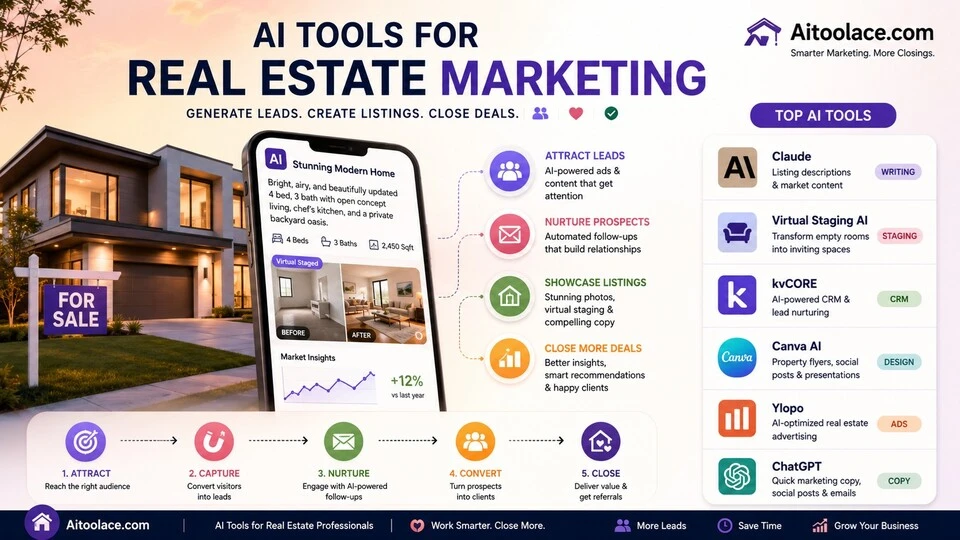
| Tool | Best For | Key Strength | Pricing |
|---|---|---|---|
| Claude | Listing descriptions and content | Highest quality property descriptions and market content | Freemium |
| Virtual Staging AI | Virtual property staging | Transform empty rooms into furnished spaces photographically | Paid |
| kvCORE | Real estate CRM | AI-powered lead nurturing and follow-up automation | Paid |
| Canva AI | Property marketing materials | Professional flyers, social posts, and presentations | Freemium |
| Ylopo | Digital advertising | AI-optimized real estate ad campaigns | Paid |
| ChatGPT | Quick marketing copy | Fast social posts, email drafts, and listing variations | Freemium |
Best AI Tools for Real Estate Marketing
Claude — Best for Listing Descriptions and Marketing Content
Every listing needs a description that makes potential buyers want to see the property. Claude produces listing descriptions that highlight the right features for the right audience — a family home emphasizes different qualities than an investment property or a luxury condo. Beyond listings, Claude handles the full range of real estate marketing content: neighborhood guides, market updates, buyer/seller tips, and email campaigns.
What it does well:
- writes listing descriptions that highlight property strengths while reading naturally rather than like a template
- adapts tone and emphasis for different property types and buyer audiences — luxury reads differently from starter home
- generates neighborhood descriptions, market analysis content, and buyer/seller educational content
- creates email sequences for lead nurturing — initial outreach, property updates, market insights, follow-up
- produces social media content that positions you as a local market expert
Where it falls short: Claude doesn’t know your local market, your properties, or your clients. It produces well-written content based on the details you provide, but the local knowledge that makes real estate marketing compelling — school district quality, neighborhood character, development trends, comparable sales — needs to come from you. And while Claude writes great listing descriptions, it can’t photograph the property, stage it, or create the visual content that drives most real estate engagement.
For writing client communications, see Best AI Tools for Writing Client Emails.
Best for: agents who write listing descriptions, market content, and client communications regularly and want faster first drafts without sacrificing quality.
Virtual Staging AI — Best for Property Visualization
Empty rooms don’t sell well. Staged homes sell faster and often for more. But traditional staging costs thousands per property and takes days to arrange. Virtual Staging AI transforms photos of empty rooms into furnished, styled spaces — giving buyers the ability to visualize the property’s potential from listing photos.
What it does well:
- transforms empty room photos into realistically furnished rooms with appropriate style and scale
- supports multiple design styles for the same room — show a living room as modern, traditional, or minimalist
- produces results in minutes rather than the days required for physical staging
- costs a fraction of traditional staging — typically under $50 per room versus thousands for physical staging
- allows multiple versions so you can show different possibilities for the same space
Where it falls short: Virtual staging looks impressive in photos but creates a gap between the listing images and the empty room buyers actually visit. Some buyers feel misled when the property looks nothing like the photos. Disclosure is important — many MLS platforms require virtual staging to be clearly labeled. The AI sometimes places furniture that doesn’t fit the room’s actual proportions or ignores architectural constraints (pillars, odd angles, low ceilings). And virtual staging works for empty rooms — it can’t improve photos of cluttered, poorly maintained, or outdated properties.
For image editing tools, see Best AI Tools for Image Editing.
Best for: listing agents who need to stage vacant properties for listings — especially when traditional staging isn’t practical due to budget, timeline, or logistics.
kvCORE — Best Real Estate CRM with AI
kvCORE is a real estate-specific CRM platform with AI-powered lead nurturing. It captures leads from your website, IDX listings, and advertising, then automatically follows up based on each lead’s behavior — which properties they viewed, how often they visit, and what price range they’re browsing.
What it does well:
- captures leads from multiple sources (website, ads, social media, referrals) into one database
- AI analyzes lead behavior and prioritizes the leads most likely to transact
- automates follow-up sequences based on lead activity — someone browsing $500K homes gets different follow-up than someone browsing $2M homes
- provides a branded IDX website where leads search listings and generate trackable activity
- includes marketing automation — email campaigns, text messages, and social media posting from one platform
Where it falls short: kvCORE is a comprehensive platform that requires significant setup and learning to use effectively. Agents who adopt it and don’t invest in configuration end up with an expensive database instead of a lead conversion system. The AI lead scoring is helpful directionally but not precise enough to rely on exclusively — some “cold” leads convert while some “hot” leads never respond. The platform is designed for individual agents and teams, not for the largest brokerages. And the automated follow-up, while efficient, can feel impersonal to leads who expect a personal touch from their agent.
For CRM tools beyond real estate, see Best AI Tools for Sales Teams.
Best for: agents and teams who generate a meaningful volume of online leads and need a system to nurture them consistently — especially agents who struggle with timely, consistent follow-up.
Canva AI — Best for Property Marketing Materials
Real estate marketing requires constant visual content — listing flyers, just-sold postcards, open house invitations, social media posts, market report graphics, and neighborhood guides. Canva AI provides templates for all of these with real estate-specific designs and AI features that speed up production.
What it does well:
- provides real estate-specific templates — listing sheets, just-sold announcements, open house flyers, market update graphics
- maintains brand consistency with your personal branding (headshot, logo, colors, contact info) across all materials
- AI features help with layout, text suggestions, and image enhancement
- supports print-ready export for physical marketing materials alongside digital formats
- enables batch creation — produce social content for a week or flyers for multiple listings efficiently
Where it falls short: Canva’s real estate templates are used by thousands of agents, which means your materials may look similar to competitors in your market. Agents who want a distinctive visual brand need custom design beyond what templates provide. The AI suggestions are functional but don’t understand real estate marketing best practices — what makes a listing photo compelling, how to highlight key selling points, or what information buyers look for first.
For broader design tools, see Best AI Tools for Designers.
Best for: agents who create their own marketing materials and need professional-looking results without a graphic designer — especially for social media content and listing presentations.
Ylopo — Best for Digital Advertising
Ylopo manages AI-optimized digital advertising campaigns for real estate agents — Facebook ads, Google ads, and retargeting campaigns that drive buyer and seller leads. The AI optimizes targeting, creative, and budget allocation based on which campaigns generate the most engaged leads.
What it does well:
- manages real estate-specific ad campaigns across Facebook, Instagram, and Google with AI optimization
- targets potential buyers and sellers based on behavioral signals and demographic data
- optimizes ad creative and budget allocation automatically based on lead quality, not just lead volume
- provides branded landing pages and IDX integration so ad traffic converts into trackable leads
- retargets website visitors who browsed listings but didn’t inquire
Where it falls short: Ylopo manages advertising but requires ad spend on top of the platform fee — the total cost (platform + ad budget) adds up quickly. The AI optimization improves over time but needs enough lead volume to learn — new agents with small budgets may not generate enough data for meaningful optimization. Ad-generated leads in real estate tend to be earlier in the buying process than referral leads — they require more nurturing and have lower conversion rates. And digital advertising is competitive in real estate — every agent in your market targets similar audiences with similar tools.
For lead generation strategies, see Best AI Tools for Lead Generation.
Best for: agents and teams with sufficient ad budgets who want AI-optimized real estate advertising campaigns — especially in competitive markets where digital lead generation is a primary business development channel.
ChatGPT — Best for Quick Marketing Copy
Real estate marketing generates a constant need for short-form content — social media posts, email subject lines, listing teasers, open house descriptions, market commentary, and client follow-up messages. ChatGPT generates this content quickly, providing first drafts you can edit and publish.
What it does well:
- generates high volumes of short-form marketing content quickly — social posts, email drafts, listing teasers
- produces listing description variations so you can test different approaches
- creates market commentary and educational content for social media positioning
- handles varied content needs without switching tools — one conversation covers posts, emails, and descriptions
- free tier provides enough usage for regular content generation
Where it falls short: ChatGPT’s real estate content is competent but generic. Listing descriptions follow predictable patterns that experienced agents and savvy buyers recognize as AI-generated. The content lacks local market specificity — ChatGPT can write about “this charming neighborhood” without knowing anything about the actual neighborhood. For high-stakes content (luxury listings, market reports, client presentations), Claude produces significantly better output. And ChatGPT can’t verify property details — it writes based on what you tell it, without checking accuracy.
For content creation more broadly, see Best AI Tools for Content Creators.
Best for: agents who need quick marketing copy for daily social posting and routine communications — not for premium listing descriptions or strategic content.
The Real Risks of AI in Real Estate Marketing
1. Generic Marketing That Doesn’t Differentiate
When every agent uses the same AI tools with similar prompts, the marketing output converges — similar listing descriptions, similar social posts, similar market updates. In a relationship-driven business where personal differentiation matters, generic AI marketing can make you interchangeable. Add your local knowledge, your personal perspective, and your specific market insights to every piece of AI-generated content.
2. Virtual Staging Misleading Buyers
Buyers who fall in love with virtually staged photos feel deceived when they visit an empty property. This damages trust at the beginning of the buying relationship. Always disclose virtual staging clearly — in the listing, in the photos (with watermarks), and in person. Many MLS platforms require disclosure, but ethical practice demands it regardless of rules.
3. Automated Follow-Up Feeling Impersonal
Real estate is a high-trust, high-value transaction. Automated emails and texts that feel like mass communication can push leads away instead of nurturing them. The best AI follow-up includes personal touches — referencing specific properties the lead viewed, mentioning recent market activity in their area, or acknowledging the stage of their buying journey. Generic “just checking in” automation does more harm than good.
4. AI-Generated Market Data Being Wrong
AI tools can generate market reports and statistics that sound authoritative but aren’t based on current, accurate data. Sharing incorrect market information with clients damages your credibility and can affect their decision-making. Always verify market statistics from your MLS or reliable local data sources before including them in any client-facing content.
Which AI Tool Should You Choose?
- Listing descriptions and content → Claude (highest quality property and market writing)
- Virtual property staging → Virtual Staging AI (empty rooms to furnished spaces)
- Lead nurturing CRM → kvCORE (AI-powered real estate lead management)
- Marketing materials → Canva AI (flyers, social posts, and presentations)
- Digital advertising → Ylopo (AI-optimized real estate ad campaigns)
- Quick daily content → ChatGPT (fast social posts and routine copy)
Best starting approach: Start with Claude (free) for listing descriptions and marketing content + Canva AI (free or low cost) for visual materials. These two cover the most time-consuming marketing tasks. Add kvCORE when your lead volume justifies a CRM. Add Ylopo when you’re ready to invest in digital advertising.
Frequently Asked Questions
What is the best AI tool for real estate marketing?
Claude is the most useful daily tool for writing listing descriptions, market content, and client communications. Canva AI is best for creating professional visual marketing materials. kvCORE is the best real estate-specific CRM with AI. Most agents benefit from combining a writing tool with a design tool.
Can AI write good listing descriptions?
AI writes competent listing descriptions that highlight key features and read professionally. The best listing descriptions include specific details that only the listing agent knows — the way light fills the kitchen in the morning, the neighbor who maintains the beautiful garden next door, the upcoming development that will add value. Use AI for structure and polish; add the local knowledge that makes listings compelling.
Is virtual staging worth it?
For vacant listings, virtual staging typically delivers positive ROI — staged listings attract more views and generate more showings. The key is clear disclosure and realistic expectations. Virtual staging works best when it accurately represents how the space could look, not when it dramatically misrepresents the property’s condition or size.
How do I generate real estate leads with AI?
AI helps at every stage of lead generation: create content that attracts (Claude + Canva), run optimized ads that capture (Ylopo), and nurture leads with automated but personalized follow-up (kvCORE). The leads still need human conversion — AI generates and nurtures them, but you build the relationship that leads to a transaction.
Should I automate all my client communication?
No. Automate routine communications — market updates, new listing alerts, general newsletters. Keep personal the high-value interactions — initial consultations, offer discussions, negotiation updates, closing coordination. The test: would this client notice if this message were automated? If yes, write it personally.
How much should agents spend on AI marketing tools?
Start at zero with Claude and Canva free tiers. A basic paid stack (Claude Pro + Canva Pro) costs about $30-40/month. Add a CRM (kvCORE) at $300-500/month when your lead volume justifies it. Digital advertising (Ylopo + ad spend) adds significantly more. Scale your tool investment with your transaction volume.
Related AI Tools Guides
- Best AI Tools for Real Estate Agents
- Best AI Tools for Lead Generation
- Best AI Tools for Sales Teams
- Best AI Tools for Image Editing
- Best AI Tools for Social Media Growth
Explore all AI tools → Browse by profession and use case
Last updated: June 2026