Skip to content
Best AI Tools for Sales Forecasting (Predict Revenue Accurately in 2026)
Quick Navigation: How I Tested • Comparison Table • Risks • Best Tools • FAQ
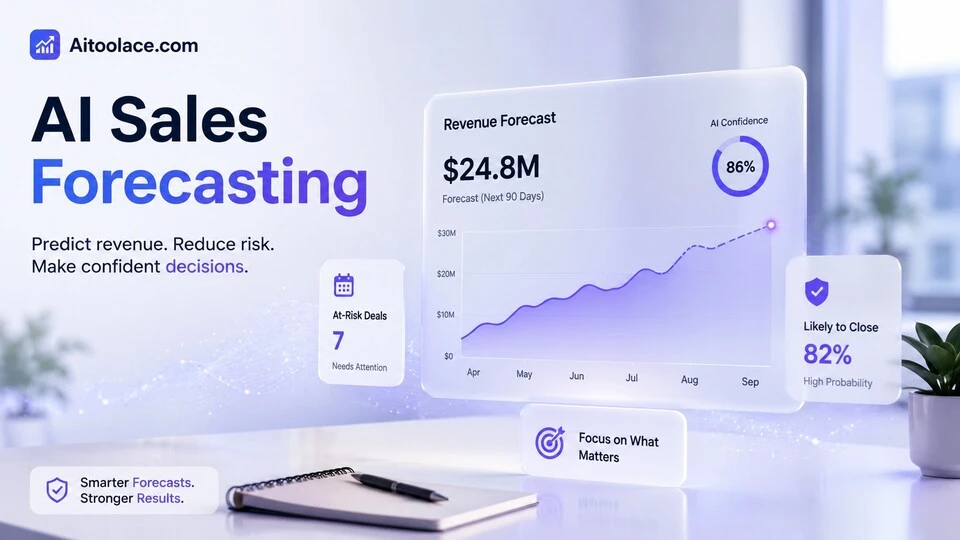
Sales forecasting is where optimism meets reality. Every sales rep thinks their deals will close. Every sales manager needs to know which ones actually will. The gap between what reps report and what actually closes is the forecast accuracy problem — and it affects hiring decisions, budget allocation, investor communication, and operational planning.
Traditional forecasting relies on reps self-reporting deal probability, which is consistently biased toward optimism. A rep who’s been working a deal for months rates it “90% likely to close” because they’ve invested too much effort to believe otherwise. The deal slips, the forecast misses, and leadership makes decisions based on revenue that never arrives.
AI forecasting tools address this by analyzing deal data objectively — engagement patterns, email responsiveness, meeting frequency, stakeholder involvement, deal velocity, and historical win rates for similar deals. The AI doesn’t care how hard the rep worked or how promising the initial conversation was. It evaluates based on patterns that actually predict outcomes.
For the broader sales workflow, Best AI Tools for Sales Teams covers the full toolkit. For data analysis that supports forecasting, Best AI Tools for Data Visualization addresses how to present forecast data.
Quick answer: Clari is the most comprehensive AI forecasting platform for enterprise sales. Gong provides the deepest conversation intelligence that feeds forecast accuracy. HubSpot Forecasting is the most accessible option for mid-market teams already on HubSpot.
How I Tested These Tools
I evaluated each tool based on what matters for sales forecasting:
- Forecast accuracy — does the AI predict outcomes more accurately than rep-reported probabilities
- Pipeline visibility — can you see which deals are genuinely progressing and which are stalled
- Risk identification — does it flag deals that are likely to slip or be lost before it happens
- Integration — does it work with your existing CRM and communication tools
- Actionability — does it tell you what to do about forecast risks, not just identify them
I reviewed each tool’s features, examined their forecasting approaches, and consulted feedback from sales leaders and revenue operations professionals. I did not fabricate accuracy improvements or invent revenue statistics.
Comparison Table
| Tool | Best For | Key Strength | Pricing |
|---|---|---|---|
| Clari | Enterprise forecasting | Comprehensive revenue intelligence platform | Paid (enterprise) |
| Gong | Conversation-based insight | AI analysis of sales calls and emails for deal health | Paid |
| HubSpot Forecasting | Mid-market CRM forecasting | AI forecasting built into an accessible CRM | Paid |
| Aviso | AI-guided selling | Predictive forecasting with rep coaching recommendations | Paid |
| InsightSquared | Revenue analytics | Historical analysis and trend identification for forecasting | Paid |
| Claude | Forecast analysis | Custom analysis of pipeline data and strategy | Freemium |
Best AI Tools for Sales Forecasting
Clari — Best Enterprise Revenue Intelligence
Clari provides the most comprehensive view of revenue — combining CRM data, email engagement, calendar activity, and conversation signals into a unified forecast that reflects what’s actually happening in deals rather than what reps report. For enterprise sales organizations where forecast accuracy directly affects business planning, Clari provides the deepest AI-powered visibility.
What it does well:
- analyzes CRM data, email engagement, meeting activity, and conversation signals to predict deal outcomes independently of rep input
- provides roll-up forecasting from individual deals through teams to the entire organization with AI-adjusted probabilities
- identifies forecast risks — deals that are likely to slip, stall, or be lost — with specific indicators explaining why
- tracks forecast changes over time so you can see how the number evolved and where it shifted
- supports multiple forecast categories (commit, best case, pipeline) with AI confidence levels for each
Where it falls short: Clari is enterprise software with enterprise pricing and implementation requirements. Small sales teams don’t generate enough deal data for the AI models to provide meaningful accuracy improvements. The platform requires strong CRM hygiene — if reps don’t update deal stages, enter notes, or log activities, Clari has less data to analyze and the predictions suffer. And Clari tells you what’s likely to happen but can’t fix the underlying deal problems — a deal flagged as “at risk” still needs a human to develop and execute a recovery strategy.
Best for: enterprise sales organizations with dedicated revenue operations teams, significant pipeline volume, and the CRM discipline needed to generate the data Clari analyzes.
Gong — Best for Conversation-Based Forecasting
Gong records and analyzes sales conversations — calls, video meetings, emails — and uses AI to assess deal health based on what’s actually being said in buyer interactions. Unlike CRM-based forecasting that relies on rep input, Gong evaluates deals based on buyer signals extracted from real conversations.
What it does well:
- analyzes actual buyer conversations to assess deal health — identifying engagement levels, objections, competitor mentions, and buying signals
- identifies deals where buyer engagement is declining before reps recognize the risk
- provides deal boards that show pipeline health based on conversation data, not rep assumptions
- tracks competitor mentions across all conversations so you see competitive dynamics in real time
- helps managers coach reps based on what’s happening in specific deals, not just pipeline spreadsheets
Where it falls short: Gong requires recording sales conversations, which raises privacy considerations and may not be appropriate in all markets or cultures. The AI analysis is most useful for sales processes that involve multiple conversations — transactional sales with one or two touchpoints don’t generate enough conversation data. The platform is expensive and designed for teams with dedicated sales operations. And conversation analysis identifies patterns but doesn’t account for all factors that influence deal outcomes — pricing negotiations, internal politics, and budget timing happen outside recorded conversations.
For sales team tools broadly, see Best AI Tools for Sales Teams.
Best for: B2B sales teams with consultative sales processes involving multiple conversations per deal — where the content of buyer interactions is the strongest predictor of deal outcomes.
HubSpot Forecasting — Best for Mid-Market Teams
HubSpot’s AI forecasting provides accessible, integrated forecasting for teams already using HubSpot CRM. It analyzes deal properties, pipeline movement, and historical win rates to generate forecasts that supplement rep-reported probabilities without requiring a separate forecasting platform.
What it does well:
- provides AI-adjusted forecasting directly inside HubSpot CRM — no separate tool or integration
- analyzes deal properties and historical patterns to predict which deals are likely to close
- supports multiple forecast views — monthly, quarterly, by team, by pipeline — with AI probability adjustments
- accessible to mid-market teams without dedicated revenue operations staff
- included in HubSpot’s Sales Hub plans, avoiding additional forecasting tool costs
Where it falls short: HubSpot’s forecasting AI is less sophisticated than Clari or Gong — it analyzes CRM data but doesn’t incorporate email engagement, conversation signals, or external data. The accuracy depends on how well your team uses HubSpot — incomplete deal records produce unreliable forecasts. The forecasting features require higher-tier HubSpot plans, adding cost. And HubSpot’s AI provides predictions but less insight into why deals are at risk — you see the probability but not the specific signals driving it.
For CRM tools broadly, see Best AI Tools for Sales Teams.
Best for: mid-market sales teams already on HubSpot that want AI-enhanced forecasting without adopting a separate enterprise platform.
Aviso — Best for AI-Guided Selling
Aviso combines predictive forecasting with prescriptive guidance — not just telling you which deals will close, but suggesting what actions to take on specific deals to improve outcomes. The AI provides rep-level coaching recommendations alongside the team-level forecast.
What it does well:
- provides deal-level predictions with specific next-action recommendations for each deal
- identifies the most impactful actions reps can take to advance at-risk deals
- analyzes win/loss patterns to identify what differentiates successful deals from unsuccessful ones
- supports scenario planning — “what happens to the forecast if we lose these three deals”
- provides rep performance analytics that connect individual behaviors to forecast accuracy
Where it falls short: Prescriptive recommendations are suggestions based on historical patterns — they don’t account for unique deal circumstances that may make standard playbooks inappropriate. The platform requires sufficient historical data to generate meaningful recommendations — new sales organizations or those entering new markets won’t have enough patterns to learn from. Aviso targets enterprise sales teams, which means enterprise complexity and pricing. And the guided selling recommendations work best when reps actually follow them — adoption is as important as accuracy.
Best for: enterprise sales organizations that want not just forecast accuracy but actionable coaching — sales leaders who need to tell reps what to do differently, not just which deals are at risk.
InsightSquared — Best for Revenue Analytics
InsightSquared provides deep analytical capabilities for understanding revenue performance — pipeline progression, win rate analysis, sales cycle trends, and forecast accuracy tracking. For organizations that want to understand the patterns behind their numbers rather than just predict the next quarter’s revenue, InsightSquared provides the analytical foundation.
What it does well:
- provides detailed pipeline analytics — conversion rates by stage, average deal velocity, and drop-off points
- tracks forecast accuracy over time so you can measure whether your forecasting is improving
- identifies patterns in won and lost deals — what characteristics predict success or failure
- supports custom reporting for specific analytical questions about your sales process
- connects revenue data to marketing activity so you can see which lead sources produce the best pipeline
Where it falls short: InsightSquared is an analytics platform, not a forecasting tool — it helps you understand your data but doesn’t generate real-time deal-level predictions the way Clari or Gong do. The depth of analysis requires someone with analytical skills to interpret and act on the insights. The platform produces reports and dashboards, not specific deal recommendations. And the value is primarily retrospective — understanding what happened and why, rather than predicting what will happen next.
For data visualization, see Best AI Tools for Data Visualization.
Best for: revenue operations teams that need deep analytical understanding of their sales process — especially organizations that want to systematically improve forecast accuracy by understanding the patterns behind their numbers.
Claude — Best for Forecast Analysis and Strategy
Claude doesn’t connect to your CRM or generate real-time forecasts. Its value is analytical — helping you interpret forecast data, identify patterns, develop strategies for at-risk deals, and think through the implications of different revenue scenarios.
What it does well:
- analyzes pipeline data you share — identifying patterns, risks, and opportunities in your deal portfolio
- helps develop strategies for specific deal situations — “this enterprise deal has stalled, what approaches might restart it”
- models revenue scenarios — “if we lose 20% of our pipeline, what’s the impact and how do we recover”
- evaluates your forecasting methodology and suggests improvements based on where accuracy breaks down
- drafts forecast presentations and board communications that present revenue data clearly
Where it falls short: Claude can’t access your CRM or see your real-time pipeline. Every analysis requires you to provide the data. The strategic suggestions are based on general sales patterns, not your specific market or buyer dynamics. And Claude provides thinking tools, not operational tools — the actual execution of forecast improvements requires your sales tools and team.
For business data analysis, see Best AI Tools for Spreadsheets & Excel.
Best for: sales leaders who need analytical support for interpreting forecast data, developing deal strategies, and communicating revenue projections to stakeholders.
The Real Risks of AI Sales Forecasting
1. False Precision
AI forecasting produces numbers with decimal-point precision that implies accuracy it doesn’t have. A forecast of “$2,347,500 in Q3 revenue” sounds exact but may have a wide confidence interval. Leaders who treat AI forecasts as precise predictions rather than informed estimates make decisions on false confidence. Always understand the confidence range around the forecast number.
2. Garbage In, Garbage Out
AI forecasting analyzes your CRM data. If reps don’t update deal stages, don’t log activities, and don’t record meeting outcomes, the AI is forecasting from incomplete information. The most sophisticated AI model can’t compensate for poor CRM hygiene. Investing in a forecasting tool without first establishing CRM data discipline wastes money.
3. Forecast Obsession Replacing Deal Execution
Sales organizations that become obsessed with forecast accuracy can redirect energy from selling to forecasting. Reps spend time updating deal stages and probabilities instead of advancing deals. Managers review forecast dashboards instead of coaching on active deals. The forecast becomes more important than the revenue it’s supposed to predict. Use forecasting tools to inform action, not to replace it.
4. Historical Patterns Applied to Changed Markets
AI learns from historical data — past win rates, deal velocities, and conversion patterns. When market conditions change (economic downturn, new competitor, product shift), historical patterns become unreliable predictors. AI forecasting tools that don’t account for market changes will produce inaccurate forecasts during exactly the periods when accuracy matters most.
Which AI Tool Should You Choose?
- Enterprise revenue intelligence → Clari (comprehensive forecasting with multi-signal analysis)
- Conversation-based deal insight → Gong (buyer engagement analysis from real conversations)
- Mid-market CRM forecasting → HubSpot (AI forecasting inside your existing CRM)
- AI-guided selling with coaching → Aviso (predictions plus action recommendations)
- Revenue analytics and patterns → InsightSquared (deep analysis of sales performance)
- Forecast analysis and strategy → Claude (custom analysis and scenario modeling)
Best starting approach: If you’re on HubSpot, start with its built-in forecasting. If forecast accuracy is a critical business issue, evaluate Clari. If conversation quality drives your deal outcomes, evaluate Gong. Use Claude for interpreting forecast data and developing strategy regardless of which operational tool you choose.
Frequently Asked Questions
What is the best AI sales forecasting tool?
Clari is the most comprehensive for enterprise sales. Gong provides the deepest deal-level insight through conversation analysis. HubSpot is the most accessible for mid-market teams. The right choice depends on your organization’s size, sales process complexity, and existing technology stack.
How accurate is AI sales forecasting?
AI forecasting is consistently more accurate than rep-reported forecasting because it evaluates deals objectively based on behavioral signals rather than subjective assessment. The accuracy improvement varies by organization but is typically meaningful — fewer surprises at quarter-end, better prediction of which deals will close, and earlier identification of pipeline risks.
What data does AI need for accurate forecasting?
At minimum: deal stage, amount, close date, and historical outcomes (won/lost). Better results come from activity data (emails, calls, meetings), engagement data (buyer responsiveness), and conversation data (what’s being discussed in meetings). The more complete and accurate your CRM data, the better the AI predictions.
Can AI forecast for new products or markets?
Less accurately than for established products. AI forecasting relies on historical patterns, and new products or markets don’t have enough history for reliable prediction. In these situations, AI forecasting should supplement human judgment rather than replace it. As you accumulate data in the new area, AI accuracy improves.
Should I replace my spreadsheet forecast with AI?
If your current spreadsheet forecast is based primarily on rep estimates, yes — AI tools will likely improve accuracy. If your spreadsheet forecast is based on sophisticated analysis by an experienced operations team, AI tools will complement rather than replace that work. The question is whether the accuracy improvement justifies the tool cost.
How long does it take for AI forecasting to become accurate?
Most AI forecasting tools need at least two to three quarters of historical data to establish meaningful patterns. Accuracy improves over time as the model learns from your specific win/loss patterns, deal velocities, and conversion rates. Don’t expect immediate accuracy — the first quarter with a new tool is calibration, not prediction.
Related AI Tools Guides
- Best AI Tools for Sales Teams
- Best AI Tools for Spreadsheets & Excel
- Best AI Tools for Data Visualization
- Best AI Tools for Competitor Analysis
- Best AI Tools for Lead Generation
Explore all AI tools → Browse by profession and use case
Last updated: June 2026