Skip to content
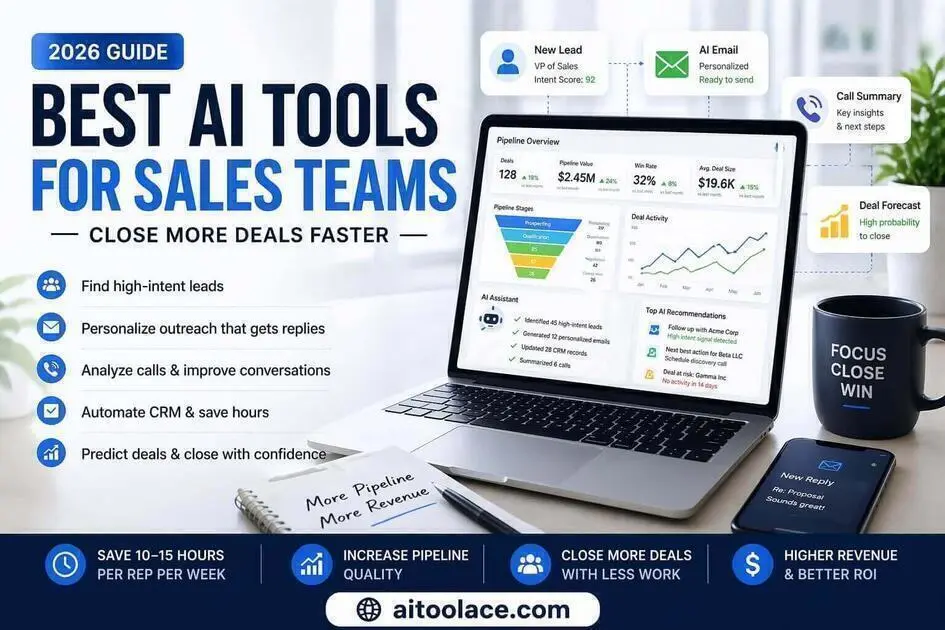
Best AI Tools for Sales Teams (Close More Deals Faster in 2026)
Quick Navigation: How I Tested • Comparison Table • Risks • Best Tools • FAQ
Sales teams have a structural productivity problem. The majority of a sales rep’s time goes to activities that aren’t selling — researching prospects, updating the CRM, writing follow-up emails, preparing for calls, and managing pipeline data. The actual conversations with prospects that lead to revenue occupy a surprisingly small portion of the workweek.
AI tools are useful for sales teams because so much of the non-selling work follows predictable patterns. Finding contacts, enriching lead data, drafting outreach emails, summarizing calls, updating deal records — these are exactly the kinds of tasks AI handles well. The tools don’t make reps better at selling. They make it possible for reps to spend more time doing it.
The challenge is choosing the right tools. The sales AI market is crowded, and many tools overlap in functionality. This guide covers the tools that solve distinct problems in the sales workflow, with honest assessments of what each one actually delivers.
If you’re focused specifically on outreach, Best AI Tools for Cold Outreach goes deeper on that workflow. For the broader marketing context, Best AI Tools for Marketers covers how marketing and sales tools connect.
Quick answer: The strongest sales team stack combines Apollo for prospecting, Gong for conversation intelligence, HubSpot Sales Hub for CRM, and Claude for email and proposal writing.
How I Tested These Tools
I evaluated each tool based on what matters for sales team performance:
- Prospecting quality — does the tool help find the right prospects or just more prospects
- Workflow integration — does it fit into an existing sales process or create a parallel one
- Time impact — does it genuinely reduce time spent on non-selling activities
- Output quality — are the emails, summaries, and insights useful without heavy editing
- Team scalability — does it work for a 3-person team and a 30-person team
I reviewed each tool’s features, tested the interfaces, examined pricing structures, and consulted feedback from sales managers and reps. I did not fabricate pipeline statistics or invent close rate improvements.
Comparison Table
| Tool | Best For | Key Strength | Pricing |
|---|---|---|---|
| Apollo.io | Prospecting | Large B2B database with built-in outreach | Freemium |
| Gong | Conversation intelligence | AI analysis of sales calls and deal health | Paid (enterprise) |
| HubSpot Sales Hub | CRM automation | Integrated CRM with AI assistants | Freemium |
| Clay | Data enrichment | Deep lead research from multiple sources | Paid |
| Claude | Emails and proposals | High-quality personalized writing | Freemium |
| Outreach | Sales sequences | Multi-channel automated outreach | Paid (enterprise) |
| Otter.ai | Meeting notes | Real-time transcription and summaries | Freemium |
Best AI Tools for Sales Teams
Apollo.io — Best for Prospecting
Apollo is the most widely used B2B prospecting platform because it combines a large contact database with built-in email sequencing. You can find prospects, verify their contact information, and start outreach campaigns without switching between tools.
What it does well:
- provides a large B2B contact database with filtering by industry, role, company size, location, funding stage, and technology stack
- includes built-in email sequencing so you can prospect and outreach from one platform
- offers intent data signals that help identify prospects who may be actively researching solutions like yours
- verifies email addresses before sending, which reduces bounce rates and protects sender reputation
Where it falls short: Apollo’s database is large but not always accurate. Contact details go stale as people change jobs, and smaller companies are less well-represented. The built-in outreach features are functional but less sophisticated than dedicated sending tools like Instantly or Outreach. And the intent data signals, while useful, are broad rather than precise — they indicate general interest areas, not specific purchase intent.
Best for: sales teams that want prospecting and basic outreach in one platform. Works especially well as the starting point of a larger stack.
Gong — Best for Conversation Intelligence
Gong records and analyzes sales calls, identifying patterns that correlate with deal outcomes. Instead of relying on reps to self-report what happened on a call, managers get objective data about conversation dynamics, objection handling, competitor mentions, and deal health.
What it does well:
- records and transcribes sales calls automatically, creating a searchable archive of every customer conversation
- identifies deal risks by analyzing conversation patterns — which calls are going well and which aren’t
- surfaces coaching opportunities by highlighting specific moments where reps struggled or excelled
- provides competitive intelligence by tracking when competitors are mentioned and in what context
Where it falls short: Gong is enterprise-priced, which puts it out of reach for small sales teams. The insights are most valuable when you have enough call volume to identify meaningful patterns — a team of two or three reps won’t generate enough data for the analytics to be useful. There’s also a behavioral impact: some reps become self-conscious knowing every call is recorded and analyzed, which can affect their natural selling style. And Gong identifies problems but doesn’t fix them — the coaching still needs to happen.
Best for: sales teams with multiple reps and enough call volume to benefit from pattern analysis and coaching insights.
HubSpot Sales Hub — Best for CRM Automation
HubSpot Sales Hub integrates CRM, email tracking, deal management, and AI assistance into one platform. Its value for sales teams is reducing the time spent on CRM administration — the data entry, deal updates, and activity logging that reps universally dislike but managers need.
What it does well:
- automates CRM data entry by logging emails, calls, and meetings automatically
- provides AI-powered email suggestions and writing assistance within the CRM interface
- includes deal forecasting that helps managers understand pipeline health without relying solely on rep opinions
- integrates tightly with HubSpot’s marketing tools, which means marketing-generated leads flow directly into the sales pipeline with full context
Where it falls short: HubSpot is a platform commitment, not just a tool purchase. Extracting full value requires adopting HubSpot as your central CRM, which means migrating data, training the team, and building processes around its structure. The free tier is genuinely useful for small teams, but the advanced AI and automation features require paid plans that escalate quickly. And like all CRMs, it only works if reps actually use it — AI can reduce the burden but can’t eliminate it.
For teams that bridge sales and marketing, see also Best AI Tools for Marketing Teams in 2026.
Best for: sales teams that want an integrated CRM with AI features and are willing to commit to HubSpot as their central sales platform.
Clay — Best for Data Enrichment
Clay fills the gap between having a prospect’s name and having enough context to write a relevant message. It pulls data from dozens of sources — company funding, tech stack, hiring activity, recent news, social profiles — and builds enriched lead profiles that fuel personalized outreach.
What it does well:
- enriches leads with data from multiple sources, providing much deeper context than any single database
- creates custom research workflows that automate what reps would otherwise do manually on LinkedIn and company websites
- generates personalization variables that can be plugged directly into outreach templates
- helps prioritize leads by scoring them based on enriched data points
Where it falls short: Clay has a significant learning curve. Building enrichment workflows takes time and experimentation to get right. The tool is most valuable at scale — if you’re enriching 50 leads a week, the setup effort may not justify itself. The data quality also varies by source; some enrichment fields are consistently accurate while others require verification. And Clay is a research and enrichment tool, not an outreach tool — you still need separate tools for sending and tracking.
For more on lead generation workflows, see Best AI Tools for Lead Generation.
Best for: outbound sales teams running high-volume personalized outreach who need their messages to feel researched and relevant.
Claude — Best for Emails and Proposals
Sales communication — outreach emails, follow-up messages, proposals, negotiation responses — requires writing that’s professional, persuasive, and specific to the prospect’s situation. Claude produces the highest quality sales writing of any AI tool, particularly for longer, more complex communications.
What it does well:
- writes personalized outreach emails that read naturally rather than robotically
- handles complex sales communications — proposals, negotiation responses, objection handling emails — with appropriate tone
- generates multiple variations of the same message so you can choose the strongest approach
- follows specific instructions about tone, length, and approach precisely
Where it falls short: Claude doesn’t know your prospects, your product, or your competitive situation. It writes well, but the specificity and relevance need to come from you. Using Claude without providing detailed context produces generic output that sounds polished but feels impersonal. Claude also isn’t integrated into CRM or outreach platforms — you write in Claude and paste into your sending tool, which adds friction.
For writing client-facing communications more broadly, see AI Tools for Writing Client Emails.
Best for: sales reps who write complex, high-stakes emails and proposals and want faster first drafts without sacrificing quality.
Outreach — Best for Sales Sequences
Outreach is a dedicated sales engagement platform built for structured outbound teams. It manages multi-channel sequences (email, phone, LinkedIn, SMS) with automation, A/B testing, and detailed analytics on what’s working.
What it does well:
- manages complex multi-step, multi-channel outreach sequences with conditional logic
- provides detailed analytics on sequence performance — which steps convert, which messages get replies, where prospects drop off
- supports team-wide sequence templates with governance and approval workflows
- integrates deeply with CRMs (especially Salesforce) for unified pipeline visibility
Where it falls short: Outreach is enterprise-priced and enterprise-complex. Small teams won’t benefit from its advanced features and will find cheaper alternatives (Apollo, Instantly) more appropriate. The platform requires significant setup and ongoing management to use effectively. And like all sequence tools, Outreach automates the mechanical parts of outreach but can’t improve the underlying message quality or targeting strategy.
Best for: structured outbound sales teams with dedicated SDRs who need sophisticated sequence management and analytics.
Otter.ai — Best for Meeting Notes
Otter provides real-time transcription during sales calls and meetings, creating searchable records that reps and managers can reference. For sales teams, this means call notes happen automatically instead of requiring reps to write summaries from memory.
What it does well:
- transcribes calls in real time with speaker identification
- creates searchable archives of all sales conversations
- generates summaries that capture key points and action items
- costs significantly less than enterprise conversation intelligence tools like Gong
Where it falls short: Otter transcribes conversations but doesn’t analyze them the way Gong does. It captures what was said but doesn’t identify deal risks, coaching opportunities, or competitive patterns. For teams that just need accurate call records, Otter is sufficient. For teams that want insights from their conversations, Gong (despite the higher cost) delivers more value. Transcription accuracy also drops with poor audio quality or heavy accents.
Best for: small sales teams that need call documentation at a fraction of Gong’s cost.
The Real Risks of Using AI in Sales
1. Robotic Outreach at Scale
AI makes it easy to send thousands of emails, but if those emails sound like AI wrote them, they get ignored. Prospects receive dozens of AI-generated emails daily and can recognize the patterns. The personalization needs to be real — based on actual research about the prospect’s situation — not just inserting their name and company into a template. Volume without quality is spam.
2. Bad Data Amplified
AI tools amplify data quality issues. If your prospect data is outdated or inaccurate, AI will efficiently send personalized messages to wrong email addresses, former employees, and irrelevant contacts. The speed that makes AI valuable also makes bad data more expensive. Verify your data before scaling outreach.
3. CRM Pollution
Automating everything into your CRM can create more noise than signal. When every interaction, every email open, and every page visit gets logged, the useful information gets buried under low-value data. Be intentional about what gets tracked and what doesn’t. More data isn’t automatically better data.
4. Compliance Exposure
AI-powered outreach at scale increases compliance risks under GDPR, CAN-SPAM, and CASL. Automated systems can send emails to opt-out contacts, fail to include required identification, or process personal data without proper justification. As you scale, compliance becomes more important, not less. Make sure your tools and processes comply with the regulations in your target markets.
Which AI Tool Should You Choose?
- Small team starting outbound → Apollo + Claude (prospecting + personalized emails)
- Growing team with multiple reps → Apollo + Gong + HubSpot (prospecting + call insights + CRM)
- High-volume outbound → Apollo + Clay + Outreach (prospecting + enrichment + sequences)
- Budget-conscious → Apollo (free) + Claude (free) + Otter (free) (covers basics at zero cost)
Start with Apollo + Claude — that covers prospecting and communication. Add Gong when you have enough call volume for the analytics to be meaningful. Add HubSpot when you need structured CRM and pipeline management.
Frequently Asked Questions
Will AI replace sales reps?
No. AI automates the administrative and repetitive parts of sales work — data entry, research, follow-up scheduling, call transcription. The activities that actually close deals — building relationships, understanding customer needs, navigating objections, negotiating terms — require human judgment and interpersonal skills that AI doesn’t have.
How do I avoid sending robotic AI emails?
Provide specific context about the prospect when using AI tools — their situation, their likely pain points, why your solution is relevant to them specifically. Edit every email before sending, especially the opening line and call to action. If you can’t articulate why this specific person should care about your email, AI can’t either.
Is AI outreach legally compliant?
AI outreach is subject to the same regulations as manual outreach — GDPR in Europe, CAN-SPAM in the US, CASL in Canada. These laws require proper identification, opt-out mechanisms, and in some cases, legitimate interest justification. AI doesn’t create new legal obligations, but the speed and scale of AI-powered outreach means compliance mistakes happen faster and affect more people.
Can small sales teams benefit from AI?
Yes — arguably more than large teams. AI allows a small team to handle the prospecting, research, and communication volume that would otherwise require additional hires. A well-equipped 3-person team can generate pipeline comparable to a larger team that operates without AI tools.
What’s the most important AI tool for a sales team?
It depends on your bottleneck. If you spend too much time finding prospects, start with Apollo. If your emails aren’t getting replies, start with Claude. If you need better visibility into deal health, start with Gong. If CRM administration is eating your time, start with HubSpot. Diagnose the specific problem before choosing the tool.
How much should a sales team spend on AI tools?
A practical starting stack (Apollo free + Claude free + Otter free) costs nothing. A mid-level stack (Apollo paid + Claude Pro + HubSpot Starter) runs roughly $100–150/month total. Enterprise tools (Gong + Outreach + Clay) are significantly more expensive and only justified when deal sizes and team sizes support the investment.
Related AI Tools Guides
- Best AI Tools for Lead Generation
- Best AI Tools for Cold Outreach
- Best AI Tools for Marketers
- Best AI Tools for Recruiters
- Best AI Tools for Small Business Owners
Explore all AI tools → Browse by profession and use case
Last updated: April 2026