Skip to content
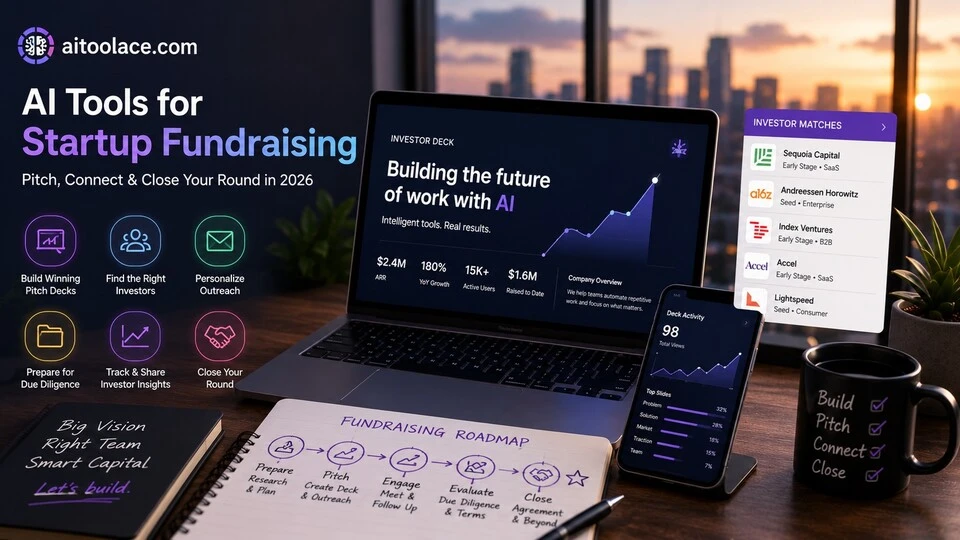
Best AI Tools for Startup Fundraising (Pitch, Connect & Close Your Round in 2026)
Quick Navigation: How I Tested • Comparison Table • Risks • Best Tools • FAQ
Fundraising is the most time-consuming distraction from building a company. It consumes months of founder time — researching investors, building pitch decks, writing cold outreach, preparing data rooms, managing follow-ups, negotiating terms, and coordinating due diligence. Every week spent fundraising is a week not spent on product, customers, and growth.
The irony is that fundraising requires many of the same skills founders use to build their companies — clear communication, compelling storytelling, rigorous data analysis, and systematic execution. But the fundraising-specific knowledge (what investors look for, how to structure a pitch, what due diligence involves) is unfamiliar territory for most first-time founders.
AI tools help by accelerating the mechanical parts of fundraising. They draft pitch decks from your business data. They identify investors who match your stage, sector, and geography. They generate outreach that stands out from the hundreds of emails investors receive weekly. They organize data rooms and prepare for due diligence questions. The strategic decisions — when to raise, how much, from whom, at what terms — remain yours.
For the broader startup toolkit, Best AI Tools for Startup Founders covers building and scaling. For creating the financial models that underpin fundraising, Best AI Tools for Spreadsheets & Excel addresses the modeling side.
Quick answer: Claude is the most useful tool for pitch narrative development and investor communication. Deckmatch is the strongest tool for finding investors who match your startup. DocSend is best for managing your pitch deck distribution and tracking engagement.
How I Tested These Tools
I evaluated each tool based on what matters for fundraising:
- Pitch quality — does the tool help create a compelling pitch that communicates your opportunity clearly
- Investor matching — can it identify investors who are genuinely relevant to your stage, sector, and geography
- Outreach effectiveness — does it help you stand out from the volume of pitches investors receive
- Process management — does it organize the fundraising process so nothing falls through the cracks
- Due diligence readiness — does it help prepare the documentation investors require
I reviewed each tool’s features, tested across different startup scenarios, and consulted feedback from founders and venture capital professionals. I did not fabricate funding success statistics or invent conversion rate improvements.
Comparison Table
| Tool | Best For | Key Strength | Pricing |
|---|---|---|---|
| Claude | Pitch narrative and communication | Strongest writing for pitch decks, memos, and investor outreach | Freemium |
| Deckmatch | Investor matching | AI-powered matching with relevant investors | Paid |
| DocSend | Pitch deck management | Track who views your deck and which slides they spend time on | Freemium |
| Notion AI | Data room and process | Organize fundraising process and due diligence documents | Freemium |
| Canva AI | Pitch deck design | Professional deck visuals without a designer | Freemium |
| Visible | Investor updates and CRM | Manage investor relationships and send structured updates | Paid |
Best AI Tools for Startup Fundraising
Claude — Best for Pitch Narrative and Investor Communication
The difference between a funded startup and an unfunded one is often the pitch — not the idea, not the market, but how clearly and compellingly the founder communicates why this company will succeed. Claude helps founders develop and articulate their pitch narrative, from the initial story structure through the detailed investor memo to the follow-up emails that keep conversations moving.
What it does well:
- develops pitch narratives that connect the problem, solution, market, traction, and team into a compelling story — not just a collection of slides
- writes investor memos that present the opportunity with the depth and rigor that serious investors expect
- generates cold outreach emails personalized to specific investors — referencing their portfolio, investment thesis, and relevant expertise
- prepares for investor questions by anticipating objections and developing clear, confident responses
- adapts communication style for different investor types — angels, seed funds, Series A investors, and strategic investors each respond to different messaging
Where it falls short: Claude doesn’t know your startup. It creates compelling narratives from the information you provide, but the specific data that makes a pitch investable — your traction metrics, your market insight, your unfair advantage — needs to come from you. A beautifully written pitch for a bad business is still a bad pitch. Claude also can’t identify investors, send emails, or track fundraising progress — it produces the content, not the process. And Claude’s fundraising advice is based on general patterns — your specific market, stage, and situation may require approaches that general advice doesn’t cover.
For broader founder tools, see Best AI Tools for Startup Founders.
Best for: founders who need to articulate their opportunity compellingly — especially first-time founders who know their business deeply but haven’t pitched investors before.
Deckmatch — Best for Investor Matching
Finding the right investors is as important as building the right pitch. An investor who focuses on your sector, invests at your stage, and has relevant portfolio experience is far more likely to engage than a random name from a VC list. Deckmatch uses AI to match startups with investors based on investment thesis alignment, sector focus, stage preference, and geographic interest.
What it does well:
- matches your startup with investors based on their actual investment patterns — not just what they claim to invest in, but what they actually fund
- analyzes investor portfolios to identify who has relevant experience and might add strategic value beyond capital
- filters by stage, sector, geography, and check size so you target investors who can actually participate in your round
- identifies warm introduction paths through shared connections and portfolio companies
- saves weeks of manual research through CrunchBase, LinkedIn, and VC websites
Where it falls short: Investor databases are never perfectly current — some investors listed as active may have closed their fund, changed their thesis, or paused new investments. The matching algorithm identifies likely fits but can’t predict whether a specific investor will be interested in your specific company. And even the best-matched investor requires a compelling pitch and warm introduction to engage — the matching just ensures you’re targeting the right people.
For cold outreach to investors, see Best AI Tools for Cold Outreach.
Best for: founders who need to build a targeted investor list efficiently — especially those raising their first round who don’t have existing investor networks.
DocSend — Best for Pitch Deck Management
Once your pitch deck is ready, how you distribute and track it matters. DocSend provides secure link sharing with detailed analytics — showing which investors opened your deck, which slides they spent time on, and which they skipped. This intelligence informs your follow-up strategy and helps you improve your deck based on actual viewer behavior.
What it does well:
- shares your pitch deck as a secure link with granular access controls — require email to view, disable downloads, set expiration dates
- tracks viewer engagement — who opened the deck, when, how long they spent on each slide, and whether they forwarded it
- identifies which slides lose investor attention so you can improve the weak points
- manages multiple deck versions so different investors can receive tailored versions while you track everything centrally
- provides data room functionality for due diligence document sharing with the same tracking capabilities
Where it falls short: DocSend tracks deck engagement but can’t tell you why an investor stopped reading at slide 7 — the data shows behavior without explaining motivation. The tracking can create unhealthy obsession — refreshing the analytics dashboard every hour doesn’t improve your fundraising outcome. And some investors are uncomfortable with tracked links — they feel monitored rather than courted. Use tracking insights for improvement, not for surveillance.
For presentation tools broadly, see Best AI Tools for Presentations.
Best for: founders actively distributing their pitch deck who want to track engagement, manage multiple investor conversations, and improve their deck based on actual viewing behavior.
Notion AI — Best for Data Room and Process Management
Fundraising involves managing a complex process — investor list, outreach status, meeting notes, follow-up tasks, due diligence documents, term sheet comparisons, and legal coordination. Notion AI provides a workspace where all of this lives together, with AI that helps generate documents, summarize conversations, and track the process.
What it does well:
- organizes the entire fundraising process — investor pipeline, outreach tracking, meeting notes, follow-up tasks — in one workspace
- creates data rooms for due diligence — organized collections of financial statements, legal documents, customer data, and team information
- AI generates meeting preparation notes, follow-up summaries, and document drafts
- templates for fundraising CRM, investor tracking, and due diligence checklists provide structure from day one
- supports collaboration when co-founders, advisors, or legal counsel need access to fundraising materials
Where it falls short: Notion is a workspace tool, not a fundraising platform. Setting up an effective fundraising system requires configuration that takes time when you’d rather be pitching. Notion doesn’t track deck engagement (DocSend does that), match you with investors (Deckmatch does that), or design your pitch (Claude and Canva do that). And Notion’s flexibility means there’s no one right way to set it up — you can spend too long optimizing your system instead of executing your fundraising plan.
For knowledge management broadly, see Best AI Tools for Knowledge Management.
Best for: founders who need to organize a complex fundraising process — especially those managing multiple investor conversations simultaneously and preparing for due diligence.
Canva AI — Best for Pitch Deck Design
Your pitch deck competes for attention against hundreds of others on an investor’s screen. Design quality doesn’t determine whether you get funded, but poor design creates a negative first impression before the investor reads a single word. Canva AI provides pitch deck templates and design tools that produce professional-looking decks without hiring a designer.
What it does well:
- provides startup pitch deck templates with appropriate slide structures (problem, solution, market, traction, team, ask)
- maintains visual consistency across all slides through brand kits and style settings
- AI features suggest layouts, generate text variations, and enhance visuals
- supports data visualization — charts and graphs that present traction metrics clearly
- enables rapid iteration — update numbers, add slides, or redesign sections quickly as your pitch evolves
Where it falls short: Canva’s pitch deck templates are used by thousands of startups, which means your deck may look visually similar to others in the same investor’s pipeline. Professional design firms create distinctive decks that reflect a startup’s brand identity — Canva produces professional but not distinctive. The template structures follow conventional pitch formats, which is appropriate for most raises but limiting for companies with unconventional stories. And Canva handles design but not content — the quality of what’s on the slides matters more than how the slides look.
For broader design tools, see Best AI Tools for Designers.
Best for: founders who need a professional-looking pitch deck quickly — especially early-stage founders where the budget doesn’t justify hiring a professional deck designer.
Visible — Best for Investor Updates and CRM
Fundraising doesn’t end when you close your round — and it doesn’t start when you decide to raise. The founders who raise most effectively maintain ongoing relationships with investors through regular updates. Visible automates investor updates and provides a CRM for managing investor relationships throughout your company’s lifecycle.
What it does well:
- sends structured investor updates with metrics, milestones, and narrative — keeping current and potential investors engaged
- tracks investor relationship history — conversations, meetings, introductions, and engagement over time
- integrates with your data sources (Stripe, QuickBooks, Google Analytics) to auto-populate metrics in updates
- manages both current investors and prospective investors in one CRM
- provides templates for investor updates that include the information experienced investors expect
Where it falls short: Visible is most valuable during and after fundraising, not before — founders who haven’t started investor conversations get less immediate value. The CRM features overlap with general CRM tools (HubSpot, Pipedrive) that founders may already use for sales. The subscription cost adds up for pre-revenue startups watching every dollar. And sending great investor updates doesn’t compensate for weak business performance — updates work when you have progress to share.
For sales CRM tools, see Best AI Tools for Sales Teams.
Best for: founders who want to build and maintain investor relationships systematically — especially those preparing for future rounds by keeping potential investors engaged with regular updates.
The Real Risks of AI in Fundraising
1. Polished Pitch, Weak Business
AI can make any pitch sound compelling — clear narrative, professional design, persuasive language. But investors look beyond the pitch to the fundamentals: market size, product-market fit, team capability, traction, and unit economics. A beautifully crafted pitch for a business that doesn’t work is still a pitch for a business that doesn’t work. Use AI to present your opportunity clearly, not to disguise its weaknesses.
2. Volume Outreach Without Targeting
AI makes it easy to send personalized-seeming outreach to hundreds of investors. But fundraising is a targeted activity — the right 20 investors produce better results than 200 generic emails. Mass outreach damages your reputation in a small community where investors talk to each other. Use AI for personalization quality, not for volume.
3. Losing Authenticity in Your Story
The most effective fundraising pitches feel authentic — the founder’s genuine passion, hard-won insight, and personal connection to the problem. AI-polished narratives can smooth away the rough edges that make a founder’s story compelling. Edit AI output to preserve your authentic voice and specific experiences, not to replace them with professional-sounding generalities.
4. Premature Fundraising Driven by Easy Preparation
Because AI makes fundraising materials easy to prepare, founders may start raising before their business is ready. Premature fundraising (before product-market fit, before meaningful traction, before the right team is in place) wastes time and can create negative signal in a market where investors share information. The decision of when to raise should be based on business readiness, not on how easy it is to prepare materials.
Which AI Tool Should You Choose?
- Pitch narrative and communication → Claude (compelling storytelling and investor writing)
- Finding the right investors → Deckmatch (AI matching based on investment patterns)
- Deck distribution and tracking → DocSend (engagement analytics for your pitch deck)
- Process and data room → Notion AI (organize fundraising and due diligence)
- Deck design → Canva AI (professional pitch deck visuals)
- Investor relationship management → Visible (updates, CRM, and ongoing engagement)
Best starting approach: Start with Claude (free) to develop your pitch narrative and write your investor memo. Design your deck in Canva AI (free). Use Deckmatch to build your investor list. Share your deck through DocSend (free tier) to track engagement. Organize your process in Notion (free). Add Visible when you have investors to update regularly.
Frequently Asked Questions
What is the best AI tool for startup fundraising?
Claude is the most useful for developing your pitch and writing investor communications. Deckmatch is best for finding relevant investors. DocSend is best for managing deck distribution. Most founders benefit from combining a writing tool (Claude), a matching tool (Deckmatch), and a tracking tool (DocSend).
Can AI write my pitch deck?
AI can draft the content for your pitch deck — the narrative, the market analysis, the competitive positioning. But the specific data that makes a pitch investable (your traction, your insight, your team’s unique capability) must come from you. Use AI for structure, clarity, and polish. Provide the substance and authenticity yourself.
How do I find the right investors for my startup?
Use Deckmatch or similar tools to identify investors who actively invest in your stage, sector, and geography. Research their recent investments to confirm alignment. Seek warm introductions through mutual connections, portfolio founders, or advisors. Personalize every outreach based on why this specific investor would find your company interesting.
How long does fundraising take?
Typical seed rounds take 3-6 months from first outreach to close. Series A rounds take 4-8 months. AI tools can reduce the time spent on preparation and logistics but can’t accelerate investor decision-making timelines. Start preparing materials 1-2 months before you plan to actively raise.
Should I send my deck to investors or present live?
Both serve different purposes. Sending your deck first lets investors evaluate the opportunity on their own schedule and self-select into taking a meeting. Live presentation lets you control the narrative and respond to questions in real time. Most fundraising processes involve both — a deck or memo to secure the meeting, then a live pitch to advance the conversation.
What do investors look for in a pitch?
Clear problem definition (a real problem worth solving), compelling solution (your approach and why it works), large market (enough opportunity to build a significant business), evidence of traction (proof that the market responds to your solution), capable team (people who can execute the vision), and a clear ask (how much you’re raising and what you’ll do with it). AI can help you present each of these clearly — but the substance needs to be real.
Related AI Tools Guides
- Best AI Tools for Startup Founders
- Best AI Tools for Presentations
- Best AI Tools for Financial Advisors
- Best AI Tools for Spreadsheets & Excel
- Best AI Tools for Cold Outreach
Explore all AI tools → Browse by profession and use case
Last updated: June 2026