Skip to content
Best AI Tools for Supply Chain Management (Forecast, Track & Optimize in 2026)
Quick Navigation: How I Tested • Comparison Table • Risks • Best Tools • FAQ
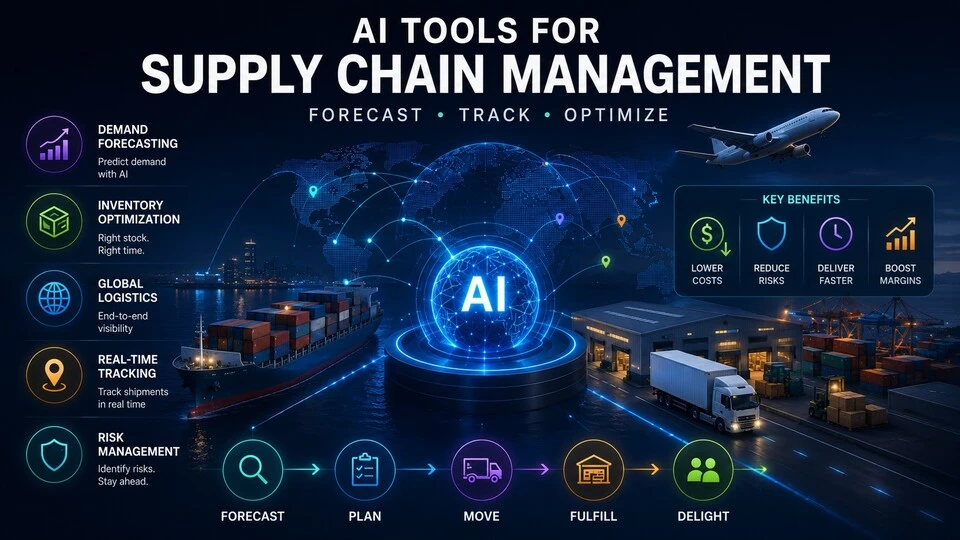
Supply chain management is a prediction problem. You need to know how much of each product to order, when to order it, where to store it, and how to get it to customers on time — all based on demand that hasn’t happened yet. Get it right and margins are healthy. Get it wrong and you’re sitting on unsold inventory or losing sales to stockouts.
AI tools improve supply chain decisions by making better predictions. They analyze historical sales data, seasonal patterns, market trends, and external factors (weather, events, economic indicators) to forecast demand more accurately than traditional methods. They optimize inventory levels, suggest reorder points, and identify inefficiencies in logistics that humans miss because the data is too complex to analyze manually.
The challenge is that supply chains are physical systems with real constraints — lead times, storage capacity, shipping routes, supplier reliability. AI can optimize decisions within these constraints, but it can’t eliminate them. A perfect demand forecast doesn’t help if your supplier can’t deliver on time.
For e-commerce businesses managing product inventory, Best AI Tools for E-commerce covers the retail side. For tracking business data in spreadsheets, Best AI Tools for Spreadsheets & Excel addresses data management.
Quick answer: o9 Solutions is the most comprehensive AI planning platform for mid-to-large businesses. Inventory Planner is best for e-commerce inventory optimization. Flexport is strongest for international shipping and logistics visibility.
How I Tested These Tools
I evaluated each tool based on what matters for supply chain operations:
- Forecast accuracy — does the AI predict demand better than simple historical averages or spreadsheet models
- Inventory optimization — does it help maintain the right stock levels without excess or shortage
- Logistics visibility — can you track shipments and identify delays before they cause problems
- Integration — does it connect with your existing ERP, e-commerce platform, and warehouse systems
- Scalability — does it work for a business with 100 SKUs and scale to 10,000
I reviewed each tool’s features, examined their approaches to forecasting and optimization, and consulted feedback from operations managers and supply chain professionals. I did not fabricate accuracy improvements or invent cost reduction statistics.
Comparison Table
| Tool | Best For | Key Strength | Pricing |
|---|---|---|---|
| o9 Solutions | Enterprise planning | Comprehensive AI planning across demand, supply, and operations | Paid (enterprise) |
| Inventory Planner | E-commerce inventory | Demand forecasting and reorder optimization for online sellers | Paid |
| Flexport | International logistics | End-to-end visibility for global shipping and freight | Paid |
| Coupa | Procurement optimization | AI-powered sourcing and spend management | Paid (enterprise) |
| ShipBob | Fulfillment optimization | AI-optimized order routing and warehouse distribution | Paid |
| Claude | Supply chain analysis | Custom analysis of supply chain data and strategic planning | Freemium |
Best AI Tools for Supply Chain Management
o9 Solutions — Best Enterprise Planning Platform
o9 Solutions provides an integrated planning platform that connects demand forecasting, supply planning, inventory optimization, and revenue management. Instead of separate tools for each planning function, o9 brings everything together with AI that understands how decisions in one area affect outcomes in others.
What it does well:
- integrates demand planning, supply planning, and inventory optimization in one platform so decisions are coordinated
- AI forecasting incorporates external signals (weather, economic indicators, social media trends, events) alongside historical data
- provides scenario planning — “what happens to our supply chain if demand increases 20% or if this supplier is delayed”
- connects planning to execution with real-time visibility into how plans translate to actual operations
- handles the complexity of multi-product, multi-channel, multi-geography supply chains
Where it falls short: o9 is enterprise software designed for organizations with mature supply chain operations. Implementation takes months, requires dedicated planning resources, and involves significant data integration work. Small businesses and e-commerce sellers don’t need this level of planning sophistication. The forecasting accuracy depends on data quality — organizations with poor historical data or inconsistent record-keeping won’t see immediate accuracy improvements. And the platform’s comprehensive scope means a steep learning curve for teams accustomed to simpler tools.
Best for: mid-to-large businesses with complex supply chains involving multiple products, channels, and geographies — where coordinated planning across demand, supply, and inventory creates significant value.
Inventory Planner — Best for E-Commerce Inventory
Inventory Planner is designed specifically for e-commerce businesses that need to predict demand and optimize reorder timing. It connects to Shopify, Amazon, WooCommerce, and other platforms, analyzes sales history, and tells you what to order, when to order it, and how much.
What it does well:
- forecasts demand at the SKU level based on sales history, seasonality, and trends
- generates purchase order recommendations — what to buy, from which supplier, and when
- accounts for lead times so recommendations arrive when you need them, not after stockouts
- identifies overstock situations and suggests markdown strategies before inventory becomes obsolete
- connects directly to major e-commerce platforms for automated data sync
Where it falls short: Inventory Planner works best with products that have stable, predictable demand patterns. New products without sales history, viral products with unpredictable demand, and fashion/trend-driven items challenge the forecasting models. The tool optimizes individual SKU ordering but doesn’t handle complex supply chain logistics — it tells you what to order, not how to get it to your warehouse. And the accuracy of recommendations depends on your historical data quality — incomplete or inconsistent sales records produce unreliable forecasts.
For broader e-commerce tools, see Best AI Tools for E-commerce.
Best for: e-commerce businesses with established products and sales history that need automated inventory replenishment — especially those managing hundreds or thousands of SKUs.
Flexport — Best for International Logistics
Flexport provides end-to-end visibility and management for international shipping — ocean freight, air freight, trucking, and customs clearance. Its AI features predict transit times, identify potential delays, optimize shipping routes, and help businesses make cost-time tradeoffs for each shipment.
What it does well:
- provides real-time visibility into shipment location, status, and estimated arrival across all transportation modes
- AI predicts delays based on port congestion, weather, carrier performance, and historical patterns
- optimizes shipping mode selection (ocean vs air vs ground) based on cost, speed, and reliability requirements
- handles customs documentation and compliance for international shipments
- consolidates shipments across multiple purchase orders to reduce per-unit shipping costs
Where it falls short: Flexport is primarily a freight forwarding and logistics platform. It manages the movement of goods but doesn’t handle demand forecasting, inventory optimization, or warehouse management — you need separate tools for those functions. The platform is most valuable for businesses importing goods internationally; domestic-only supply chains get less value. Pricing is transaction-based, which can be unpredictable. And Flexport’s AI predictions are most accurate on major shipping lanes with abundant data — less common routes have less reliable predictions.
Best for: businesses that import products internationally and need visibility, optimization, and management across complex global shipping routes.
Coupa — Best for Procurement Optimization
Coupa helps businesses buy smarter. Its AI analyzes spending patterns, identifies savings opportunities, evaluates suppliers, and optimizes procurement processes — turning purchasing from a transactional activity into a strategic function that directly improves margins.
What it does well:
- analyzes spending across the organization to identify savings opportunities — duplicate purchases, off-contract spending, volume consolidation
- evaluates suppliers based on performance, risk, and cost — helping you choose the right supplier, not just the cheapest
- automates procurement workflows — requisitions, approvals, purchase orders — reducing the time from need to purchase
- provides risk assessment for suppliers based on financial stability, delivery performance, and compliance
- benchmarks your spending against industry data to identify where you’re overpaying
Where it falls short: Coupa is enterprise procurement software. Small businesses that purchase from a few suppliers don’t need this level of procurement sophistication. Implementation requires significant time and organizational commitment — you’re changing how your entire company buys things. The savings identified by AI analysis are only realized if the organization actually changes its purchasing behavior, which requires change management beyond the tool. And the pricing reflects its enterprise positioning.
For managing business finances, see Best AI Tools for Accountants.
Best for: mid-to-large organizations with significant procurement spend that want to reduce costs, manage supplier risk, and automate purchasing processes.
ShipBob — Best for Fulfillment Optimization
ShipBob provides fulfillment infrastructure with AI-powered optimization. It manages inventory across multiple warehouses, routes orders to the optimal fulfillment center based on customer location, and optimizes shipping speed versus cost. For e-commerce businesses that have outgrown self-fulfillment, ShipBob handles the physical logistics.
What it does well:
- distributes inventory across multiple warehouses and routes each order to the closest fulfillment center
- AI optimizes inventory placement — suggesting how much stock to keep in each location based on regional demand patterns
- provides real-time inventory visibility across all warehouse locations
- handles picking, packing, and shipping with optimized carrier selection for each order
- integrates with major e-commerce platforms (Shopify, Amazon, WooCommerce) for automated order routing
Where it falls short: ShipBob is a fulfillment provider, not a planning tool. It handles the physical movement of orders but doesn’t forecast demand or optimize purchasing. The AI routing works best when you have enough order volume across regions to justify multi-warehouse distribution — single-warehouse businesses get less optimization value. Fulfillment costs can be opaque and variable. And outsourcing fulfillment means losing direct control over the customer delivery experience — quality issues at the warehouse level affect your brand.
For e-commerce optimization, see Best AI Tools for E-commerce.
Best for: e-commerce businesses with enough order volume to benefit from multi-warehouse fulfillment and AI-optimized shipping — typically businesses shipping hundreds or thousands of orders per month.
Claude — Best for Supply Chain Analysis
Claude doesn’t manage inventory or track shipments. Its value in supply chain is analytical — helping you analyze demand patterns, evaluate strategic options, model scenarios, and make sense of complex supply chain data. You describe your situation, share your data, and get structured analysis.
What it does well:
- analyzes supply chain data you share — demand patterns, inventory turnover, supplier performance, cost structures
- helps model scenarios — “what happens if we switch to this supplier” or “how should we adjust inventory for seasonal demand”
- evaluates strategic options with structured pro/con analysis and recommendation
- drafts supplier communications, RFPs, and procurement documentation
- explains complex supply chain concepts for stakeholders who aren’t operations experts
Where it falls short: Claude can’t access your systems, track your inventory, or monitor your shipments. Every analysis requires you to provide the data. The recommendations are based on general supply chain principles, not your specific operational constraints. And supply chain management is ultimately physical — analysis and strategy matter, but execution depends on real-world logistics that AI conversation can’t manage.
For analyzing business data more broadly, see Best AI Tools for Data Analysts.
Best for: operations managers who need analytical support for supply chain decisions — especially for strategic questions like supplier evaluation, inventory strategy, and distribution network design.
The Real Risks of AI in Supply Chain
1. Over-Trusting Demand Forecasts
AI forecasts are better than simple historical averages, but they’re still predictions. Unexpected events — economic shifts, viral social media, competitor actions, weather disruptions — can make the most sophisticated forecast wrong. Always maintain safety stock margins and have contingency plans for when forecasts miss. A forecast is a best guess, not a guarantee.
2. Data Quality Determines Everything
AI supply chain tools are only as good as the data they analyze. Incomplete sales history, inconsistent SKU naming, unreported returns, and delayed inventory counts all corrupt the analysis. Before investing in AI supply chain tools, invest in data hygiene. Clean data with a simple forecast outperforms dirty data with sophisticated AI.
3. Optimizing One Metric at the Expense of Others
AI tools often optimize for a specific metric — minimize inventory cost, maximize fill rate, reduce shipping time. But supply chain decisions involve tradeoffs. Minimizing inventory reduces holding costs but increases stockout risk. Fastest shipping maximizes customer satisfaction but kills margins. Make sure your AI optimization reflects your actual business priorities, not just one metric.
4. Supplier Relationship Reduction to Data
AI can evaluate suppliers on cost, delivery performance, and quality metrics. It can’t evaluate the relationship value — a supplier who’s flexible during crises, who prioritizes your orders during shortages, or who collaborates on product development. Don’t let AI analysis replace the relationship management that makes supply chains resilient.
Which AI Tool Should You Choose?
- Enterprise supply chain planning → o9 Solutions (integrated demand, supply, and inventory planning)
- E-commerce inventory → Inventory Planner (demand forecasting and reorder optimization)
- International shipping → Flexport (global logistics visibility and management)
- Procurement optimization → Coupa (spending analysis and supplier management)
- Fulfillment and shipping → ShipBob (multi-warehouse order routing and fulfillment)
- Supply chain analysis → Claude (strategic analysis and scenario modeling)
Best starting approach for e-commerce: Start with Inventory Planner to optimize what you order and when. Add ShipBob when your volume justifies outsourced fulfillment. Add Flexport when you import internationally. Enterprise planning tools (o9, Coupa) are for larger organizations with complex supply chains.
Frequently Asked Questions
What is the best AI tool for supply chain management?
It depends on your supply chain complexity. Inventory Planner is best for e-commerce inventory optimization. Flexport is best for international logistics. o9 Solutions is best for enterprise-level integrated planning. Most businesses start with inventory optimization and add logistics and planning tools as they grow.
Can AI predict demand accurately?
AI improves demand prediction compared to simple methods (last year’s sales, moving averages) by incorporating more data signals and identifying complex patterns. But no prediction method is perfectly accurate. AI reduces forecast error — it doesn’t eliminate it. Always plan for forecast inaccuracy with appropriate safety stock and contingency plans.
Do small businesses need AI supply chain tools?
Small e-commerce businesses benefit from Inventory Planner for automated reorder recommendations. Very small businesses with a few products and simple supply chains can manage with spreadsheets. AI tools become increasingly valuable as SKU count, supplier complexity, and order volume grow — typically when manual management starts consuming disproportionate time.
How does AI reduce supply chain costs?
AI reduces costs through better demand forecasting (less overstock and fewer stockouts), optimized inventory placement (lower shipping costs), smarter procurement (better supplier selection and volume consolidation), and efficient routing (faster and cheaper fulfillment). The specific savings depend on your current inefficiencies and supply chain complexity.
What data do I need for AI supply chain tools?
At minimum: historical sales data (by product, by period), current inventory levels, supplier lead times, and product costs. Better results come from additional data: seasonal patterns, marketing calendar, pricing changes, competitor activity, and external factors. The more complete and accurate your data, the better the AI predictions.
Can AI handle supply chain disruptions?
AI can identify disruptions faster (monitoring supplier news, shipping delays, demand spikes) and suggest responses (alternative suppliers, adjusted orders, rerouted shipments). It can’t prevent disruptions or guarantee solutions. The value is in faster detection and more informed decision-making during disruptions, not in preventing them.
Related AI Tools Guides
- Best AI Tools for E-commerce
- Best AI Tools for Spreadsheets & Excel
- Best AI Tools for Automating Workflows
- Best AI Tools for Small Business Owners
- Best AI Tools for Data Analysts
Explore all AI tools → Browse by profession and use case
Last updated: June 2026