Skip to content
Best AI Tools for Therapists (Notes, Treatment Plans & Practice Management)
Quick Navigation: How I Tested • Comparison Table • Risks • Best Tools • FAQ
Most therapists didn’t get into this profession to spend their evenings writing SOAP notes. Yet that’s exactly what happens — session after session, you reconstruct conversations from memory, structure them into clinical formats, and update treatment plans. Documentation is necessary for continuity of care, insurance compliance, and legal protection. But the time it consumes comes directly at the expense of clinical work, professional development, or personal life.
AI tools for therapists have matured significantly. The tools covered in this guide are purpose-built for mental health documentation — they understand clinical formats (SOAP, DAP, BIRP), therapeutic terminology, and the compliance requirements that general AI tools don’t address. They generate note drafts that require your clinical review, not your clinical writing from scratch.
But therapy is different from other professions. The data is more sensitive, the ethical obligations are stricter, and the therapeutic relationship can be affected by the tools you use. This guide covers what works, what doesn’t, and what risks you need to understand before adopting any AI tool in your practice.
For other healthcare-related AI tools, see Best AI Tools for Doctors and Best AI Tools for Nurses.
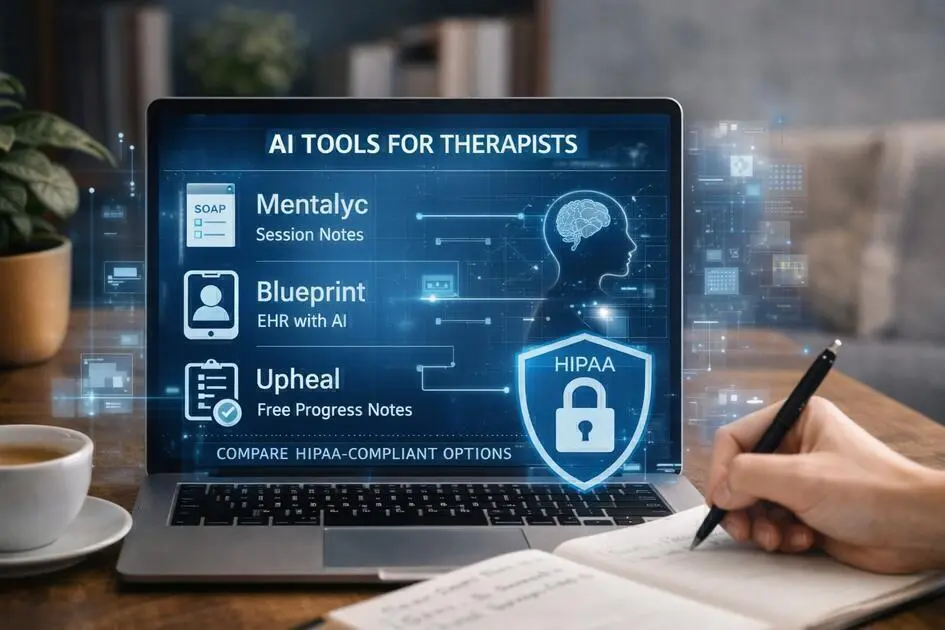
Quick answer: Mentalyc is the strongest option for therapy-specific documentation. Blueprint is best if you want an integrated EHR with AI built in. Upheal is the best free entry point. Claude is most useful for client communication and psychoeducation materials.
How I Tested These Tools
I evaluated each tool based on what matters for therapists specifically:
- Clinical documentation quality — does the tool understand therapeutic terminology, clinical formats, and the difference between client-reported content and clinical observation
- Privacy and compliance — does it offer HIPAA compliance, BAA availability, data encryption, and control over audio retention
- Therapeutic relationship impact — does using the tool require recording sessions, and how might that affect client disclosure
- Workflow integration — does it fit into existing practice workflows or require restructuring how you work
- Modality adaptability — does it handle different therapeutic approaches (CBT, DBT, EMDR, psychodynamic, couples, group)
I reviewed each tool’s features, compliance documentation, privacy policies, and clinical output quality. I consulted feedback from practicing therapists. I did not fabricate time-saved statistics or invent clinical accuracy metrics.
Comparison Table
| Tool | Best For | Key Strength | Pricing |
|---|---|---|---|
| Mentalyc | Therapy-specific notes | Clinical format generation (SOAP, DAP, BIRP) with treatment thread tracking | Freemium |
| Blueprint | Integrated EHR + AI | Full practice platform with AI documentation | Paid |
| Upheal | Budget-friendly notes | Free unlimited basic progress notes | Freemium |
| AutoNotes | Modality-specific templates | Customizable templates by therapeutic approach | Freemium |
| Eleos | Group practices | Team analytics and quality assurance | Paid |
| Claude | Client communication | Psychoeducation materials and referral letters | Freemium |
The Real Risks of Using AI in Therapy Practice
These risks are specific to therapy and more serious than in other professions. Understand them before adopting any tool.
1. Confidentiality Is Non-Negotiable
Therapy sessions contain the most sensitive information a person can share. Before using any AI tool, verify it has a signed Business Associate Agreement (BAA), encrypts data end-to-end, and does not use session content to train its AI models. A tool without a BAA is a HIPAA violation waiting to happen. Free, general-purpose AI tools (ChatGPT, Claude) should never be used with identifiable client information.
2. Recording Changes the Therapeutic Dynamic
Some AI tools require recording full sessions. Even with client consent, the presence of a recording device can inhibit disclosure — especially for clients dealing with trauma, shame, or legal issues. Consider whether the documentation benefit outweighs the potential impact on therapeutic openness. Recording-free alternatives (summary-based note generation) may better serve the therapeutic relationship in some cases.
3. Clinical Nuance Can Be Lost
A general AI scribe might document that a client “discussed relationship problems.” A therapy-specific tool captures that the client “presented with anxious attachment patterns in the context of a recent separation, with affect incongruent to reported distress.” If your documentation tool doesn’t understand clinical nuance, the notes are less useful for treatment continuity and potentially problematic for insurance audits.
4. AI Cannot Replace Clinical Judgment
AI-generated treatment plans and progress notes are drafts. They require your review, clinical reasoning, and professional sign-off. An AI that suggests a diagnosis or treatment direction based on pattern matching is not practicing within any scope — you are. Never submit AI-generated clinical documentation without thorough review.
5. Subpoena and Legal Exposure
Session recordings stored on third-party servers can be subpoenaed. Understand your tool’s data retention policies, choose platforms that allow immediate deletion of audio after note generation, and consult with your malpractice insurance provider about documentation practices.
Best AI Tools for Therapists
Mentalyc — Best for Therapy-Specific Documentation
Mentalyc was built exclusively for therapists. It generates progress notes in SOAP, DAP, BIRP, GIRP, and other clinical formats from session recordings or audio uploads. Unlike general medical scribes, its AI is trained on mental health documentation patterns and understands the difference between client-reported content and therapist clinical observations.
What it does well:
- generates structured clinical notes in multiple formats (SOAP, DAP, BIRP, GIRP) from session audio
- categorizes information into correct clinical sections and uses appropriate therapeutic terminology
- tracks treatment goals across sessions, maintaining the “golden thread” that connects your documentation
- references treatment modalities (CBT, DBT, EMDR, psychodynamic) appropriately in notes
- HIPAA-compliant with BAA, audio auto-delete options, and transcript anonymization
Where it falls short: Mentalyc requires session recording, which means you need client consent and you need to be comfortable with audio capture during therapeutic conversations. The AI captures what was said but can miss important non-verbal observations — changes in affect, body language, hesitations — that experienced therapists routinely document. The notes are strong first drafts but still require your clinical eye to add observations the AI couldn’t capture and to correct any misinterpretations of clinical content.
Best for: solo practitioners and small group practices who want therapy-specific documentation that understands clinical formats and therapeutic terminology.
Blueprint — Best for Integrated EHR with AI
Blueprint combines a full electronic health record system with an AI documentation assistant. Instead of using separate tools for your EHR and AI note generation, everything lives in one platform — documentation, treatment plans, progress tracking, outcome measurement, and billing.
What it does well:
- integrates AI documentation directly into a complete EHR system, eliminating the need to sync between separate tools
- provides pre-session summaries highlighting last session’s key points, current treatment goals, and suggested focus areas
- connects notes to treatment plans, outcome measures, and billing codes automatically
- tracks client outcomes over time, which supports both clinical decision-making and insurance documentation
Where it falls short: Blueprint is a platform commitment. Switching your EHR means migrating client records, learning a new system, and potentially disrupting your practice workflow during the transition. If you already have an EHR you’re comfortable with, adding Blueprint means replacing it, not supplementing it. The AI features are the draw, but the EHR switch is the barrier. The pricing also scales with session volume, which affects cost predictability.
Best for: therapists who are either starting a practice (and choosing their first EHR) or who are ready to switch from a basic EHR to an AI-integrated platform.
Upheal — Best for Budget-Friendly Documentation
Upheal offers free unlimited basic progress notes, making it the most accessible entry point for therapists who want to try AI documentation without financial commitment. The platform also includes session analytics and a telehealth video calling feature.
What it does well:
- provides free unlimited basic progress notes — genuinely useful, not a stripped-down demo
- includes a built-in telehealth video platform, combining documentation with session delivery
- generates notes automatically from telehealth sessions conducted through the platform
- offers a low-risk way to evaluate AI documentation before committing to a paid tool
Where it falls short: The free tier generates basic notes that may lack the clinical depth of tools like Mentalyc. For complex cases, multi-modal treatment, or detailed clinical observations, the notes may require more editing. The telehealth-integrated approach is convenient but means the tool is less useful for therapists who primarily see clients in person. And “free” often means the business model will evolve — consider whether you want to build your documentation workflow around a free tool that may change its terms.
Best for: therapists on a tight budget who want to start with AI documentation at zero cost, especially those who conduct sessions via telehealth.
AutoNotes — Best for Modality-Specific Templates
AutoNotes generates clinical documentation with customizable templates that match your specific therapeutic modality. Whether you practice CBT, EMDR, couples therapy, family therapy, or group work, you can create note templates that reflect your approach.
What it does well:
- adapts to different therapeutic modalities with customizable note templates
- generates SOAP, DAP, BIRP notes, treatment plans, intake assessments, and discharge summaries
- learns your writing style over time, making notes feel more personalized with continued use
- handles different session types (individual, couples, family, group) with appropriate formats
Where it falls short: AutoNotes’ flexibility means more setup work — you need to create or customize templates before the tool matches your practice style. The AI output quality depends on the quality of your input (recordings or dictated summaries). And while it adapts to modalities, the underlying AI doesn’t have deep understanding of any specific therapeutic approach — it structures information into your templates, which is different from genuinely understanding the clinical content.
Best for: therapists who work across multiple modalities and need different documentation formats for different session types.
Eleos — Best for Group Practices
Eleos is designed for group practices where multiple clinicians need consistent documentation quality, supervisors need oversight, and the practice needs quality assurance across its clinical team.
What it does well:
- provides consistent documentation standards across multiple clinicians in a practice
- includes supervisor dashboards for reviewing clinician documentation quality
- offers quality assurance tools that identify documentation gaps or compliance issues
- supports team-wide analytics for practice management and outcomes tracking
Where it falls short: Eleos is built for group practices, not solo practitioners. The team management features that justify its cost don’t apply to independent therapists. The platform is also more complex to set up and manage than individual documentation tools. And as with all recording-based tools, the question of how recording affects the therapeutic relationship applies to every clinician in the practice.
Best for: group therapy practices that need consistent documentation quality across multiple clinicians with supervisor oversight.
Claude — Best for Client Communication and Psychoeducation
Claude isn’t a therapy documentation tool — it’s a general-purpose AI writing tool that happens to be very useful for the non-clinical writing therapists do. Psychoeducation handouts, referral letters, treatment summaries for clients, between-session worksheets, and professional correspondence all benefit from Claude’s ability to adapt tone and complexity to different audiences.
What it does well:
- generates psychoeducation materials tailored to specific conditions, age groups, and reading levels
- writes referral letters with appropriate clinical language for different recipients (psychiatrists, PCPs, schools)
- creates between-session worksheets and exercises customized to individual client needs
- adapts tone naturally — a grounding techniques handout for a teenager reads differently from one for an adult
Where it falls short: Claude is a general AI tool without HIPAA compliance, BAA, or healthcare-specific data protections. You should never input identifiable client information into Claude. Use it for generic psychoeducation content, template creation, and professional correspondence — not for anything that contains or references specific client data. The clinical content it generates is also based on general patterns, not current clinical research — always verify therapeutic recommendations against evidence-based sources.
For writing client-facing communications more broadly, see AI Tools for Writing Client Emails.
Best for: therapists who want to create better client resources and professional correspondence without spending hours on writing — with appropriate data privacy precautions.
Which AI Tool Should You Choose?
- Just starting with AI documentation → Upheal (free, unlimited basic notes, zero financial risk)
- Want the best therapy-specific notes → Mentalyc (deepest clinical understanding, HIPAA-compliant)
- Want everything in one platform → Blueprint (EHR + AI documentation + outcomes tracking)
- Work across multiple modalities → AutoNotes (customizable templates for different approaches)
- Run a group practice → Eleos (team oversight + quality assurance)
- Need better client resources → Claude (psychoeducation materials + referral letters, but not for client data)
Best starting approach: Try Upheal first — it’s free and gives you a concrete sense of what AI documentation feels like. If you find value, upgrade to Mentalyc for deeper clinical quality or Blueprint for full practice integration.
Frequently Asked Questions
Is it ethical to use AI for therapy notes?
Yes, when used as a documentation aid rather than a clinical decision-making tool. AI generates note drafts that you review, edit, and sign off on. Your clinical judgment remains the authority. Major professional organizations recognize AI documentation as an efficiency tool. The ethical obligation is to review every note before it becomes part of the clinical record.
Do I need client consent to record sessions for AI notes?
Yes, always. Obtain informed consent before recording any session. Explain what the recording is used for, how it’s stored, when it’s deleted, and who can access it. Many therapists add an AI documentation clause to their existing informed consent forms. Some clients will decline — respect that decision and use summary-based tools instead.
Will AI-generated notes hold up in an audit?
AI-generated notes that are reviewed, edited, and signed by a licensed clinician meet the same documentation standards as manually written notes. The key is that you review every note before it becomes part of the clinical record. Unreviewed AI-generated notes are a liability — both clinically and legally.
How do I choose between recording-based and summary-based tools?
Recording-based tools (Mentalyc, Blueprint) capture more detail and generate more accurate notes, but require client consent and may affect therapeutic openness. Summary-based tools (AutoNotes) don’t require recording but depend on your recall and note-taking during sessions. Consider your comfort level with recording, your clients’ likely reactions, your state’s recording consent laws, and the types of therapeutic work you do.
Can AI replace a human therapist?
No. AI tools assist with documentation, administrative tasks, and client communication materials. They do not provide therapy, make clinical decisions, or form therapeutic relationships. The therapeutic alliance between a human therapist and client is the foundation of effective treatment and remains irreplaceable.
What about HIPAA compliance?
Any tool that handles identifiable client information must be HIPAA-compliant with a signed Business Associate Agreement (BAA). Tools specifically built for therapy (Mentalyc, Blueprint, Upheal, Eleos) offer this. General-purpose AI tools (ChatGPT, Claude) do not and should never be used with identifiable client data. Always verify compliance before using any tool with client information.
Related AI Tools Guides
- Best AI Tools for Doctors
- Best AI Tools for Nurses
- Best AI Tools for Dentists
- Best AI Tools for Coaches
- Best AI Tools for Consultants
Explore all AI tools → Browse by profession and use case
Last updated: April 2026