Skip to content
Best AI Tools for Translators in 2026 (Translate Faster Without Losing Quality)
Quick Navigation: Comparison Table • Best Tools • Important Note
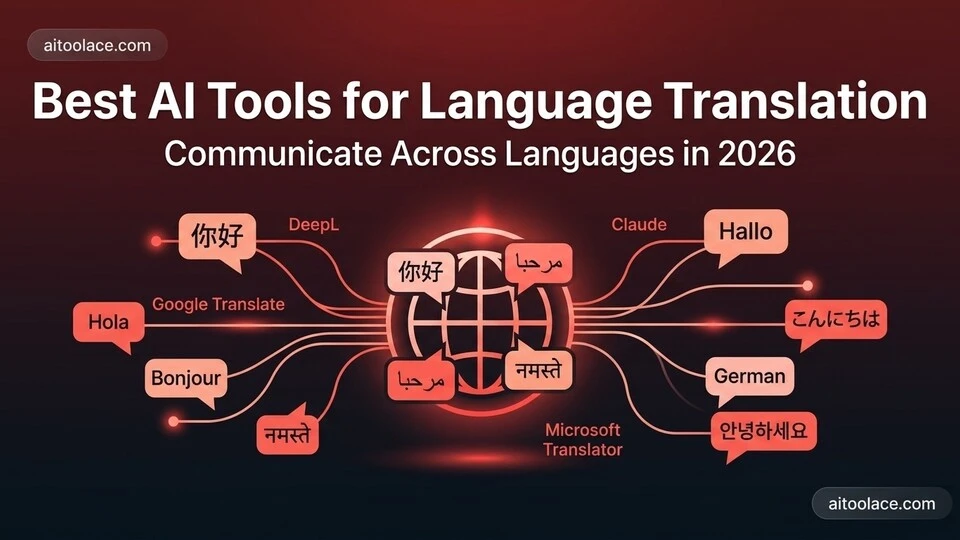
Professional translators who use AI in 2026 handle more projects, deliver faster, and maintain higher quality than those working without AI assistance. Here are the best AI tools for every aspect of professional translation work.
Quick Comparison Table
| Tool | Best For | Free Plan | Price |
|---|---|---|---|
| DeepL | AI translation quality | Yes | $8/month |
| Claude | Post-editing and communication | Yes | $20/month |
| memoQ | Translation memory | No | $200/year |
| Grammarly | Proofreading | Yes | $12/month |
| Otter.ai | Client meeting notes | Yes | $17/month |
DeepL — Best for AI Translation Quality
DeepL consistently produces the highest quality AI translations available, with a natural fluency that significantly reduces post-editing time compared to other machine translation tools.
How translators use it:
- Generate high-quality first drafts for post-editing
- Translate large volumes of content quickly
- Compare multiple translation suggestions instantly
- Integrate with CAT tools for seamless workflow
Just as developers use AI tools to write code faster and copywriters use AI to draft copy faster, translators find DeepL dramatically reduces the time needed to produce a first draft.
Claude — Best for Post-Editing and Client Communication
Claude excels at nuanced language tasks that require deep understanding of context, tone, and cultural references — exactly what professional translators deal with daily.
How translators use it:
- Post-edit machine translations with nuanced corrections
- Research cultural context and idiomatic expressions
- Write professional client proposals and communications
- Check terminology consistency across long documents
- Handle complex linguistic questions quickly
memoQ — Best for Translation Memory
memoQ is one of the leading computer-assisted translation platforms, with AI-powered translation memory that learns from your previous work and suggests consistent terminology automatically.
How translators use it:
- Build and leverage translation memories across projects
- Maintain consistent terminology with AI terminology management
- Handle large document projects efficiently
- Collaborate with other translators on large projects
Grammarly — Best for Proofreading
For translators working into English, Grammarly ensures every translated text is grammatically correct, stylistically appropriate, and error-free before delivery to clients.
How translators use it:
- Proofread translated texts automatically
- Ensure grammatical accuracy in target language
- Improve sentence flow and readability
- Check for inconsistencies in style and tone
Otter.ai — Best for Client Meeting Notes
Translators regularly meet with clients to discuss project requirements, terminology preferences, and style guidelines. Otter.ai automatically transcribes these conversations so nothing gets missed.
How translators use it:
- Transcribe client briefing meetings automatically
- Keep accurate records of client terminology preferences
- Document style guide discussions for future reference
- Generate meeting summaries to send to clients
Important Note on AI and Professional Translation
AI translation tools are powerful assistants but cannot replace the cultural knowledge, subject matter expertise, and linguistic judgment of professional human translators. Always review and post-edit AI-generated translations thoroughly before delivery, especially for legal, medical, or marketing content where accuracy and cultural appropriateness are critical.
Translator Action Plan
- Use DeepL for high-quality first draft translations
- Use Claude for post-editing, research, and client communication
- Invest in memoQ for translation memory and terminology management
- Install Grammarly for automatic proofreading of target language texts
- Add Otter.ai for client meeting and briefing transcription
Conclusion
DeepL and Claude together give translators a powerful AI stack for both translation speed and quality. DeepL handles the first draft while Claude handles the nuanced post-editing and research that requires deeper linguistic understanding.
For other language and writing professionals, check out our best AI tools for copywriters and best AI tools for journalists guides. Freelance translators will find our best AI tools for freelancers guide very useful for the business side of their work. For a complete overview of all AI tools available, see our best AI tools in 2026 guide.
Frequently Asked Questions
What is the best AI tool for translators in 2026?
DeepL is the best for AI-assisted translation quality. Claude is the best for post-editing, research, and client communication. memoQ is the best for translation memory and terminology management across large projects.
Will AI replace professional translators?
No. AI translation tools produce drafts that require significant human post-editing for quality, accuracy, and cultural appropriateness. Professional translators who use AI are significantly more productive than those who do not, but the human expertise remains essential.
How much can AI tools increase a translator’s output?
Translators using AI-assisted workflows report being able to handle 30 to 50 percent more words per day compared to purely manual translation. The time savings are highest for technical and repetitive content where AI accuracy is highest.
Is DeepL better than Google Translate for professional use?
Yes, for most language pairs. DeepL consistently produces more natural, fluent translations than Google Translate, which significantly reduces post-editing time. However, Google Translate supports more languages and is better for less common language pairs.
Can AI tools help with legal and medical translation?
AI can assist with drafts, but legal and medical translation requires certified human translators who are accountable for accuracy. Never rely on AI alone for certified translation in regulated contexts.
Explore all AI tools → Browse by profession and use case
Last updated: April 2026