Skip to content
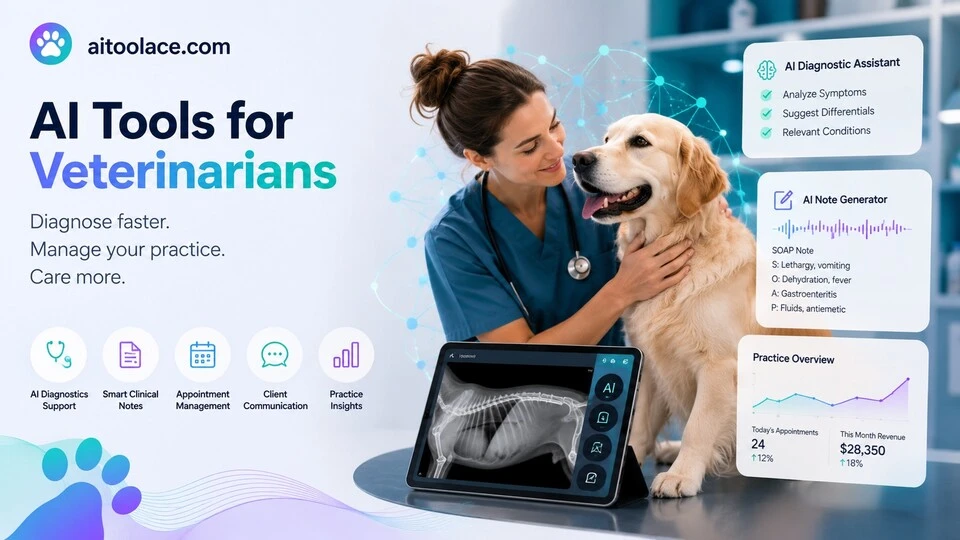
Best AI Tools for Veterinarians (Diagnose Faster & Manage Your Practice in 2026)
Quick Navigation: How I Tested • Comparison Table • Risks • Best Tools • FAQ
Veterinary medicine faces many of the same challenges as human healthcare — overwhelming documentation, appointment scheduling chaos, diagnostic complexity, and too little time with each patient. But veterinary practices operate with tighter margins, smaller teams, and patients who can’t describe their symptoms. The administrative burden that consumes a veterinarian’s day directly reduces the time available for clinical care.
AI tools address the operational side of veterinary practice. They automate clinical notes so you document while you examine rather than after hours. They assist with differential diagnosis by analyzing symptoms and lab results. They manage scheduling and client communication without dedicated front desk staff. And they help with the business side — inventory management, billing, and client retention — that determines whether a practice survives financially.
The important distinction: AI assists veterinary decision-making but doesn’t replace clinical judgment. Diagnostic AI can suggest differentials you might consider, but the physical examination, the patient history from the owner, and your professional experience remain the foundation of every clinical decision.
For human healthcare administration, Best AI Tools for Healthcare Administration covers the administrative workflow. For dentists facing similar practice management challenges, Best AI Tools for Dentists addresses that specialty.
Quick answer: Shepherd Veterinary Software is the most comprehensive AI-powered practice management system. VetRec is the best tool for automating clinical documentation. Claude is most useful for client communication and educational content.
How I Tested These Tools
I evaluated each tool based on what matters for veterinary practice:
- Clinical documentation — does it reduce the time spent writing SOAP notes and medical records
- Diagnostic support — does it provide useful differential diagnosis suggestions based on clinical data
- Practice management — does it handle scheduling, billing, and inventory efficiently
- Client communication — does it help maintain client relationships and improve compliance
- Veterinary specificity — is it designed for veterinary medicine, not just adapted from human healthcare
I reviewed each tool’s features, veterinary-specific capabilities, and integration with practice workflows. I consulted feedback from practicing veterinarians and practice managers. I did not fabricate diagnostic accuracy statistics or invent efficiency metrics. I am not a veterinarian and this guide does not constitute veterinary medical advice.
Comparison Table
| Tool | Best For | Key Strength | Pricing |
|---|---|---|---|
| Shepherd | Practice management | AI-powered scheduling, billing, and clinical workflows | Paid |
| VetRec | Clinical documentation | AI-generated SOAP notes from voice recordings | Paid |
| Claude | Client communication | Educational content, discharge instructions, and client emails | Freemium |
| Talkatoo | Voice-to-text notes | Veterinary-trained speech recognition for medical records | Paid |
| Digitail | Modern practice platform | Cloud-based practice management with telemedicine | Paid |
| Petriage | Triage assessment | AI symptom checker for client-facing triage | Paid |
Best AI Tools for Veterinarians
Shepherd Veterinary Software — Best Practice Management
Shepherd provides a complete practice management system built for veterinary clinics with AI features that streamline the operational work — scheduling, billing, inventory, medical records, and client communication. Instead of juggling separate tools for each function, Shepherd integrates everything into one platform designed around how veterinary practices actually operate.
What it does well:
- integrates scheduling, medical records, billing, inventory, and client communication in one veterinary-specific platform
- AI automates appointment reminders, vaccination due notices, and follow-up scheduling to improve compliance
- manages inventory with reorder alerts and usage tracking so medications and supplies don’t run out unexpectedly
- provides financial reporting and analytics that show practice performance — revenue by service, client retention, appointment utilization
- supports multi-doctor practices with schedule coordination and shared medical records
Where it falls short: Migrating from an existing practice management system to Shepherd is a significant undertaking — data migration, staff training, and workflow adjustment take weeks. The platform is designed for small to mid-size practices; large veterinary hospitals or specialty referral centers may need more specialized systems. The AI features are operational (scheduling, reminders, analytics) rather than clinical (diagnostic support, treatment planning). And the subscription cost is a fixed overhead that very small or new practices may find difficult to justify initially.
Best for: veterinary practices that want one integrated system for all practice operations — especially practices currently managing scheduling, records, and billing across separate tools.
VetRec — Best Clinical Documentation
Clinical documentation is the biggest time sink in veterinary practice. SOAP notes, medical records, discharge instructions, and surgical reports all need to be written for every patient encounter. VetRec records the consultation and generates structured clinical notes automatically — you examine and talk, the AI documents.
What it does well:
- generates SOAP notes from recorded consultations — you speak naturally during the exam and get structured documentation afterward
- understands veterinary terminology, drug names, breeds, and common conditions without requiring corrections for medical language
- produces consistent, structured documentation that meets medical record standards
- reduces the after-hours documentation time that contributes to veterinary burnout
- supports customization for different note formats and practice preferences
Where it falls short: Voice recording during consultations requires client awareness and consent. Some clients may feel uncomfortable being recorded, even when the recording is used only for documentation. The AI-generated notes need review — inaccuracies in species-specific drug dosing, breed-specific conditions, or complex multi-system presentations can occur. Audio quality affects accuracy — busy clinics with background noise produce less reliable transcription. And VetRec documents consultations but doesn’t help with the clinical thinking that determines the note’s content.
For human healthcare documentation, see Best AI Tools for Doctors.
Best for: veterinarians who spend significant after-hours time writing up medical records — especially those in high-volume practices where documentation backlog is a chronic problem.
Claude — Best for Client Communication
Veterinary practices communicate constantly with clients — discharge instructions, post-surgical care guides, medication explanations, nutrition advice, behavioral guidance, and the difficult conversations around chronic illness and end-of-life decisions. Claude produces clear, empathetic client communications that explain medical concepts in language pet owners understand.
What it does well:
- writes discharge instructions that explain post-visit care clearly without medical jargon
- generates client education materials — disease explanations, medication guides, preventive care information — in accessible language
- drafts difficult communications — chronic disease management plans, prognosis discussions, and euthanasia decision support materials
- creates social media content and newsletter material that positions the practice as a trusted local resource
- adapts communication tone for different situations — routine care instructions versus sensitive health discussions
Where it falls short: Claude doesn’t know your patients, your protocols, or your specific treatment approaches. Every communication needs review for medical accuracy specific to the patient’s situation. Claude provides general veterinary information that may not reflect current best practices in rapidly evolving areas of veterinary medicine. And client communication about specific cases should never include identifiable patient or client information in general-purpose AI tools.
For writing professional communications, see Best AI Tools for Writing Client Emails.
Best for: veterinary practices that want better client communication without spending hours writing — especially for educational content, discharge instructions, and the written materials that support client compliance.
Talkatoo — Best Voice-to-Text for Veterinary Notes
Talkatoo provides speech recognition specifically trained for veterinary medicine. Unlike general dictation tools that stumble on drug names, breed terms, and medical vocabulary, Talkatoo understands veterinary language and converts spoken notes into text accurately — without the correction cycle that makes general dictation tools frustrating.
What it does well:
- recognizes veterinary-specific vocabulary — drug names, breeds, medical conditions, surgical procedures — without requiring manual corrections
- works inside your existing practice management software — dictate directly into your medical record system
- faster than typing for most practitioners — speak naturally and get accurate text
- learns your speaking patterns and frequently used terms over time for improving accuracy
- supports multiple languages for practices in multilingual communities
Where it falls short: Talkatoo converts speech to text but doesn’t structure the output — you get a transcript, not formatted SOAP notes. VetRec provides structured notes while Talkatoo provides raw transcription. Background noise in busy practices reduces accuracy. And dictation requires privacy — you can’t dictate sensitive client financial or personal information in the reception area.
Best for: veterinarians who prefer speaking to typing and want veterinary-accurate transcription inside their existing practice management software — especially those who find general dictation tools too inaccurate for medical terminology.
Digitail — Best Modern Practice Platform
Digitail provides a cloud-based veterinary practice management platform with a modern interface and telemedicine capabilities. Its AI features assist with appointment scheduling, client engagement, and practice analytics — offering a contemporary alternative to legacy practice management systems.
What it does well:
- provides a modern, cloud-based interface that feels current rather than dated — important for staff satisfaction and training
- includes telemedicine capabilities for remote consultations, follow-ups, and triage
- AI-powered client engagement automates reminders, follow-ups, and wellness plan communication
- mobile access lets veterinarians review records, update notes, and manage schedules from anywhere
- integrates with diagnostic equipment and lab systems for streamlined results management
Where it falls short: Cloud-based systems require reliable internet — practices in areas with unstable connectivity may experience frustration. Digitail is newer than established practice management systems, which means a smaller user community and fewer third-party integrations. The telemedicine features are useful for follow-ups but can’t replace physical examination for most veterinary conditions. And migrating from a legacy system requires data conversion that can be imperfect.
For scheduling tools broadly, see Best AI Tools for Scheduling & Calendar Management.
Best for: veterinary practices looking to modernize from legacy practice management systems — especially those wanting telemedicine capabilities and cloud-based access.
Petriage — Best for Client-Facing Triage
Petriage provides an AI symptom checker that clients use before contacting the practice. Pet owners describe their animal’s symptoms, and the AI assesses urgency — emergency (go to the ER now), urgent (schedule today), or routine (schedule this week). This helps practices manage appointment flow and ensures urgent cases are seen promptly.
What it does well:
- assesses symptom urgency using AI trained on veterinary triage protocols
- reduces unnecessary emergency visits while ensuring genuinely urgent cases are identified
- provides the practice with symptom information before the appointment so the veterinarian can prepare
- available 24/7 so clients can assess urgency outside practice hours rather than waiting until morning or going to an emergency clinic unnecessarily
- branded for your practice so clients use it as your tool, not a generic symptom checker
Where it falls short: AI triage for animals is inherently limited — pets can’t describe their symptoms, and owner observations vary enormously in accuracy. A client who says their dog “seems off” provides less useful input than a client who describes specific behavioral changes. The triage assessment is conservative by design (to avoid missing emergencies), which means it may over-triage — directing routine cases to urgent appointments. And client trust in AI health assessment for their pets varies — some find it reassuring, others want to talk to a human immediately.
For customer-facing chatbots, see Best AI Tools for Customer Service Chatbots.
Best for: veterinary practices that want to manage appointment urgency and client expectations — especially practices that receive many after-hours calls about symptom urgency.
The Real Risks of AI in Veterinary Practice
1. Diagnostic Over-Reliance
AI diagnostic tools can suggest differentials based on symptoms, lab results, and signalment. But veterinary diagnosis depends on physical examination findings, patient history from the owner (who may be an unreliable historian), and clinical experience with how diseases present in different species and breeds. AI suggestions are starting points for clinical thinking, not conclusions.
2. Species-Specific Errors
AI tools trained primarily on canine and feline data may produce less reliable results for exotic species, large animals, or avian patients. Drug dosing, disease presentation, and treatment protocols vary dramatically across species. Always verify that AI-generated information is appropriate for the specific species you’re treating.
3. Documentation Accuracy Affecting Patient Care
AI-generated clinical notes that contain errors — wrong drug doses, incorrect breed-specific information, or missed clinical findings — become part of the permanent medical record and can affect future treatment decisions. Every AI-generated note must be reviewed for clinical accuracy before becoming part of the record.
4. Client Communication Tone
AI-generated client communications about sensitive topics (poor prognosis, euthanasia, financial limitations) need careful review for tone. A technically accurate discharge instruction that reads coldly about a beloved pet’s terminal diagnosis damages the client relationship. Review AI communications for emotional appropriateness, not just medical accuracy.
Which AI Tool Should You Choose?
- Complete practice management → Shepherd (scheduling, billing, records, and client communication)
- Clinical documentation → VetRec (AI-generated SOAP notes from voice recordings)
- Client communication → Claude (discharge instructions, education, and client emails)
- Veterinary dictation → Talkatoo (speech recognition trained on veterinary vocabulary)
- Modern cloud platform → Digitail (cloud-based management with telemedicine)
- Client triage → Petriage (AI symptom assessment for appointment urgency)
Best starting approach: Start with what causes the most daily frustration. If documentation takes too long — try VetRec or Talkatoo. If scheduling and billing are chaotic — evaluate Shepherd or Digitail. If client communication is inconsistent — use Claude for templates and educational materials. Address the biggest pain point first, then expand.
Frequently Asked Questions
What is the best AI tool for veterinarians?
Shepherd is the most comprehensive for practice management. VetRec is best for clinical documentation. Claude is most useful for client communication. The right choice depends on whether your biggest challenge is documentation, operations, or communication.
Can AI diagnose animal diseases?
AI can suggest differential diagnoses based on symptoms, lab results, and signalment — providing a useful checklist for clinical consideration. It cannot diagnose — diagnosis requires physical examination, clinical judgment, and professional experience that AI doesn’t have. Use AI differentials as a thinking prompt, not a conclusion.
Is AI documentation accurate enough for veterinary records?
AI-generated SOAP notes from tools like VetRec are generally accurate for straightforward consultations but need review for complex cases, unusual presentations, and specific drug dosing. The veterinarian is responsible for the accuracy of the medical record regardless of how it was generated. Always review before finalizing.
How do I choose between VetRec and Talkatoo?
VetRec generates structured SOAP notes from recordings — you get formatted clinical documentation. Talkatoo provides veterinary-accurate speech-to-text — you get a transcript you format yourself. Choose VetRec if you want complete note generation. Choose Talkatoo if you prefer dictating into your existing record system.
Will AI replace veterinarians?
No. AI automates administrative tasks (documentation, scheduling, communication) and assists with clinical thinking (differential diagnosis suggestions, drug interaction checks). The physical examination, surgical skills, clinical judgment, and client relationship management that define veterinary medicine remain human skills. AI makes veterinarians more efficient; it doesn’t make them unnecessary.
How much do veterinary AI tools cost?
Practice management systems (Shepherd, Digitail) typically cost $200-500/month per practice. Documentation tools (VetRec, Talkatoo) cost $100-200/month per veterinarian. Claude’s free tier handles basic client communication. The costs should be evaluated against time saved — reducing documentation time by even 30 minutes per day has significant value.
Related AI Tools Guides
- Best AI Tools for Healthcare Administration
- Best AI Tools for Dentists
- Best AI Tools for Doctors
- Best AI Tools for Scheduling & Calendar Management
- Best AI Tools for Small Business Owners
Explore all AI tools → Browse by profession and use case
Last updated: July 2026